How To Become More Self-Sufficient Without Starting a Full-Blown Farm…
Want to start preserving your harvest, making your own soap, or building a backyard root cellar — but not sure where to begin? “Homesteading Advice” gives you instant lifetime access to 35+ practical homesteading books on food preservation, veggie gardening, DIY natural cleaning products (save over $250 per year with this skill alone), brewing, off-grid energy, and a whole lot more…
Click Here To Check It Out Now!
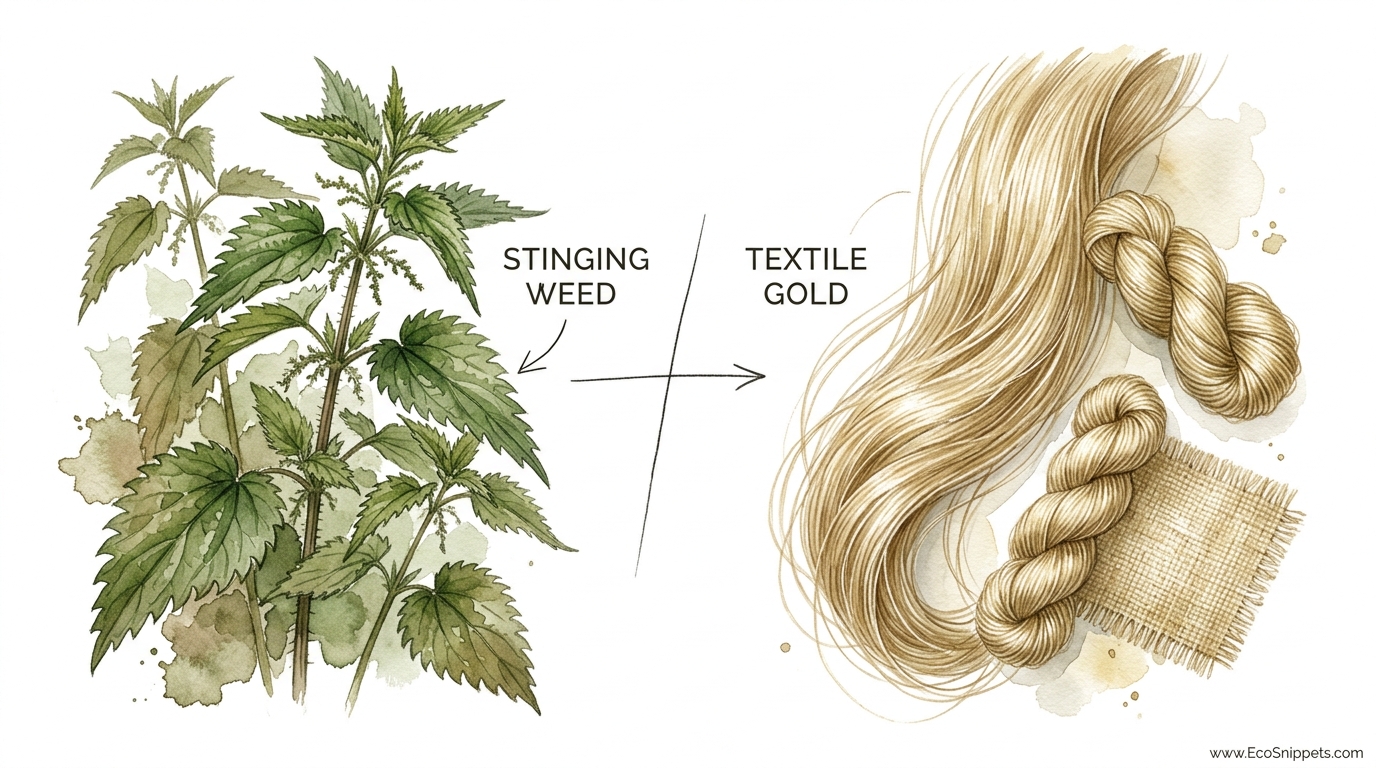
The plant you’ve been spraying with chemicals was once used to clothe entire armies. Before the global cotton trade, Europeans wore ‘Urtica’ – the fiber of the stinging nettle. It’s stronger than cotton, as soft as silk when processed correctly, and it grows for free in the shadows where nothing else will. Don’t pull those weeds; harvest them for the most resilient cordage you’ll ever own.
For centuries, the common stinging nettle (Urtica dioica) served as a backbone of self-reliance for rural communities across the globe. From the trenches of the First World War to the burial mounds of the Bronze Age, this misunderstood “weed” has provided warmth and protection to those who knew its secrets. It represents a lost lineage of textile wisdom that requires no heavy machinery, no massive irrigation systems, and no toxic pesticides.
When you learn to extract the hidden gold within a nettle stalk, you aren’t just making string; you are reclaiming a skill that allowed your ancestors to survive in harsh landscapes. This guide will walk you through the transformation of a stinging nuisance into a lustrous, high-performance textile fiber. We will explore the biology of the plant, the chemistry of the retting process, and the manual techniques required to turn a wild harvest into a spool of yarn.
How To Make Textile Fiber From Stinging Nettles
Making textile fiber from stinging nettles involves extracting the “bast” fibers—the long, strong cells located between the outer bark and the inner woody core of the plant stalk. These fibers provide the plant with its structural integrity, allowing it to stand tall in the wind. When isolated through mechanical and biological processes, these fibers become a material that rivals linen in beauty and exceeds cotton in strength.
Nettle fiber exists as a sustainable alternative because the plant is a nitrophilous perennial, meaning it thrives in nitrogen-rich environments and returns year after year without replanting. In the real world, this material has been used for everything from heavy-duty naval sails and fishing nets to the finest lace for royalty. Because the fibers are hollow, they act as natural insulators, keeping the wearer cool in summer and warm in winter.
Visualizing the process is simple: imagine the nettle stalk as a bundle of high-tensile wires protected by a thin layer of skin and glued to a wooden stick. Your goal is to dissolve the “glue” (pectins and lignins) and strip away the skin and wood, leaving only the silver-green “wires” behind. It is a slow, rhythmic transition from a jagged, stinging plant to a bundle of fibers as soft as wool.
How It Works: The Step-by-Step Processing Method
The transformation of raw nettle into workable fiber follows a logical progression of stages: harvesting, stripping, retting, drying, breaking, scutching, and hackling. Each step is designed to further refine the material and remove non-fibrous plant matter. Mastery of these steps ensures a high-quality “line” fiber that is suitable for spinning into fine threads.
Step 1: Harvesting and Initial Preparation
Timing is critical for a successful harvest. For the best textile yield, you should cut the nettles when they have reached their full height, typically between late July and September in the Northern Hemisphere, or January and March in the Southern Hemisphere. Look for stalks that are at least 1.5 meters (5 feet) tall and have begun to turn slightly yellow at the base but are not yet brittle or dead.
Wear thick gloves and long sleeves to protect against the trichomes (stinging hairs) which contain formic acid. Use sharp shears to cut the stalks at the very base to maximize the length of the fibers. Once cut, strip away the leaves by running a gloved hand from the bottom of the stalk to the top. These leaves can be saved for compost, tea, or even a green dye bath, as they contain no textile fiber themselves.
Step 2: Retting (The Softening Process)
Retting is a controlled form of rotting where moisture and microorganisms break down the pectins that bind the fibers to the woody pith. There are three primary methods for retting nettles: water retting, dew retting, and root retting. Each has a specific timeframe and result.
- Water Retting: Submerge the stalks in a pond, stream, or water tank. In temperatures around 20°C (68°F), this takes about 7 to 14 days. This method produces the cleanest, lightest-colored fibers.
- Dew Retting: Lay the stalks out in a single layer on the grass. The morning dew and soil microbes will slowly process the plant over 3 to 5 weeks. You must turn the stalks every few days to ensure even retting.
- Root Retting: Leave the stalks standing through the winter and harvest them in early spring. Nature does the work for you, but the fibers may be weaker and more “cottonized” (broken into shorter lengths).
Step 3: Drying and Conditioning
Once the retting is complete—indicated by the bark easily peeling away from the wood—the stalks must be thoroughly dried. Spread them out in a well-ventilated area or a greenhouse. In a survival or primitive setting, you can lean them in “teepee” shapes. If the stalks are not completely dry, the wood will not snap cleanly, and the fibers will remain damp and prone to mold. Some practitioners even “bake” the stems in a low oven at 70°C (158°F) for an hour to ensure they are perfectly brittle before the next stage.
Step 4: Breaking and Decorticating
Breaking involves crushing the woody inner core (the pith) without damaging the flexible fibers on the outside. Traditionally, a “flax break”—a heavy wooden lever—is used to smash the stalks. You can also achieve this by laying the stalks on a flat rock and beating them with a wooden mallet or a heavy stick. The goal is to shatter the inner “straw” into small fragments called shives or boon.
Step 5: Scutching and Hackling
Scutching is the process of scraping away the broken bits of wood. Hold a bundle of broken fibers and strike them downward with a wooden scutching knife or the edge of a blunt board. This knocks the shives loose and begins to align the fibers. Finally, hackling involves pulling the fibers through a series of metal combs or “hackles.” This removes shorter, tangled fibers (called tow) and leaves behind long, parallel strands of “line” fiber ready for the spindle.
Benefits of Nettle Textiles
Nettle fiber offers technical advantages that few modern synthetics can match. One of the most significant benefits is its hollow core. These microscopic air pockets provide exceptional thermal regulation. A nettle garment acts as a natural thermos, trapping body heat in cold weather while remaining highly breathable and moisture-wicking in the heat. This makes it an ideal year-round fabric.
The strength of the material is another major factor. Nettle fibers have a tensile strength that can reach up to 1594 MPa, which is significantly higher than cotton and even rivals some industrial glass fibers. Because the fibers are naturally rich in silica, they are also inherently fire-retardant, making nettle cloth a safer choice for hearth-side activities compared to highly flammable synthetic blends.
Sustainability is perhaps the most modern benefit. Unlike cotton, which requires thousands of liters of water and heavy pesticide use to produce a single t-shirt, nettles grow in marginal soils and actually improve soil health by absorbing excess nitrogen. They require no irrigation beyond natural rainfall and support over 40 species of insects, making them a “biodiversity-positive” crop.
Challenges and Common Mistakes
Processing nettle is a labor of patience, and the most common mistake is rushing the retting process. If you stop retting too early, the fibers will remain “glued” to the wood, making it nearly impossible to clean them without breaking the strands. Conversely, if you ret for too long, the microorganisms will begin to eat the cellulose of the fibers themselves, leading to weak, “rotten” thread that snaps during spinning.
Another frequent error occurs during the harvesting phase. Newcomers often harvest young, succulent nettles thinking they will be softer. In reality, young plants have very little developed bast fiber. For textile work, you need the tall, tough, “woody” giants of the late summer. These older plants have had time to build thick walls of fiber around their stems. Failure to wear proper protection during the first stage is a mistake you will only make once, as the sting of a mature nettle can persist for 24 hours.
Proper drying is also often overlooked. If the stalks are even slightly “bendy” when you attempt to break them, the wood will simply flatten rather than shatter. This leads to fibers that are permanently contaminated with green plant matter, resulting in a coarse, scratchy finished product rather than the silken thread you desire.
Limitations and Constraints
Despite its many virtues, nettle has limitations that prevent it from being a dominant commercial fiber today. The primary constraint is the low yield-to-labor ratio. It takes a significant amount of manual work to produce even a few ounces of clean fiber. On average, only about 10% to 15% of the dry weight of a nettle stalk is usable textile fiber. For a full garment, you would need to harvest and process hundreds of individual plants.
The variability of the wild plant also poses a challenge. Unlike standardized industrial crops, wild nettles vary in fiber quality based on the soil they grow in, the amount of sunlight they receive, and the specific subspecies. This makes it difficult to achieve a perfectly uniform yarn without rigorous sorting and blending. Furthermore, the short length of the individual fiber cells (compared to the very long fibers of flax) means that nettle can be “slippery” to spin, requiring a higher degree of skill from the spinner.
Technical Comparison: Nettle vs. Alternatives
To understand where nettle fits in the world of natural fibers, it helps to compare it directly with its closest relatives and its primary competitor, cotton. Nettle occupies a unique middle ground between the ruggedness of hemp and the delicacy of linen.
| Characteristic | Stinging Nettle | Flax (Linen) | Cotton |
|---|---|---|---|
| Fiber Type | Bast (Stem) | Bast (Stem) | Seed Hair |
| Tensile Strength | Very High | High | Moderate |
| Insulation | Excellent (Hollow) | Good | Poor |
| Water Needs | Minimal/Rainfall | Moderate | Very High |
| Processing Effort | Very High (Manual) | High | Low (Industrial) |
Practical Tips for Success
If you are new to fiber processing, start small by making simple cordage before attempting to spin yarn. You can practice the “green stripping” method: harvest a fresh nettle, strip the leaves, and use your thumbnail to split the stem in half. Peel the outer bark away from the pith in long ribbons. You can then twist these ribbons together into a remarkably strong garden twine while they are still wet. This provides an immediate feel for the plant’s strength.
Always keep a small “test bundle” during the retting phase. Every two days, take one stalk out of the water or off the grass and try to “snap and peel” it. If the fibers come away clean with no wood sticking to them, the retting is done. This prevents you from ruining an entire harvest by over-rotting. If you find the fibers are too stiff to spin, you can “wash” the finished yarn in a mild soap or wood-ash lye solution to further dissolve any remaining pectins and soften the thread.
Consider the “S-twist” when spinning. Traditionally, nettle fibers are said to have a natural “S” inclination (counter-clockwise) based on the way the plant grows. While modern spinners often use a standard “Z-twist,” experimenting with an S-twist can sometimes result in a more balanced, less kinky yarn. Use a distaff—a simple stick to hold your bundle of fiber—to keep the strands organized and prevent them from tangling while you work.
Advanced Considerations for the Serious Practitioner
For those looking to move beyond basic cordage, the “cottonization” of nettle fiber is a valuable technique. This involves carding the nettle fibers using wool cards or a drum carder. This process breaks the long fibers into shorter, uniform lengths and creates a “rolag” or fluffy cloud of fiber. Cottonized nettle is much easier to blend with other fibers like wool or alpaca, creating a yarn that combines the softness of the animal fiber with the strength and drape of the nettle.
You may also want to explore the chemical properties of the plant for dyeing. While the fibers themselves are a beautiful silvery-tan or pale green, they take natural dyes exceptionally well. Interestingly, the leaves you stripped at the beginning can be used to create a vibrant range of greens and yellows. By using a mordant like alum, you can create a completely “single-source” garment where the fabric and the color both come from the same nettle patch.
Advanced tool-making is also a hallmark of the serious practitioner. While you can process nettles with rocks and sticks, building a dedicated hackle board with rows of sharpened steel pins will vastly improve the quality of your fiber. Fine hackling removes the “chaff” and leaves you with fibers that have a micron count similar to silk, allowing for the creation of delicate, high-value textiles.
Example Scenario: The Legend of the Nettle Dress
A modern example of this dedication can be found in the work of textile artist Allan Brown, who famously spent seven years harvesting and processing thousands of nettles to create a single dress. He relied on the traditional “dew retting” method, laying his harvest in the damp English woods. His process demonstrated that even with wild-foraged materials, it is possible to create a fabric that is indistinguishable from high-end linen.
In a survival scenario, imagine you need a fishing line. By harvesting ten mature nettle stalks and performing a quick “green strip,” you can produce 15 meters (50 feet) of high-tensile line in less than an hour. Once the fibers dry, they will shrink slightly and tighten, increasing the strength of your knots. This practical application shows that while the “seven-year dress” is a feat of artistry, the same plant provides immediate, life-saving utility in the field.
Final Thoughts
The stinging nettle is far more than a garden nuisance; it is a resilient and generous teacher of self-reliance. By learning to see past the sting, you gain access to a world of sustainable, high-performance textiles that are literally growing at your doorstep. Whether you are interested in historical reenactment, primitive skills, or the future of eco-friendly fashion, the nettle offers a path forward that is rooted in the wisdom of the past.
The process of turning “weeds” into gold requires patience and a willingness to work with your hands, but the reward is a material that carries a story in every stitch. We encourage you to find a local patch, put on your gloves, and begin your own experiment. You might just find that the most useful tool in your survival kit was the one you were trying to get rid of all along.
