How To Become More Self-Sufficient Without Starting a Full-Blown Farm…
Want to start preserving your harvest, making your own soap, or building a backyard root cellar — but not sure where to begin? “Homesteading Advice” gives you instant lifetime access to 35+ practical homesteading books on food preservation, veggie gardening, DIY natural cleaning products (save over $250 per year with this skill alone), brewing, off-grid energy, and a whole lot more…
Click Here To Check It Out Now!
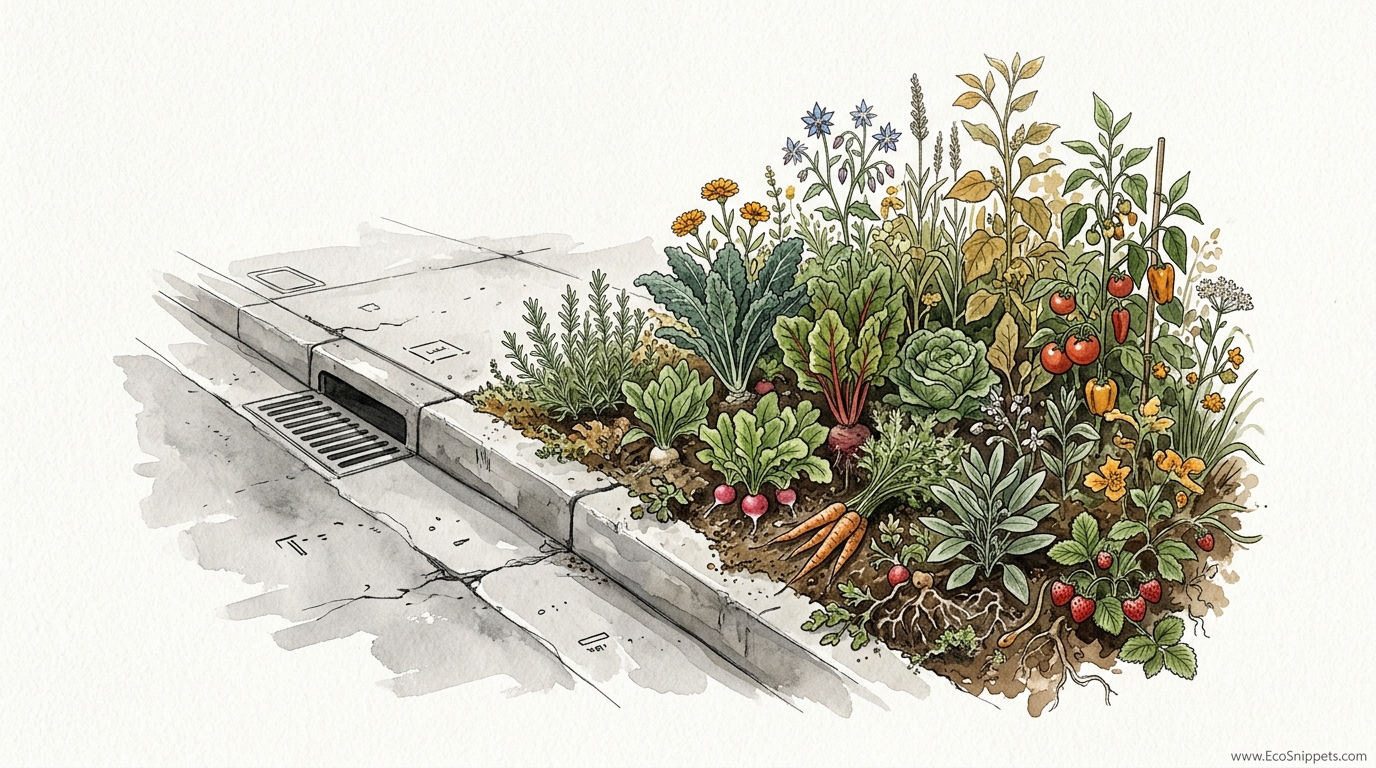
The ‘dead space’ in front of your house is actually a high-yield farm waiting to happen. Most city curb strips are just a waste of water and mowing time. Applying permaculture principles to the ‘Nature Strip’ allows you to create a community larder and a pollinator sanctuary in just 100 square feet (9.3 square meters). It’s time to turn our sterile urban edges into wild, productive havens.
Urban living often feels disconnected from the rhythm of the seasons and the source of our sustenance. We live in a landscape of sterile concrete and thirsty turf, where every square inch of earth is either paved or poisoned with herbicides. Yet, right at the edge of the asphalt, there is a forgotten frontier: the curb strip. Often called the “hellstrip” due to its harsh conditions, this narrow patch of ground is a canvas for ancestral wisdom and modern self-reliance.
Permaculture offers a roadmap for reclaiming these edges. Instead of fighting the heat and the compaction of a city street, we can work with these constraints to build a resilient, productive ecosystem. You do not need a multi-acre homestead to start your journey toward food security; you only need the patch of land between your sidewalk and the street. Transforming this space is an act of quiet rebellion against a system that prefers manicured emptiness over productive wildness.
This guide will walk you through the process of converting your nature strip into a flourishing garden. We will cover the practical steps of soil preparation, plant selection for harsh street environments, and the legal hurdles you might face. Whether you are a beginner looking to plant your first herb or an experienced practitioner aiming to design a complex urban guild, this deep dive provides the tools you need to succeed.
Transforming Curb Space Into Food
The curb strip, also known as a boulevard, parkway, tree lawn, or verge, is that narrow swath of land located between the sidewalk and the street. In the traditional urban design of the 20th century, these strips were intended to provide a buffer for pedestrians and space for utility poles or street trees. Most homeowners treat them as an extension of their lawn, which leads to a constant cycle of mowing, edging, and watering a patch of grass that serves no ecological or nutritional purpose.
Transforming this space into food production means shifting from a “mow-and-throw” mentality to a “harvest-and-replenish” mindset. In permaculture, we view the nature strip as a “Zone 4” or “Zone 5” edge—a transition zone between the private home (Zone 1) and the public commons. By planting edible perennials, medicinal herbs, and pollinator-friendly shrubs, you turn a high-maintenance liability into a low-maintenance asset that feeds both people and the local ecosystem.
Real-world examples of this are popping up in cities like Seattle, USA, and Melbourne, Australia, where residents are replacing grass with “beauty strips” of drought-tolerant food crops. These gardens act as community larders, where neighbors can pick a handful of chives or a sprig of rosemary on their way home. They also function as pollinator corridors, providing much-needed nectar for bees and butterflies in the middle of a concrete jungle. The concept is simple: if you are already required to maintain the space by law, you might as well get a yield from it.
Visualizing this transformation requires looking past the current state of the soil. Most curb strips are suffering from extreme compaction due to foot traffic and are laced with road salts or pollutants from car exhaust. However, these are not deal-breakers. They are design constraints. When we understand that the sidewalk reflects heat and the street sheds water, we can select plants that thrive in those specific microclimates, turning “hell” into a productive haven.
How to Convert Your Nature Strip: Step by Step
The process of building a street-side garden differs from a traditional backyard patch. You are working in a highly visible, public space with specific environmental stresses. Success requires a methodical approach that starts with observation and ends with a robust, self-sustaining system.
1. Site Observation and Site Assessment
Permaculture begins with observation. Spend a few days watching your curb strip. Note where the sun hits and for how long. Is it shaded by a neighbor’s large oak tree or a utility pole? Does the street slope, causing rainwater to pool at one end, or does it drain away instantly? Look at how people use the space—do they park their cars and step out onto the strip, or is it a high-traffic dog-walking route? Understanding these patterns will dictate where you place paths and which plants can withstand being stepped on.
2. Legal Due Diligence and Utility Location
Most curb strips are technically public land that the homeowner is required to maintain. Before you dig, check your local municipal ordinances. Many cities have height restrictions (often 30 to 36 inches or 76 to 91 cm) to ensure drivers have a clear line of sight at intersections. Others may require a permit for planting trees or installing hardscaping like pavers. Crucially, call your local utility location service (such as 811 in the United States) to mark any buried lines for water, gas, or electricity. These spaces are often crowded with infrastructure, and hitting a line is both dangerous and expensive.
3. Soil Testing for Contaminants
Roadside soil is frequently contaminated with heavy metals like lead (from legacy gasoline) or cadmium. If you plan to grow food, a soil test is mandatory. Collect five small scoops from different spots across the strip, going about 6 to 8 inches (15 to 20 cm) deep. Mix them in a clean bucket and send a sample to a lab for a “heavy metals” screen. If your lead levels are above 100-200 mg/kg, do not plant edible roots or leafy greens directly in the ground. Instead, focus on fruiting bushes (where lead is less likely to accumulate) or use raised beds with a bottom barrier and clean imported soil.
4. The No-Dig Method: Sheet Mulching
Tilling urban soil is often counterproductive as it can bring weed seeds to the surface and further damage the soil structure. Instead, use sheet mulching (also known as lasagna gardening). Mow the existing grass as short as possible. Lay down a thick layer of plain brown cardboard (remove all tape and staples) or 10 layers of newspaper. Soak this barrier thoroughly with water. This smothers the grass and weeds without chemicals. On top of the cardboard, add 2 to 4 inches (5 to 10 cm) of high-quality compost, followed by 3 to 4 inches (7 to 10 cm) of wood chips or straw. Over time, the cardboard will decompose, and earthworms will incorporate the organic matter into the compacted soil, loosening it naturally.
5. Planting for Resilience
When you are ready to plant, cut an “X” through the cardboard layer and dig a small hole. Group your plants into “guilds”—communities of plants that support one another. For example, a “Medicinal Border Guild” might include Echinacea (for immunity), Yarrow (for soil health and salt tolerance), and Sage (as a culinary herb). Ensure that you include a “pedestrian path”—stepping stones or a gravel strip—so people can exit their cars without crushing your plants. This small design choice prevents soil compaction and keeps your neighbors happy.
The Benefits of a Productive Nature Strip
Converting a sterile patch of grass into a permaculture garden offers measurable advantages for both the individual and the community. These benefits go beyond just growing a few tomatoes; they address the very real problems of urban living in a changing climate.
Mitigation of the Urban Heat Island Effect: Concrete and asphalt absorb solar energy and radiate it back as heat, making cities significantly hotter than rural areas. A lushly planted curb strip uses evapotranspiration to cool the air. Shaded ground can be 20°F to 45°F (11°C to 25°C) cooler than unshaded pavement, which can even reduce the cooling costs for the adjacent home.
Stormwater Management: Traditional lawns act like a hard surface during heavy rain, sending runoff into storm drains where it picks up oils and pollutants. A garden with deep-rooted perennials and thick mulch acts as a sponge, soaking up rainwater and filtering it before it reaches the groundwater. This reduces the risk of local flooding and recharges the local aquifer.
Biodiversity and Pollinator Support: Modern cities are often biological deserts for bees, butterflies, and birds. By planting native flowering perennials like Goldenrod or New York Aster, you create a “waystation” for these vital creatures. Even a small 100-square-foot garden can provide food and habitat for dozens of beneficial insect species, helping to rebuild the local food web.
Community Building and Social Connection: A garden at the edge of the street is a conversation starter. It turns a “dead” space into a place of interest, where neighbors stop to talk, share seeds, or ask about a specific plant. This “social permaculture” aspect is one of the most powerful tools for building resilient, connected neighborhoods where people look out for one another.
Challenges and Common Mistakes to Avoid
Gardening in the “hellstrip” is not without its difficulties. The environment is harsh, and the public nature of the space presents unique social hurdles. Avoiding these common pitfalls will save you time, money, and frustration.
One of the most frequent errors is ignoring the sightline regulations. It is tempting to plant a tall, beautiful screen of sunflowers or a bushy berry hedge, but if these obstruct the view of drivers turning a corner, the city will likely demand you remove them. Stick to plants that stay under 30 inches (76 cm) near intersections and driveways. Always prioritize safety over aesthetics to ensure your garden is allowed to remain.
Another common mistake is underestimating the salt and pollutant load. In cold climates, road salt used for de-icing can build up in the soil, dehydrating most garden plants. Selecting salt-tolerant species like Sea Kale (Crambe maritima) or Rugosa Rose (Rosa rugosa) is essential. Similarly, dog urine can be highly acidic and high in nitrogen, which “burns” sensitive plants. Choosing tough, woody-stemmed groundcovers or installing a low, decorative fence can help mitigate this damage.
A third pitfall is neglecting utility access. The city or utility company has the legal right to dig up your nature strip to repair pipes or cables. If you spend thousands of dollars on permanent hardscaping or rare specimen trees, you risk losing them with little notice. A better approach is to use modular elements—stepping stones instead of poured concrete, and easily transplantable perennials instead of expensive shrubs. Treat the space as a “temporary paradise” that you are stewarding, rather than an unchangeable fortress.
Limitations and Environmental Constraints
While permaculture can work wonders, there are realistic boundaries to what a curb strip can provide. Recognizing these constraints is part of being a responsible practitioner and ensures you don’t set yourself up for failure.
Physical space is the most obvious limitation. Most nature strips are between 3 and 6 feet (0.9 to 1.8 meters) wide. This narrow profile makes it difficult to plant larger fruit trees without their roots eventually lifting the sidewalk or the curb. If you want fruit, look for “columnar” varieties or dwarf rootstock that stays small and has a less aggressive root system. Trying to force a full-sized apple tree into a 4-foot strip is a recipe for structural damage in a decade.
Pollution is another serious consideration. While many permaculture enthusiasts want to eat everything they grow, the nature strip is subjected to constant tire dust (which contains heavy metals and microplastics) and car exhaust. Avoid growing “hyper-accumulators” like spinach or chard directly in the ground if the road is high-traffic. These plants are excellent at pulling toxins from the soil, but they store them in their leaves, making them unsafe to eat. Stick to “fruiting” crops like peppers, berries, or fruit trees where the plant acts as a filter, as research shows contaminants are less likely to migrate into the fruit itself compared to roots or leaves.
Water availability can also be a bottleneck. Most nature strips do not have built-in irrigation, and dragging a hose across a busy sidewalk can be a trip hazard. If you live in an arid region or a place with long dry summers, you must design for extreme water efficiency. This means choosing “xeriscape” plants or implementing advanced water-harvesting techniques like curb cuts, which we will discuss later.
Productive Wild vs. Sterile Concrete
To understand the impact of your garden, it helps to compare the traditional approach to the permaculture approach. This comparison isn’t just about looks; it’s about the energy and resources required to maintain the system.
| Feature | Sterile Concrete/Turf | Productive Wild (Permaculture) |
|---|---|---|
| Maintenance | High (Weekly mowing, edging, fertilizing) | Low (Seasonal pruning, annual mulching) |
| Water Use | High (Regular irrigation required to keep grass green) | Low (Drought-tolerant plants, water harvesting) |
| Soil Health | Poor (Compacted, low organic matter, chemical-heavy) | Excellent (Rich in humus, biologically active, no-dig) |
| Yield | Zero (Only clippings to dispose of) | High (Food, medicine, flowers, seeds) |
| Habitat | None (Often a “biological desert”) | Rich (Supports bees, butterflies, and birds) |
| Community Impact | Passive (Invisible/forgettable landscape) | Active (Encourages interaction and sharing) |
The “Sterile Concrete” model is an energy sink—it requires constant inputs of fuel, water, and time while producing nothing of value. The “Productive Wild” model is a regenerative system that builds capital (soil, food, and community) over time while requiring fewer inputs as it matures.
Practical Tips for a Successful Hellstrip Garden
If you are ready to begin, keep these actionable best practices in mind to ensure your garden thrives despite the challenges of its location.
- Select “Salt-Tough” Species: If your area uses road salt in winter, prioritize plants like Rosa rugosa, Daylilies, Yarrow, and Blue Flag Iris. These species have evolved or adapted to handle higher salinity levels in the soil.
- Design for “Cues for Care”: To prevent the city from labeling your garden a “weed patch,” use intentional design elements. A neat brick border, a small birdbath, or a hand-painted “Pollinator Sanctuary” sign signals to the public and code enforcement that the area is being actively managed.
- Prioritize Perennials: Annual vegetables require constant soil disturbance and high water. Edible perennials like Chives, Lovage, Sorrel, and currants are “plant once, harvest for years” crops that develop deep roots and become more drought-resistant over time.
- Keep a “Human Zone”: If there is on-street parking, leave a 12-to-18-inch (30 to 45 cm) wide strip of flat pavers or mulch along the curb. This allows passengers to step out of vehicles without stepping into your plants or a muddy puddle.
- Use “Scoop and Dump”: If your soil is as hard as concrete, use the “scoop and dump” method. Dig a hole, dump in a few gallons of compost, and mix it coarsely with the native soil. This creates “veins” of fertility that allow roots to penetrate the compaction.
Advanced Considerations: Curb Cuts and Rain Gardens
For the serious practitioner, the nature strip is an opportunity to engage in “micro-watershed” restoration. One of the most effective advanced techniques is the curb cut rain garden. This involves creating a small, intentional break in the concrete curb (with city permission) that allows street runoff to flow into a sunken basin in your garden strip.
Instead of the water rushing down the street into a storm drain, it enters your garden where it is “slowed, spread, and sunk.” The basin should be 4 to 8 inches (10 to 20 cm) deep and planted with species that can handle “wet feet” during a storm and “dry feet” during a drought. Blue Flag Iris and Switchgrass are excellent choices for this specific niche. This setup provides free irrigation and significantly reduces your city’s stormwater burden. However, ensure the basin has an “overflow” point—a place where water can exit back to the street once the soil is saturated—to prevent flooding the sidewalk.
Another advanced strategy is the creation of micro-climates using hardscaping. Large stones placed on the southern side of the strip (in the Northern Hemisphere) act as thermal masses, absorbing sun during the day and radiating it at night. This allows you to grow slightly more tender herbs, like Rosemary, in zones where they might otherwise struggle with winter frost. Conversely, using light-colored mulch or stones can reflect light into the understory of your garden, boosting the growth of smaller groundcovers.
Real-World Example: The “Honey and Spice” Strip
Imagine a standard 5-foot by 20-foot (1.5m by 6m) nature strip. The homeowner, Sarah, wants to create a low-maintenance medicinal and culinary garden. Here is how she applies the principles:
Sarah begins by sheet mulching the entire area in the fall using local tree service wood chips and grocery store cardboard. By spring, the soil is soft enough to plant. She designs three “guilds” focused on toughness and yield. In the center, she plants two serviceberry bushes (Amelanchier) which stay under 8 feet (2.4m) but provide delicious fruit that tastes like blueberries and almonds. Around the base of the bushes, she plants a ring of chives and garlic chives to act as a pest deterrent.
On the edges, she uses creeping thyme as a living mulch that can handle light foot traffic from people getting out of cars. For color and pollinator support, she adds Echinacea and Yarrow in clusters of three. She leaves a 2-foot (60 cm) path of flat flagstones in the middle so neighbors can walk through. Within two years, Sarah is harvesting enough herbs for her kitchen and enough berries for several jars of jam, all from a space that used to be a patch of dusty crabgrass. Her water bill has decreased because the deep mulch retains moisture, and her neighbors frequently stop to admire the “wild” beauty of her front curb.
Final Thoughts
The transformation of a curb strip is more than a landscaping project; it is a small-scale restoration of the commons. By taking responsibility for the narrow edges of our property, we demonstrate that urban spaces can be productive, beautiful, and ecologically sound. We move from being passive consumers of city infrastructure to active stewards of the earth.
Experimenting with these techniques requires patience. Not every plant will survive the unique stresses of the street, and you will undoubtedly face questions from curious passersby. However, the reward of seeing a honeybee on a flower where there once was only concrete, or tasting a sun-warmed berry from your own boulevard, is well worth the effort. The “hellstrip” is only hellish if we leave it neglected; with permaculture, it becomes a testament to human ingenuity and the resilience of nature.
Apply what you have learned slowly. Start with one small section, build the soil, and observe the results. As you gain confidence, you can expand your “wild” haven, perhaps even inspiring your neighbors to do the same. Together, we can turn our sterile streetscapes into a patchwork of productive forests, one curb strip at a time.
