How To Become More Self-Sufficient Without Starting a Full-Blown Farm…
Want to start preserving your harvest, making your own soap, or building a backyard root cellar — but not sure where to begin? “Homesteading Advice” gives you instant lifetime access to 35+ practical homesteading books on food preservation, veggie gardening, DIY natural cleaning products (save over $250 per year with this skill alone), brewing, off-grid energy, and a whole lot more…
Click Here To Check It Out Now!
If you are still hauling water by hand, you are working harder than a farmer from 2000 BC. Irrigation doesn’t require a gas pump or a chiropractor. The Shadouf uses a simple counterweight to do 90% of the lifting for you. It turns a grueling chore into a rhythmic, low-impact flow. If you have a pond and a garden, this wooden lever is the most strategic tool you can build this weekend.
Ancient Egyptian Shadouf DIY For Backyard Ponds
The shadouf, also known as a shadoof or well-sweep, is one of the most enduring pieces of technology in human history. Developed in the arid landscapes of Mesopotamia and Ancient Egypt, this device allowed early civilizations to thrive by moving water from rivers and canals to higher ground. It is essentially a large, counterbalanced lever that makes lifting heavy loads of water feel almost weightless. In a modern backyard setting, it serves as a beautiful, functional, and energy-free way to irrigate your raised beds or garden plots directly from a pond.
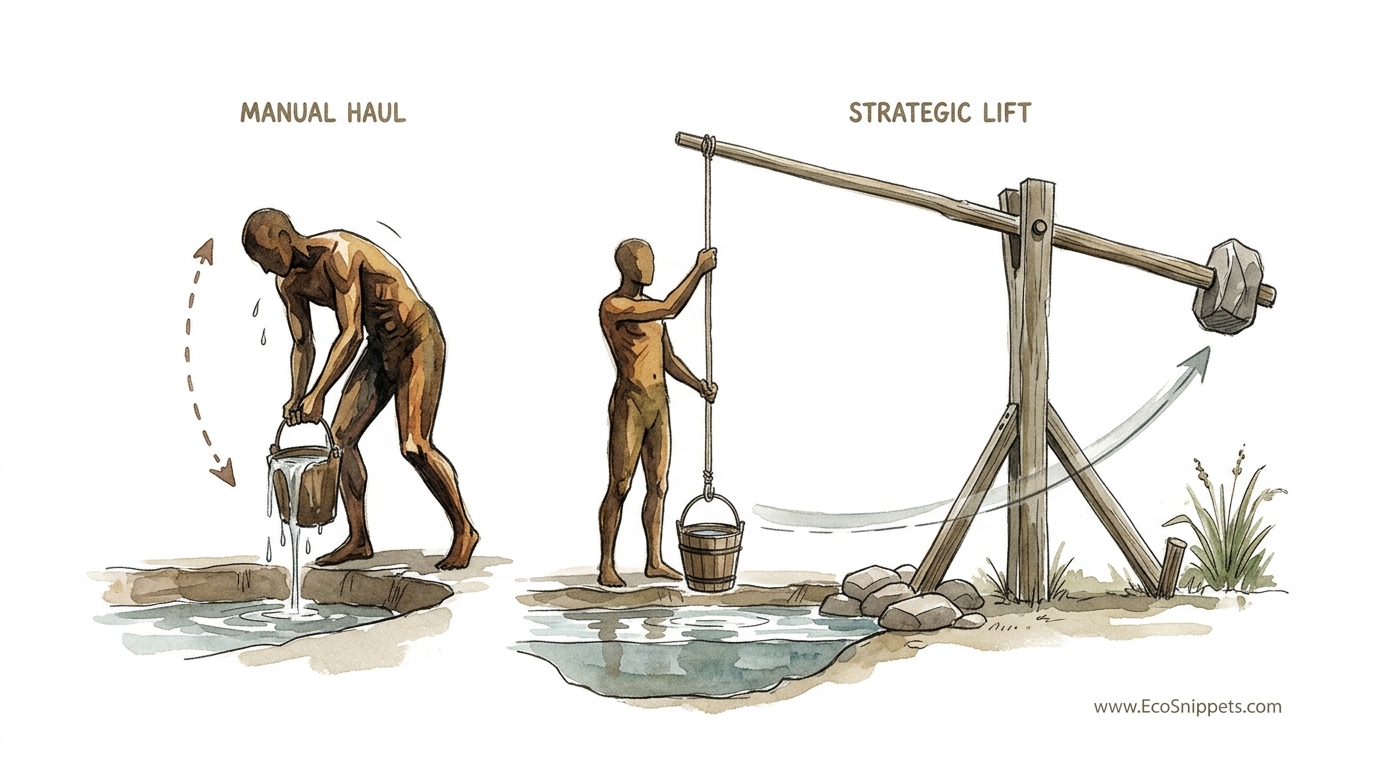
This ancient tool exists because human muscle is better at pulling down than lifting up. Moving a 15-liter (4-gallon) bucket of water from a pond edge to a garden bed multiple times a day is a recipe for back strain. The shadouf changes the physics of the task. Instead of fighting gravity to lift the water, you use your body weight to pull down on a pole, and the counterweight does the heavy lifting for you as the bucket rises. It is the original “strategic lift” that replaced the “manual haul.”
Visualizing a shadouf is simple. Imagine a playground seesaw, but instead of two children, one side has a heavy stone and the other has a long rope with a bucket. The pivot point is usually set on a tall, vertical post. When the bucket is empty, the stone sits near the ground. To get water, you pull the bucket end down into the pond. Once the bucket is full, you let the stone pull the weight back up. It is a graceful, silent, and incredibly efficient system that has remained unchanged for over 5,000 years.
How the Physics of the Pivot Works
A shadouf is a classic Class 1 lever. This means the fulcrum (the pivot point) is located between the effort (you) and the load (the water). To make this work effectively, the placement of that pivot point is critical. Typically, the beam is divided so that the side with the bucket is much longer than the side with the counterweight. This provides the reach necessary to dip into a pond or well while keeping the heavy stone manageable and close to the main support post.
The secret to a perfect shadouf is the “near-balance” state. You want the counterweight to be slightly heavier than the empty bucket and the pole combined, but slightly lighter than the bucket when it is full of water. This creates a rhythmic cycle. You pull down to fill the bucket, which requires a bit of effort, and then the counterweight assists you in bringing the full load back up to the surface. Most historical designs allow for a lift of 1 to 3 meters (3 to 10 feet), though multi-stage systems can go much higher.
Selecting Your Materials
Wood selection determines whether your shadouf lasts two years or twenty. Ancient builders used what was available, often palm or acacia. For a modern DIY build, Black Locust is the gold standard due to its incredible rot resistance and strength. If that is unavailable, Eastern Red Cedar or White Oak are excellent alternatives. Avoid using standard pine unless it is pressure-treated, as the constant proximity to water and soil will cause it to rot within a few seasons.
Building the Upright Support
The main vertical post must be incredibly stable. It handles all the downward pressure and the shifting weight of the lever. You should bury the post at least 1 meter (3 feet) deep for a standard 3-meter (10-foot) tall support. Packing the base with gravel or pouring a small concrete footing will prevent the post from leaning over time. Some builders prefer a forked post—a natural “Y” shape—which provides a built-in cradle for the horizontal beam to rest in.
Step-By-Step Construction Guide
Start by identifying the exact spot where your shadouf will sit. It needs to be close enough to the pond edge that the bucket can submerge fully, but on stable enough ground that your weight doesn’t cause the bank to collapse. Once the vertical support is in the ground and level, you can begin work on the lever arm.
The lever arm should be a long, straight pole. Drill a hole through the lever arm at the intended pivot point. Use a heavy-duty steel bolt or a seasoned hardwood dowel as the axle. If you use a bolt, add large washers on both sides to prevent the wood from wearing down over time. The pivot should be smooth; applying a bit of tallow or beeswax can reduce friction and the annoying squeak of wood-on-wood contact.
Attach your counterweight to the short end of the beam. This can be a large, flat stone lashed with heavy rope, or a basket filled with smaller rocks. Traditional Egyptian models often used a large ball of dried Nile mud, but a modern concrete block or a heavy decorative stone works just as well. Ensure the weight is secured tightly. A falling counterweight is a major safety hazard for the operator and anyone nearby.
Finally, attach the bucket to the long end. You can use a sturdy rope, but a thin wooden pole (the “bucket rod”) is often better. A rod prevents the bucket from swinging wildly in the wind and makes it easier to push the bucket down into the water if it’s a lightweight material like plastic or wood. Ensure your bucket has a sturdy handle that can withstand the constant tugging and weight of the water.
Benefits of the Strategic Lift
The most immediate benefit is the reduction of physical strain. By using a counterweight, you are essentially “storing” energy. When you pull the empty bucket down, you are lifting the stone. Gravity then gives that energy back to you when you need to lift the heavy water. This allows an operator to move thousands of liters of water in a single afternoon without the back fatigue associated with carrying buckets.
Cost is another significant advantage. A shadouf can be built entirely from salvaged materials or local timber. There are no monthly electricity bills, no expensive gasoline to buy, and no complex plastic parts that will eventually crack in the sun. It is a zero-input system. For the self-reliant gardener, it represents a level of independence that modern pumps simply cannot match.
Environmental harmony is often overlooked but deeply satisfying. The shadouf operates in total silence, save for the occasional splash of water. It doesn’t disturb the local pond life with vibrations or exhaust fumes. It also encourages a slower, more mindful approach to gardening. You become aware of exactly how much water your plants are receiving, leading to better water management and less waste.
Challenges and Common Mistakes
The most frequent error is improper balancing. If the counterweight is too heavy, you will struggle to pull the bucket down into the water. If it is too light, you will still be doing all the lifting yourself. Achieving that perfect “sweet spot” usually requires a bit of trial and error. Start with a lighter weight and add stones to your basket until the lift feels effortless.
Pivot friction is another common pitfall. A dry, tight pivot will sap your energy and eventually wear through the wood. The hole for the axle should be slightly larger than the bolt itself to allow for wood expansion when it gets damp. Regular lubrication is key. Ignoring this leads to the “death groan” of the shadouf, where the wood begins to grind and eventually split.
Rope failure can be dangerous. Constant exposure to water and UV rays from the sun will degrade natural fibers like hemp or sisal. Inspect your lashing and bucket ropes monthly. If you see fraying, replace them immediately. Many modern practitioners use UV-resistant synthetic ropes that look like natural fibers to maintain the aesthetic while ensuring long-term safety.
Limitations and Practical Constraints
A shadouf is not a universal solution. Its primary limitation is height. While a single unit is very efficient for lifts up to 2.5 meters (8 feet), trying to lift water much higher than that requires a massive beam that becomes unwieldy. Ancient farmers solved this by building “ladders” of shadoufs, where one unit lifts water into a basin, and a second unit lifts it from that basin to the next level. This is effective but requires more space and labor.
Space is also a factor. The lever arm for a standard backyard shadouf might be 4 to 5 meters (13 to 16 feet) long. You need a clear arc of space for the beam to move up and down without hitting tree branches, power lines, or the roof of a nearby shed. If your pond is tucked into a tight corner of the yard, a shadouf might not fit the footprint.
Regional climate plays a role in maintenance. In very humid areas, even rot-resistant wood will eventually succumb to fungus if it isn’t allowed to dry. In extremely arid regions, the wood may shrink and crack. You must be prepared to treat the wood with natural oils (like linseed or tung oil) once or twice a year to keep the fibers supple and resilient.
Manual Haul vs. Strategic Lift
| Factor | Manual Haul (Buckets) | Strategic Lift (Shadouf) |
|---|---|---|
| Physical Strain | High (Back and Shoulders) | Low (Core and Body Weight) |
| Energy Cost | Free (Human Caloric) | Free (Human Caloric + Gravity) |
| Complexity | Zero | Low (Basic Carpentry) |
| Efficiency | Low (Slow and Tiring) | High (Rhythmic and Fast) |
| Lifespan | Indefinite (Bucket dependent) | 15-50 Years (Wood dependent) |
Practical Tips and Best Practices
When selecting a bucket, choose one with a wide mouth but a slightly tapered bottom. This makes it easier to “tip” the bucket into the water with a flick of the wrist. If the bucket is too light and floats on the surface, you can attach a small stone to the rim to help it submerge instantly. This small adjustment can save you seconds on every lift, which adds up during a long watering session.
Consider the ergonomics of the handle. Many people find that adding a “grip” to the bucket rod or rope—such as a smooth wooden crossbar—makes the downward pull much more comfortable. This prevents the rope from digging into your palms and allows you to use your entire body weight to pull, rather than just your arm muscles.
Setting up a “receiving trough” is the final step in a pro-level system. Instead of carrying the bucket from the shadouf to the garden, pour the water into a wooden trough or a series of bamboo pipes that gravity-feed the water directly into your garden beds. This creates a closed-loop system where you never actually carry the weight of the water across the yard.
Advanced Considerations for Serious Practitioners
Serious practitioners often look at the scaling potential of the shadouf. If you have a large garden, you can install multiple shadoufs at different points along your pond or canal. This allows several people to work simultaneously, or simply provides backup locations so you aren’t siempre walking to the same spot. In some traditional systems, the pivot point itself is adjustable, allowing the operator to change the leverage based on the current water level of the pond.
Seasoning your wood before construction is another advanced tip. Using “green” or fresh-cut wood for the lever beam might seem convenient, but as the wood dries, it will warp and check (split). This can throw off your balance and weaken the pivot point. Ideally, your main beam should be seasoned for at least six months in a dry, shaded area before you drill your pivot holes.
Aesthetics often matter in a backyard setting. You can “hide” the modern aspects of your build by using traditional lashing techniques. Instead of bright silver bolts, use dark, galvanized hardware and cover the pivot with a decorative wooden cap. Some builders even carve the counterweight stone or use a large, attractive river boulder to turn the shadouf into a focal point of their landscape design.
Example Scenario: The 500-Square-Foot Garden
Let’s look at a practical application. Imagine you have a 500-square-foot (46-square-meter) vegetable garden that requires approximately 1 inch (2.5 cm) of water per week. This equates to roughly 300 gallons (1,135 liters) of water. Hauling this by hand with a standard 5-gallon (19-liter) bucket would require 60 trips back and forth from the pond.
With a well-balanced shadouf, an operator can comfortably lift and pour one bucket every 15 seconds. This means you can move all 300 gallons in just 15 to 20 minutes of rhythmic work. Because the counterweight is doing the heavy lifting, the physical exertion is comparable to a brisk walk rather than a heavy weightlifting session. By connecting the shadouf to a simple gravity-fed ditch system, the water is delivered to the roots of the plants with almost no walking required.
Final Thoughts
Building a shadouf is more than just a weekend project; it is an exercise in ancestral wisdom. It reminds us that the most effective solutions are often the simplest ones. By using basic geometry and the power of gravity, you can eliminate one of the most back-breaking chores on the homestead. It is a quiet, dignified way to interact with your land, providing life-giving water to your crops without the noise and expense of modern machinery.
Whether you are a serious gardener looking to reduce your footprint or a hobbyist who appreciates the elegance of ancient engineering, the shadouf is a worthy addition to any backyard pond. It encourages a deeper connection to the rhythms of nature and the physics of the world around us. Once you feel that first full bucket rise effortlessly toward the sky, you will never want to go back to the “manual haul” again.
Start small, focus on the balance, and don’t be afraid to experiment with your materials. The beauty of this system is its flexibility. With a sturdy post, a long beam, and a bit of patience, you can master a technology that has sustained civilizations for millennia. Your garden—and your back—will thank you.
