How To Become More Self-Sufficient Without Starting a Full-Blown Farm…
Want to start preserving your harvest, making your own soap, or building a backyard root cellar — but not sure where to begin? “Homesteading Advice” gives you instant lifetime access to 35+ practical homesteading books on food preservation, veggie gardening, DIY natural cleaning products (save over $250 per year with this skill alone), brewing, off-grid energy, and a whole lot more…
Click Here To Check It Out Now!
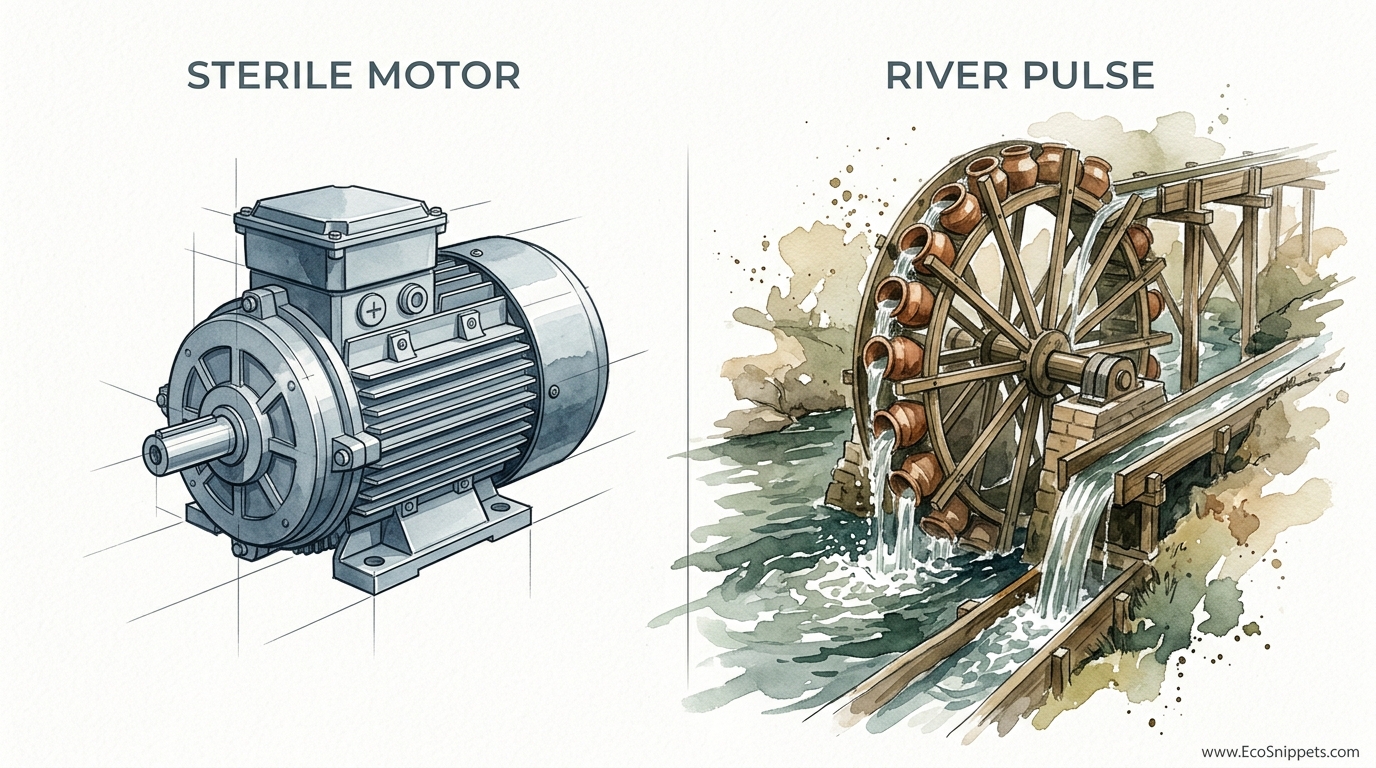
Why convert water into electricity just to pump water, when you can let the river’s own heartbeat do the heavy lifting for you? Every time you convert energy from one form to another, you lose efficiency. Modern systems take a river, turn it into electricity, and then use that electricity to run a pump. The Ancient Noria skips the middleman, using the living current to provide a lifetime of free irrigation. It is time to return to systems that breathe with the landscape.
For centuries, the rhythmic groan of the water wheel was the soundtrack of the fertile valley. These massive structures didn’t just sit in the water; they were part of the water. Unlike a modern centrifugal pump that screams with high-speed rotation, a Noria turns with a slow, deliberate strength. It is a machine that understands the river’s pulse.
In this guide, we will explore the engineering and history of the Noria, particularly the Roman and medieval designs that reached the height of their evolution in the Middle East. Whether you are a homesteader looking for a zero-fuel irrigation solution or a history buff fascinated by mechanical elegance, there is much to learn from the “growler” of the ancient world.
Ancient Roman Noria Water Wheel
The Noria, from the Arabic n?‘?ra (meaning “to groan” or “to grunt”), is a water-lifting machine that operates entirely on the kinetic energy of a flowing stream. While basic paddle wheels appeared in Egypt and India centuries earlier, it was the Roman engineer Vitruvius who, in the 1st century BCE, described the mechanics that would revolutionize agriculture across the Mediterranean. The Romans recognized that a wheel didn’t need to drive a mill to be useful; it could be its own pump.
At its simplest, a Noria is a large, vertical undershot wheel. Its rim is fitted with paddles that catch the current and buckets—historically ceramic pots or wooden boxes—that scoop water at the bottom of the rotation. As the wheel turns, these containers carry the water to the apex. Once they reach the top, they naturally tilt, spilling their contents into an elevated trough or aqueduct. This water then flows by gravity to fields that would otherwise be too high to irrigate.
The most famous surviving examples are the Norias of Hama in Syria. These giants, some reaching 20 meters (66 feet) in diameter, have stood on the Orontes River for nearly a millennium. They demonstrate the incredible scale of this technology. One single wheel, like the Al-Muhammadiya, could lift over 200,000 liters (52,800 US gallons) of water per hour to a height of 21 meters (69 feet). This is not just a primitive tool; it is industrial-scale engineering powered by nothing but the river.
How It Works: The Physics of the Lift
The brilliance of the Noria lies in its simplicity and the way it handles torque. Because the wheel is powered by the current at the bottom, it requires a steady, predictable flow. The mechanics can be broken down into three primary stages: the capture, the carry, and the spill.
1. Kinetic Capture
The wheel sits in the stream, supported by stone pillars or a wooden frame. The lower 10–20% of the wheel is submerged. Wide paddles, or “float boards,” catch the moving water. The force exerted on these paddles creates torque on the central axle. Because the current is constant, the torque is constant, allowing the wheel to move thousands of kilograms of water upward without the need for high-speed momentum.
2. The Gravity-Defying Carry
As the wheel rotates, buckets or compartments along the rim dip below the surface. In the Roman style, these were often separate ceramic pots tied to the outside. In later medieval designs, they were integrated wooden boxes built directly into the rim. Each bucket captures a specific volume of water—usually between 5 and 15 liters (1.3 to 4 US gallons). Because the wheel moves slowly (often only one or two revolutions per minute), the water doesn’t slosh out significantly during the ascent.
3. The Precision Spill
This is the most critical part of the design. At the top of the wheel, the bucket must empty its water into a waiting flume. The angle of the bucket’s opening and the placement of the collection trough must be perfectly synchronized. If the spill happens too early, the water falls back into the river. If it happens too late, the bucket carries the water back down the other side. Engineers often use a “slanted spout” design to ensure the water exits the box the moment it clears the height of the aqueduct.
Benefits of the Noria System
Choosing a Noria over a modern electric or diesel pump offers several long-term advantages that align with self-sufficiency and low-impact living.
- Zero Fuel Costs: Once the structure is built, the energy is free. The river provides the fuel 24 hours a day, 365 days a year.
- Low Maintenance: Without high-speed bearings, seals, or combustion engines, the primary maintenance involves occasional grease for the axle and replacing weathered wood. A well-built wooden Noria can last decades, and stone components can last centuries.
- Consistent Irrigation: Unlike solar pumps that stop at night or during cloudy weather, a Noria works as long as the river flows. This provides a steady, rhythmic supply of water that is easy to manage via gravity-fed channels.
- Environmental Harmony: The system produces no greenhouse gases and no noise pollution—only the rhythmic, low-frequency “groan” that gives the machine its name. It doesn’t require a large dam that blocks fish migration, as it only needs a small weir or current-directing channel.
Challenges and Common Mistakes
Building a Noria is an exercise in structural integrity and site selection. Many modern attempts fail because they underestimate the forces involved.
One common mistake is using wood that is too light or prone to rot. Historical Norias used dense, water-resistant woods like walnut or mulberry. If the wood is not properly seasoned or selected, the constant wet-dry cycle will cause it to warp, throwing the wheel out of balance. A wobbly wheel creates uneven stress on the axle, eventually leading to a catastrophic failure of the support structure.
Another frequent error is poor bucket venting. When a bucket enters the water at the bottom, it can trap air, which resists the downward motion and reduces efficiency. Conversely, as the bucket empties at the top, it can create a vacuum that prevents the water from flowing out smoothly. Small vent holes or specific bucket shapes are necessary to allow air to displace the water instantly.
Limitations and Practical Constraints
While the Noria is a masterclass in efficiency, it is not a universal solution. It has realistic constraints that must be understood before planning a build.
Environmental limitations are the biggest hurdle. You must have a flowing river or stream with enough volume and velocity to push the paddles. In slow-moving water, you may need to build a “wing dam” or a weir to funnel the current and increase its speed at the wheel’s location. Furthermore, the Noria is susceptible to floods. A heavy surge can rip the paddles off or even dislodge the entire wheel from its stone base. In regions with extreme seasonal flooding, Norias were often designed to be partially disassembled or lifted during the off-season.
The height of the lift is also limited by the diameter of the wheel. If you need to lift water 10 meters (33 feet), you need a wheel significantly larger than 10 meters in diameter. This makes the Noria a “low-head” solution. For very high elevations, a hydraulic ram pump or a multi-stage system would be more practical than building a massive 30-meter wheel.
Comparison: Noria vs. Modern Pumping Systems
The choice between “River Pulse” (Noria) and “Sterile Motor” (Electric Pump) often comes down to the scale of your project and your long-term goals.
| Feature | Ancient Noria | Electric Centrifugal Pump |
|---|---|---|
| Initial Cost | High (Labor & Materials) | Low to Moderate |
| Operating Cost | $0 | High (Electricity/Gas) |
| Expected Lifespan | 50–100+ years (with repairs) | 5–15 years |
| Skill Required | Carpentry & Masonry | Electrical & Plumbing |
| Environmental Impact | Negligible | Significant (Carbon/Noise) |
Practical Tips for the Modern Builder
If you are planning to build a small-scale Noria for a garden or small farm, keep these best practices in mind to maximize efficiency.
- Calculate Your Flow: Measure the stream velocity in meters per second (or feet per second). An undershot wheel is most efficient when the paddle speed is roughly 30-40% of the water speed.
- Use Marine-Grade Bearings: While the ancients used greased wood, modern sealed stainless steel bearings will significantly reduce friction and extend the life of your axle.
- Balance the Wheel: A Noria that is “heavy” on one side will stall or put massive strain on the frame. After attaching your buckets, test the rotation without water to ensure it turns smoothly and stays in whatever position you leave it.
- Manage the Splash: Water falling from the spillway can erode the ground beneath the wheel. Use a stone or concrete splash pad to prevent your support pillars from being undermined.
Advanced Considerations: Hydraulic Calculations
For a serious practitioner, understanding the math behind the machine is essential. The power (P) available from the stream can be estimated by the formula: P = 0.5 × ? × A × v³, where ? is the water density, A is the submerged area of the paddles, and v is the velocity of the water. However, an undershot Noria usually only captures about 20-30% of this theoretical energy.
When sizing your wheel, remember the “torque vs. lift” trade-off. A larger wheel provides more height but requires more force from the river to turn, as the weight of the water-filled buckets creates a longer lever arm against the axle. If your wheel is stalling, you must either increase the surface area of the paddles or reduce the size of the buckets. It is often better to have 50 small buckets than 10 large ones; this keeps the load distributed and the rotation steady.
Example Scenario: The 5-Meter Homestead Noria
Imagine a small homestead with a stream moving at 1.5 meters per second (approx. 5 feet per second). The owner builds a 5-meter (16.4-foot) diameter Noria using treated cedar and 2-liter (0.5-gallon) plastic buckets.
The wheel is set to submerge the bottom 0.5 meters of the paddle. With a rotation speed of 2 RPM, the wheel lifts 2 liters every 1.2 seconds (assuming 30 buckets on the rim). This results in roughly 100 liters per minute or 6,000 liters (1,585 gallons) per hour. This volume is more than enough to keep a large market garden hydrated through a gravity-drip system, all without a single watt of electricity or a drop of gasoline.
Final Thoughts
The Ancient Roman Noria is a testament to the power of observation. The engineers of the past didn’t try to dominate the river; they learned to cooperate with it. By capturing the kinetic energy that was already there, they turned arid landscapes into lush gardens that sustained empires for generations.
Returning to these “slow” technologies provides more than just free water. It provides a connection to the environment that modern machines obscure. When you maintain a Noria, you become intimately aware of the river’s height, the seasonal changes in current, and the health of the wood. It is a partnership between human ingenuity and the natural world.
Whether you build a small version to water your vegetables or simply appreciate the history of the great wheels of Hama, remember that the most “advanced” solution isn’t always the one with the most wires. Sometimes, the most advanced solution is the one that has worked for two thousand years and still hasn’t cost a dime in fuel.
