How To Become More Self-Sufficient Without Starting a Full-Blown Farm…
Want to start preserving your harvest, making your own soap, or building a backyard root cellar — but not sure where to begin? “Homesteading Advice” gives you instant lifetime access to 35+ practical homesteading books on food preservation, veggie gardening, DIY natural cleaning products (save over $250 per year with this skill alone), brewing, off-grid energy, and a whole lot more…
Click Here To Check It Out Now!
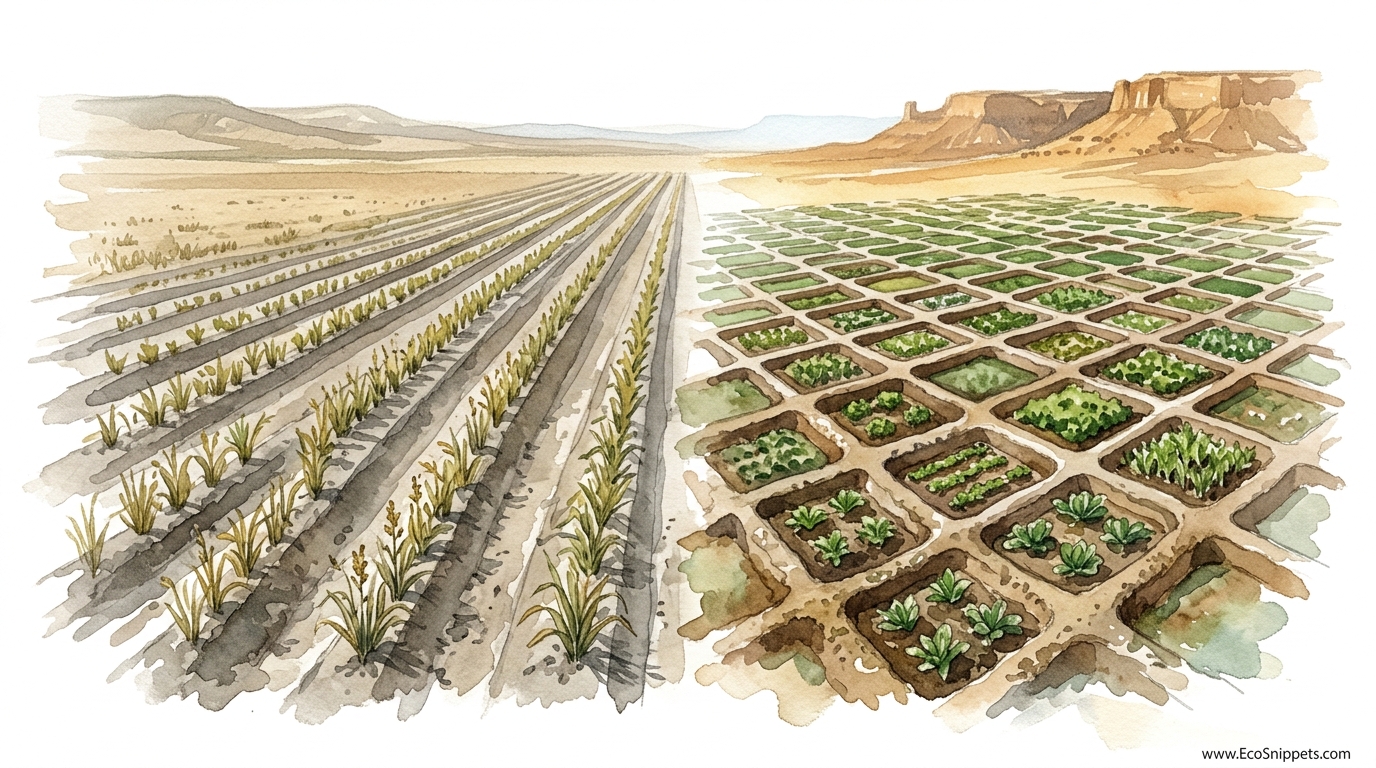
While modern sprinklers lose 60% of their water to the wind, this ancient geometric trick grows abundance in the middle of a desert. In the arid Southwest, the Zuni people didn’t fight the wind – they used geometry to defeat it. By creating sunken ‘waffles’ with raised earth berms, they trapped every drop of dew and rain while shielding tender plants from the drying desert breeze. It’s a dynamic use of earthworks that makes a garden thrive where a sprinkler system would fail.
Water is the lifeblood of the high desert, yet it is also the most elusive resource. For centuries, the A:shiwi (Zuni) people of western New Mexico have flourished in a landscape that receives less than 12 inches (30 cm) of annual rainfall. Their success did not come from trying to impose European gardening styles on a thirsty land. Instead, they observed the way water moved across the soil and how the wind stripped moisture from every leaf.
The result was the waffle garden, or Latdekwi:we. This system turns the traditional raised bed on its head. Where a standard garden bed sits above the ground and drains away, the waffle garden sinks into the earth to hold moisture close to the roots. It is a masterclass in ecological engineering that remains as relevant today as it was a thousand years ago.
Zuni Farming Methods For Dry Climates
The Zuni waffle garden is a traditional dryland farming technique designed to maximize every available drop of moisture in an arid environment. It consists of a grid of small, sunken planting areas surrounded by raised earthen walls or berms. This structure creates a series of individual basins that look remarkably like a breakfast waffle when viewed from above.
Historically, these gardens served as the family kitchen garden. While larger fields of corn and beans were planted at the base of mesas to catch seasonal runoff, the waffle gardens were situated closer to the village and the Zuni River. They were often the responsibility of the women in the community, providing fresh vegetables, herbs, and specialty crops that required more careful attention than the staple field crops.
This method exists because desert environments are inherently hostile to tender seedlings. High temperatures, low humidity, and constant wind combine to create a high rate of evapotranspiration. This means plants lose water through their leaves faster than they can pull it from the ground. The waffle garden solves this by creating a series of miniature microclimates. The berms act as windbreaks, while the sunken floor keeps the root zone shaded and cool.
In the real world, this system is a precursor to modern “square foot gardening,” but with a specific focus on water harvesting. It is used in regions where rain is unpredictable and irrigation water must be carried by hand or used with extreme precision. Today, permaculture practitioners and desert homesteaders are reviving these methods to combat rising temperatures and persistent drought conditions across the globe.
Constructing Your Own Waffle Garden
Building a waffle garden is a labor of love that requires nothing more than a shovel, a rake, and a source of water. The process begins with selecting the right location. You need a flat area with soil that has a high enough clay content to hold its shape when formed into walls.
Start by clearing the area of rocks, large roots, and perennial weeds. Once the ground is clear, mark out your grid. Traditional waffles are often 1 foot by 1 foot (30 cm x 30 cm) or 2 feet by 2 feet (60 cm x 60 cm). Smaller squares are easier to maintain by hand, as you can reach into the center without stepping on the berms.
Digging the basins is the next step. Excavate the soil within each square to a depth of about 4 to 6 inches (10 to 15 cm). Use this excavated soil to build up the berms around the perimeter of the square. These walls should be approximately 4 inches (10 cm) wide and 4 to 5 inches (10 to 12 cm) high.
Mixing a little water into the soil as you build the walls helps them become stable. This creates an “adobe” effect where the clay particles bond together to form a sturdy rim. Once the grid is complete, the floor of each basin should be leveled and loosened. This ensures that when you water the square, the moisture spreads evenly across the entire root zone rather than pooling in one corner.
Planting occurs in the center of these depressions. For seeds like corn or squash, you can plant a small cluster in the middle of each waffle. As the plants grow, the surrounding walls protect the stems from being snapped by the wind. Watering is done by filling the basin to the top of the berm, allowing the water to soak slowly and deeply into the soil.
The Practical Benefits of Sunken Basins
The most immediate advantage of this design is superior water conservation. Unlike a flat field where water might run off or a raised bed that dries out from the sides, the waffle garden traps water exactly where it is needed. This containment eliminates runoff and ensures that 100% of the water applied reaches the root system.
Wind protection is another critical factor. Desert winds are notoriously drying, often carrying away the humidity that plants naturally release. The raised berms of a waffle garden serve as miniature fences. They slow the airflow across the surface of the soil, which significantly reduces the rate of evaporation. Even a few inches of vertical wall can create a still-air pocket that keeps a seedling alive during a heatwave.
Thermal regulation is a hidden benefit of the earthen walls. Clay and soil have high thermal mass, meaning they absorb the sun’s heat during the day and radiate it slowly at night. In the desert, where temperatures can swing 40 degrees Fahrenheit (22 degrees Celsius) between day and night, these berms act as a battery. They keep the soil cooler during the midday sun and provide a buffer of warmth during chilly nights, extending the growing season in both directions.
Nutrient retention is also improved in these systems. In conventional gardening, heavy rains can wash away topsoil and fertilizers. The waffle structure prevents this erosion. Each square is a self-contained unit that catches sediment and organic matter, keeping the “gold” of your garden right where the plants can use it.
Common Challenges and Pitfalls to Avoid
Labor is the primary challenge for modern gardeners. Creating a 20-square waffle grid by hand is physically demanding work compared to tilling a long row. Many people underestimate the time it takes to properly compact and shape the berms. If the walls are not packed well, they will simply melt away during the first heavy rainstorm.
Soil composition can also be a hurdle. If your soil is too sandy, the berms will not hold their shape. In such cases, you must bring in clay-rich soil or use stones and wooden slats to reinforce the walls. Conversely, if the soil is pure heavy clay, the basins may drain too slowly, potentially leading to root rot if you overwater.
Maintenance of the berms is a continuous task. Rain, wind, and the occasional stray animal will eventually wear down the earthen walls. You must be prepared to “patch” your waffles throughout the season. Adding a little fresh mud to the rims after a storm keeps the system functioning. Neglecting this maintenance leads to the walls breaching, which causes water to escape and ruins the efficiency of the garden.
Another common mistake is overcrowding the basins. Because the squares look small, it is tempting to plant too many seeds. However, desert plants often need more space for their root systems to search for moisture. Sticking to one or two heavy feeders per square is usually better than trying to cram in a dozen plants.
Limitations of the Waffle Method
This method is specifically designed for arid and semi-arid climates. It is not an ideal choice for regions with high rainfall or poorly draining soils. In a wet climate, a sunken waffle garden would essentially become a series of miniature ponds. This leads to anaerobic soil conditions, root rot, and the death of most common garden vegetables.
Large-scale mechanical farming is another limitation. Waffle gardens are designed for human-scale interaction. They cannot be easily weeded or harvested by tractors or heavy machinery. This makes them perfect for homesteads, community gardens, and backyard plots, but less practical for commercial monoculture operations.
Environmental constraints also play a role. If you live in an area with a high water table, digging down into the soil may bring you too close to the saturated zone. Similarly, if your ground is composed of solid bedrock or heavy caliche, the labor required to excavate the basins might outweigh the benefits of the system.
Comparing Static Rows and Dynamic Waffles
Traditional European gardening often relies on “Static Rows.” These are long, linear strips of tilled earth, often mounded slightly to encourage drainage. While these are easy to plant with machinery, they are highly inefficient in terms of water and space in a desert context.
| Feature | Static Rows | Dynamic Waffles |
|---|---|---|
| Water Efficiency | Low; high runoff and evaporation. | High; water is trapped and focused. |
| Wind Resistance | Low; plants are fully exposed. | High; berms act as windbreaks. |
| Labor Level | Low to Moderate (Mechanized). | High (Hand-built). |
| Soil Stability | Prone to erosion from rain/wind. | Highly stable; berms prevent loss. |
The dynamic waffle system focuses on containment rather than extraction. In a static row, you are often fighting the environment to keep the soil moist. In a dynamic waffle, the garden’s very structure works with the environment to harvest dew and hold onto every drop of moisture provided.
Practical Tips for Best Results
Using mulch inside the waffle basins can double your water efficiency. Traditionally, the Zuni used a thin layer of sand or small gravel on top of the soil. This “mineral mulch” breaks the capillary action of the soil, preventing water from being pulled to the surface and evaporated. In a modern setting, you can use straw or wood chips, but be careful not to fill the basin so high that you lose the windbreak effect of the berms.
Companion planting is highly effective within the waffle structure. The “Three Sisters” (corn, beans, and squash) are a classic choice. Planting the corn in the center provides a trellis for the beans, while the squash spreads its large leaves across the floor of the waffle. These leaves act as a “living mulch,” shading the soil and keeping the roots cool.
Timing your watering is equally important. Watering in the late evening or very early morning ensures that the moisture has time to soak deep into the earth before the sun begins to bake the surface. When you do water, fill the basin to the brim and let it drain completely. This encourages the roots to grow deep into the cool, moist subsoil rather than staying near the hot surface.
Advanced Considerations for Arid Success
Experienced practitioners often integrate “ollas” into their waffle gardens. An olla is an unglazed terra cotta jar that is buried in the center of the planting basin. You fill the jar with water and put a lid on it. The water slowly seeps through the porous clay walls, providing constant, underground moisture directly to the roots. This combination of sunken basins and olla irrigation is perhaps the most water-efficient gardening system ever devised.
Succession planting can also be adapted for waffles. Because each square is an independent microclimate, you can rotate crops through the grid more easily. For example, once a cool-season crop like lettuce is finished in one square, you can immediately prepare that specific basin for a heat-loving pepper plant without disturbing the neighboring squares.
Building on contours is another advanced technique. If your garden is on a slight slope, you can arrange your waffles so they follow the natural level of the land. This allows you to create “spillways” between the squares. During a heavy rain, the top waffle fills up, and the excess water flows into the next one down the line, essentially turning your entire garden into a managed watershed.
A Realistic Setup Scenario
Imagine you have a 10-foot by 10-foot (3 meters by 3 meters) patch of sun-baked earth in a dry climate. Using the waffle method, you could create a grid of 16 squares, each roughly 2 feet (60 cm) across.
In the center four squares, you plant your heirloom corn and pole beans. The surrounding 12 squares are dedicated to chiles, tomatoes, and herbs like cilantro. Every evening, you take a single five-gallon (19-liter) bucket of water and distribute it among the squares that feel dry.
Because the water is contained by the berms, none of it is wasted on the pathways. The plants stay upright despite the afternoon winds, and the heavy clay walls keep the roots significantly cooler than the surrounding soil. Within a few weeks, the squash in the corner waffles has spread out to cover the walkways, creating a green carpet that protects the entire system.
Final Thoughts
The Zuni waffle garden is more than just a historical curiosity; it is a vital tool for a more resilient future. By looking back at ancestral wisdom, we find solutions to the modern problems of water scarcity and extreme heat. This system proves that we don’t need expensive technology to grow food in difficult places—we simply need to understand the physics of the land.
Embracing this method requires a shift in mindset. It asks us to slow down, to work with our hands, and to observe the subtle needs of each individual plant. While it takes more effort to build than a flat row, the reward is a garden that can survive on a fraction of the water and stand strong against the elements.
Whether you are a beginner looking to save on your water bill or a serious practitioner of permaculture, the waffle garden offers a path toward self-reliance. It is an invitation to turn the desert into an oasis, one square at a time. Experiment with this ancient geometry and watch how your garden responds when you finally stop fighting the wind and start using the earth to protect your abundance.
