How To Become More Self-Sufficient Without Starting a Full-Blown Farm…
Want to start preserving your harvest, making your own soap, or building a backyard root cellar — but not sure where to begin? “Homesteading Advice” gives you instant lifetime access to 35+ practical homesteading books on food preservation, veggie gardening, DIY natural cleaning products (save over $250 per year with this skill alone), brewing, off-grid energy, and a whole lot more…
Click Here To Check It Out Now!
Your panels are only working at peak for 2 hours a day – here is how to command the sun. Fixed solar panels are ‘Chaos’—they wait for the sun to hit them at the right angle, losing power every minute they aren’t perfectly aligned. A Heliostat array brings ‘Order’ to the system. These computer-controlled mirrors track the sun and focus its energy onto a single point. Whether you’re generating high-heat steam or concentrated light for PV, it’s about making every photon count.
DIY Solar Heliostat For Home Heating
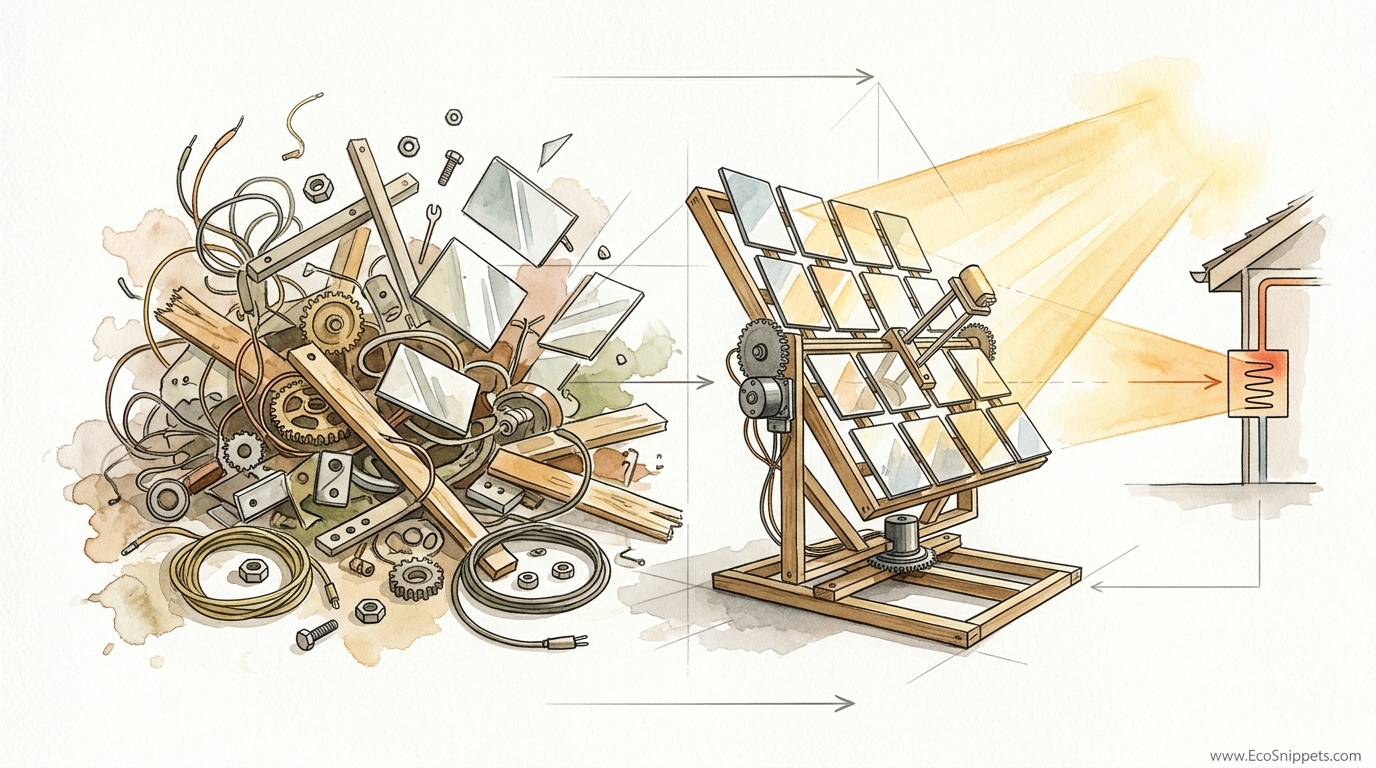
The sun delivers an incredible amount of energy to our doorstep every day, but most of it is scattered and wasted. A solar heliostat is a mechanical device that follows the sun across the sky and reflects its rays toward a fixed target. Unlike a standard solar panel that sits flat on a roof, a heliostat uses dual-axis tracking to ensure the mirror is always at the perfect angle to bounce light where you need it most.
In a practical home setting, this usually means reflecting a “sun patch” through a south-facing window or onto a thermal collector. In the dead of winter, when the sun is low and weak, a single mirror can turn a cold, dark room into a bright, warm sanctuary. It is the difference between waiting for the sun to find you and reaching out to grab it yourself.
Real-world applications range from massive industrial solar towers that melt salt for electricity to simple DIY rigs made of plywood and glass. For a homeowner, a heliostat acts as a powerful supplemental heater. On a clear day, a mirror measuring 1 square meter (roughly 10.7 square feet) can reflect nearly 800 to 1,000 watts of thermal energy. That is equivalent to running a small space heater for free, powered entirely by a handful of computer chips and a couple of small motors.
How It Works and How to Build Your Own
The logic of a heliostat is rooted in the law of reflection: the angle of incidence equals the angle of reflection. To keep sunlight on a fixed target while the sun moves, the mirror must always point halfway between the sun and that target. This requires a dual-axis mount that can move both horizontally (azimuth) and vertically (altitude).
Building a basic unit starts with a sturdy frame. Many successful DIY projects use 1.5-inch (40mm) PVC pipe or pressure-treated lumber to create a mount that can withstand the wind. The “brains” of the system are typically an Arduino or an ESP32 microcontroller. You have two choices for tracking: sensors or math. Sensor-based systems use Light Dependent Resistors (LDRs) to “hunt” for the brightest spot in the sky.
Mathematical systems are often more reliable. They use the Solar Position Algorithm (SPA) to calculate exactly where the sun is based on your GPS coordinates, date, and time. This means even if a cloud passes over, the mirror stays locked on target, ready for the moment the sky clears. Small NEMA 17 stepper motors, the same ones used in 3D printers, provide the precision needed to move the mirror in tiny, incremental steps.
The reflective surface itself is a critical choice. Standard glass mirrors are the most durable and offer the best clarity. However, for those on a budget, aluminized Mylar sheets or polished aluminum can work. If you are using glass, ensure it is securely mounted with a backing plate to prevent it from shattering in a storm.
Benefits of Active Solar Tracking
The primary advantage of a heliostat is the massive increase in efficiency over static systems. Static solar panels suffer from “cosine losses,” where the energy capture drops off sharply as the sun moves away from the 90-degree perpendicular angle. A heliostat eliminates this problem by maintaining a perfect orientation throughout the entire day.
Heliostats can deliver 30% to 50% more total energy over a 24-hour period than a fixed panel of the same size. This is especially valuable in northern latitudes during winter, where the sun sits low on the horizon and daylight hours are precious. Instead of getting a few hours of decent heat, you can harvest high-intensity energy from sunrise to sunset.
The cost-to-heat ratio is also hard to beat. A well-built DIY heliostat can be constructed for under $150 and provide the equivalent of 4.5 kilowatts of heat over a sunny day. Compared to the price of running an electric baseboard heater or a propane furnace, the system often pays for itself in just one or two winter seasons.
Challenges and Common Mistakes
Precision is the biggest hurdle for any beginner. If your mirror is off by just a few degrees, the reflected beam could miss your window entirely or, worse, hit a neighbor’s house. Calibration is not a “set it and forget it” task; you must ensure the mirror’s home position is perfectly aligned with true north or south at the start of every season.
Wind loading is a silent killer of solar projects. A mirror acts like a sail. In a 30 mph (48 km/h) gust, a large mirror can exert hundreds of pounds of force on its mount. Many DIYers make the mistake of using flimsy plastic gears that strip under pressure. Using worm gears or heavy-duty linear actuators is a better way to ensure the motors aren’t forced to “hold” the weight of the wind.
Another frequent error is neglecting the “park” position. When the sun goes down or the wind picks up, the system should automatically move the mirror to a flat, safe position. Without a dedicated parking routine in your code, you risk the mirror becoming a projectile during a midnight storm.
Limitations and Environmental Constraints
Heliostats are only as good as the sky above them. In regions with persistent cloud cover or heavy fog, the mirrors have nothing to reflect. Unlike solar PV, which can still generate a small amount of power from diffused light on a gray day, concentrated solar thermal requires direct “Direct Normal Irradiance” (DNI) to function.
Space is another constraint. To heat a home effectively, you need a clear line of sight from the ground (where the heliostat is usually mounted) to the target window or collector. Trees, fences, and nearby buildings can create shadows that render the system useless for large chunks of the day.
Maintenance is more involved than with static panels. You must keep the mirrors clean, as even a thin layer of dust can reduce reflectivity by 10% or more. Lubricating the moving joints and checking the belt tension or gear mesh is a bi-monthly chore for anyone serious about longevity.
Comparison: Static Solar vs. Active Heliostats
To understand the value, it helps to look at the numbers. Static panels represent “Static Chaos”—they are simple but inefficient. Heliostats represent “Ordered Focus”—they are complex but high-performing.
| Feature | Static Solar Panels | DIY Heliostat Tracker |
|---|---|---|
| Peak Performance Window | 2-3 Hours | 8-10 Hours |
| Mechanical Complexity | None (Fixed) | High (Motors/Gears) |
| Typical Heat Output | Passive Only | 800W – 1000W per m² |
| Maintenance Required | Minimal | Moderate (Cleaning/Lubrication) |
| Best Use Case | Roof-mounted Electricity | Ground-mounted Home Heating |
Practical Tips and Best Practices
Start small before you scale up. A single 50cm (20-inch) mirror is enough to learn the mechanics of tracking without the danger of creating a “death ray” that could damage your siding or furniture. Use a pinhole box for calibration: a small piece of wood with a hole that allows a tiny beam of light through to a target marks the center of your reflection perfectly.
For the best heating results, target a thermal mass. Reflecting light onto a dark-colored brick wall or a large water tank inside the house will allow the heat to be absorbed and slowly released throughout the night. If you shine the light directly into a room, the air will heat up quickly, but that warmth will vanish the moment the sun goes down.
Wiring matters more than you think. Use shielded cables for your motor connections to prevent electromagnetic interference from confusing your microcontroller. If your heliostat is sitting 30 meters (100 feet) away in the yard, the voltage drop over thin wires can cause your motors to stall. Always size your wire gauge for the distance.
Advanced Considerations for Serious Practitioners
Serious builders often move toward “Concentrated Solar Thermal” (CST). Instead of reflecting light into a window, they aim an array of 5 to 10 heliostats at a single insulated pipe or boiler. This can generate temperatures well above 200°C (392°F). This heat can then be stored in an IBC tote filled with water or a bed of rocks.
Thermal storage allows you to “shift” the sun’s energy. A 1,000-liter (265-gallon) water tank can store roughly 40-50 kWh of heat. By pumping the sun’s energy into this tank during the day, you can run a standard radiator loop to heat your home at midnight. This is the ultimate form of self-reliance, decoupling your comfort from the grid.
Software optimization is another frontier. Advanced trackers use “backtracking” algorithms. When you have multiple mirrors in a field, they can shade each other during the early morning or late afternoon. Smart code adjusts the angles slightly to ensure no mirror blocks its neighbor, maximizing the total harvest of the array.
Examples of Heliostats in Practice
Consider a homeowner in a temperate climate with a cold basement. By installing two 1-square-meter mirrors on the north side of the lawn, they can reflect light into the basement’s small windows. Even on a 0°C (32°F) day, the intense focus of the mirrors can raise the temperature of that room by 10 to 15 degrees Celsius (18 to 27 degrees Fahrenheit) within two hours.
Another scenario involves a “Solar Air Box.” A DIY builder mounts a black-painted aluminum box on their exterior wall. A heliostat in the yard tracks the sun and keeps a concentrated beam focused on the face of the box. A small fan kicks on when the box reaches 50°C (122°F), blowing hot, fresh air into the living room. This system can operate for 8 hours straight, whereas a static version of the box would only work for 3 hours.
Final Thoughts
The transition from static panels to active heliostats is a journey from being a passive observer of the seasons to being an active participant in your own energy production. It requires a bit of grit—you have to be willing to tinker with code, tighten bolts, and watch the weather. But the reward is a system that works with the precision of a Swiss watch.
By mastering the movement of the sun, you gain access to a level of thermal energy that simply isn’t possible with stationary equipment. Whether you are aiming for total off-grid independence or just want to shave a few hundred dollars off your winter heating bill, the heliostat is the ultimate tool for the modern pioneer.
Start with one mirror, learn the rhythm of the sky, and soon you will find yourself commanding the sun to work for you, rather than just waiting for it to shine. The energy is there, hitting your soil every single day. All you have to do is focus it.
