How To Become More Self-Sufficient Without Starting a Full-Blown Farm…
Want to start preserving your harvest, making your own soap, or building a backyard root cellar — but not sure where to begin? “Homesteading Advice” gives you instant lifetime access to 35+ practical homesteading books on food preservation, veggie gardening, DIY natural cleaning products (save over $250 per year with this skill alone), brewing, off-grid energy, and a whole lot more…
Click Here To Check It Out Now!
One pair of these birds can hunt 1,000 rodents in a single nesting season – if you give them the right room. Stop setting traps and start building homes. Barn owls are the most efficient rodent hunters on earth, but they won’t stay if they feel exposed. This specific box design provides the darkness and safety they need to raise a hungry, rat-eating family.
Working with nature requires a shift in perspective. Instead of seeing a pest problem as something to be poisoned, we see it as a resource that has been left untapped. For centuries, farmers relied on the silent flight of the owl to keep granaries clear and harvests safe. Today, we return to that ancestral wisdom with modern precision.
Barn owls are unique among raptors. They do not build nests of sticks and twigs like hawks or eagles. They are cavity nesters, searching for the deep hollows of old-growth trees or the dark, forgotten corners of a hayloft. When we provide a nesting box, we are not just giving them a house; we are fulfilling a biological requirement for total darkness and security.
Establishing a resident pair on your land is a long-term investment in self-reliance. It requires a bit of honest labor and a willingness to understand the world through the eyes of a nocturnal predator. Once you invite them in, these “ghost birds” become tireless partners in your stewardship of the land.
How To Attract Barn Owls To Your Barn For Rodent Control
Attracting these legendary hunters begins with understanding their primary motivation: survival. The barn owl, or Tyto alba, is a specialist. It thrives in open landscapes like meadows, pastures, and agricultural fields where its primary prey—voles, pocket gophers, and mice—live in abundance. If your property provides at least 5 to 10 acres (2 to 4 hectares) of open hunting ground, you have the foundation for a successful partnership.
These birds are often called “ghost owls” because of their pale, heart-shaped faces and silent flight. Unlike the territorial Great Horned Owl, barn owls are relatively tolerant of one another and can even live in loose colonies if the food supply is high. This makes them ideal for integrated pest management on farms, vineyards, and orchards. They do not want to be near humans, but they are happy to use human structures if those structures offer a high enough vantage point and a dark enough interior.
The real-world application of an owl box is simple: it replaces the lost natural habitat. Old barns are being torn down and hollowed-out trees are often cleared for safety or aesthetic reasons. By mounting a specifically designed box, you provide a “high-rent” district for owls that are currently roosting in less-than-ideal spots. They will recognize the dark entrance of a well-placed box from a distance, seeing it as the ultimate sanctuary for their vulnerable young.
Providing this sanctuary is a commitment to the ecosystem. You must stop the use of anticoagulant rodenticides. A poisoned rat is a slow-moving target that an owl will inevitably catch. The poison then travels up the food chain, often killing the very predator you are trying to attract. To have the owl, you must first have a healthy, poison-free landscape.
The Blueprint of the Sanctuary: Designing the Box
A successful nest box is more than just a wooden crate. It must be a fortress. The internal design is the most critical factor in whether a pair will stay and successfully fledge their young. A common mistake is building a simple open box; this leaves the owlets vulnerable to predators and the elements.
A professional-grade design includes an internal baffle or a “dark room.” This is a partition that separates the entrance hole from the main nesting area. It creates a “L” shaped path that blocks out the light and prevents larger predators, like Great Horned Owls or raccoons, from reaching in and grabbing the chicks. This baffle also protects the young from the wind and driving rain, ensuring the interior stays dry and temperate.
Dimensions matter. For the North American barn owl, the floor space should be approximately 30 inches by 24 inches (76 cm by 61 cm) to prevent overcrowding. The entrance hole should be an ellipse roughly 4.5 inches wide and 5.5 inches tall (11.4 cm by 14 cm). Placing the hole at least 16 inches (40.6 cm) above the floor is a safety requirement; this prevents curious owlets from accidentally falling out before they are strong enough to fly.
Material choice is equally vital. Use 3/4-inch (19 mm) exterior-grade plywood, such as CDX, to handle the moisture of the outdoors. Avoid pressure-treated lumber, as the chemicals can be harmful to the birds. Assemble the box with galvanized or ceramic-coated deck screws to prevent rust. A well-built box, sealed with a water-based, low-VOC stain on the exterior only, can last a decade or more.
The Mechanics of Natural Predation: How It Works
Barn owls operate on a different frequency than almost any other animal. Their hearing is the most sensitive of any creature ever tested. Their ears are placed asymmetrically on their heads, allowing them to triangulate the exact position of a mouse moving under a layer of snow or dense grass. When they hunt, they don’t just see the prey; they hear the heartbeat of the problem.
One pair of barn owls and their chicks can consume over 3,000 rodents in a single year. During the peak of the nesting season, the male will make dozens of trips to the nest each night, delivering a fresh rodent every few minutes. This is not just random hunting; it is a systematic clearing of the territory. They typically hunt within a 1- to 3-mile (1.6 to 4.8 km) radius of the nest, focusing on the areas with the highest prey density.
The “nesting substrate” is also part of the process. Barn owls do not bring in straw or feathers. Instead, they regurgitate “pellets”—compact bundles of undigestible bones and fur. Over time, these pellets are shredded by the owls to create a thick, soft, and insulating carpet on the floor of the box. This carpet cushions the eggs and provides a sanitary base for the growing owlets.
Owls are also incredibly efficient in their energy use. Their feathers have fringed edges that break up the air as it passes over the wing, making their flight completely silent. This allows them to ambush prey without warning. By providing a home, you are essentially installing a 24-hour, high-tech surveillance and elimination system that runs on nothing but the pests it removes.
The Harvest of the Night: Benefits of Owl Occupancy
The most immediate benefit is the measurable reduction in rodent populations. Studies in vineyards have shown that barn owls can remove gophers at a cost of roughly $0.34 per rodent, compared to over $8.00 per rodent for traditional trapping and baiting methods. This is an massive increase in efficiency for any land manager or gardener.
Beyond the numbers, there is the benefit of safety. Traditional rodent control often involves neurotoxins that can leach into the soil or affect pets and children. Owls are a “clean” technology. They leave no chemical footprint, only a pile of pellets that can actually be broken down into nitrogen-rich fertilizer for the soil.
There is also the advantage of psychological peace. Traps need to be checked, reset, and emptied—a grisly and time-consuming chore. An owl box, once installed, works while you sleep. The owls are the ones doing the heavy lifting, the cleaning, and the monitoring. It is a form of passive pest control that grows more effective as the birds return to the same site year after year.
Finally, having owls provides a sense of connection to the land. Watching a pale shape glide over your fields at dusk is a reminder that the ecosystem is working as it should. It brings a prehistoric rhythm back to the modern farm, proving that the old ways are often the most resilient ways.
The Pitfalls of Modern Shortcuts: Common Mistakes
The greatest error people make is choosing a box that is too small. While it might be cheaper or easier to hang, a small box leads to overheating and sibling aggression. If the chicks don’t have enough room to stretch their wings, they may become stunted or die from the heat. Always aim for a minimum of 8 cubic feet (0.22 cubic meters) of internal volume.
Placement is the next hurdle where many stumble. Hanging a box on a tree is often tempting, but it is the least effective location. Trees provide easy access for climbing predators like raccoons and snakes. They also tend to have branches that obstruct the owl’s flight path. A pole-mounted box or one mounted to the high gable of a barn is significantly more likely to be occupied.
Neglecting the internal baffle is another critical failure. Without that darkness, the owls feel “exposed.” They are intensely private birds. If they can see the world from their nesting scrape, they feel the world can see them. Darkness is their primary defense, and if you don’t provide it, they will likely move on to a darker, safer cavity elsewhere.
Ignoring the maintenance schedule can also lead to abandonment. While owls are hardy, their boxes eventually fill up with years of debris. If the carpet of shredded pellets gets too high—sometimes reaching several inches deep—the chicks can be pushed too close to the entrance hole. Cleaning the box once a year during the non-breeding season is a requirement for long-term success.
Realistic Constraints: When Owls Are Not the Answer
Owls are not a “silver bullet” for every situation. They require a specific environment to be effective. If you live in a heavily forested area, you are more likely to attract Great Horned Owls or Screech Owls, which hunt in the woods. Barn owls need the “edge” habitat—the transition between shelter and open fields. If there is no open ground within a mile of your home, the owls will struggle to find enough food to support a brood.
Road hazards are another serious limitation. Barn owls hunt by flying low over the grass, often just 3 to 5 feet (1 to 1.5 meters) off the ground. If your property is adjacent to a major highway or a road with high-speed traffic, the owls are at high risk of being hit by vehicles. In some regions, road mortality is the leading cause of death for juvenile barn owls.
Urban environments also present challenges. While owls can and do live in cities, the high density of “light pollution” can disrupt their hunting. They rely on the cover of darkness to stay invisible to their own predators. If your barn is surrounded by bright security lights that cannot be turned off, a barn owl will likely find it too “loud” visually to feel safe.
Lastly, do not expect immediate results. It can take one to three years for a scout owl to find your box and decide it is a suitable home. Nature works on its own timeline. If you are looking for an overnight solution to a massive infestation, you may still need to use mechanical traps in the interim while the owl population establishes itself.
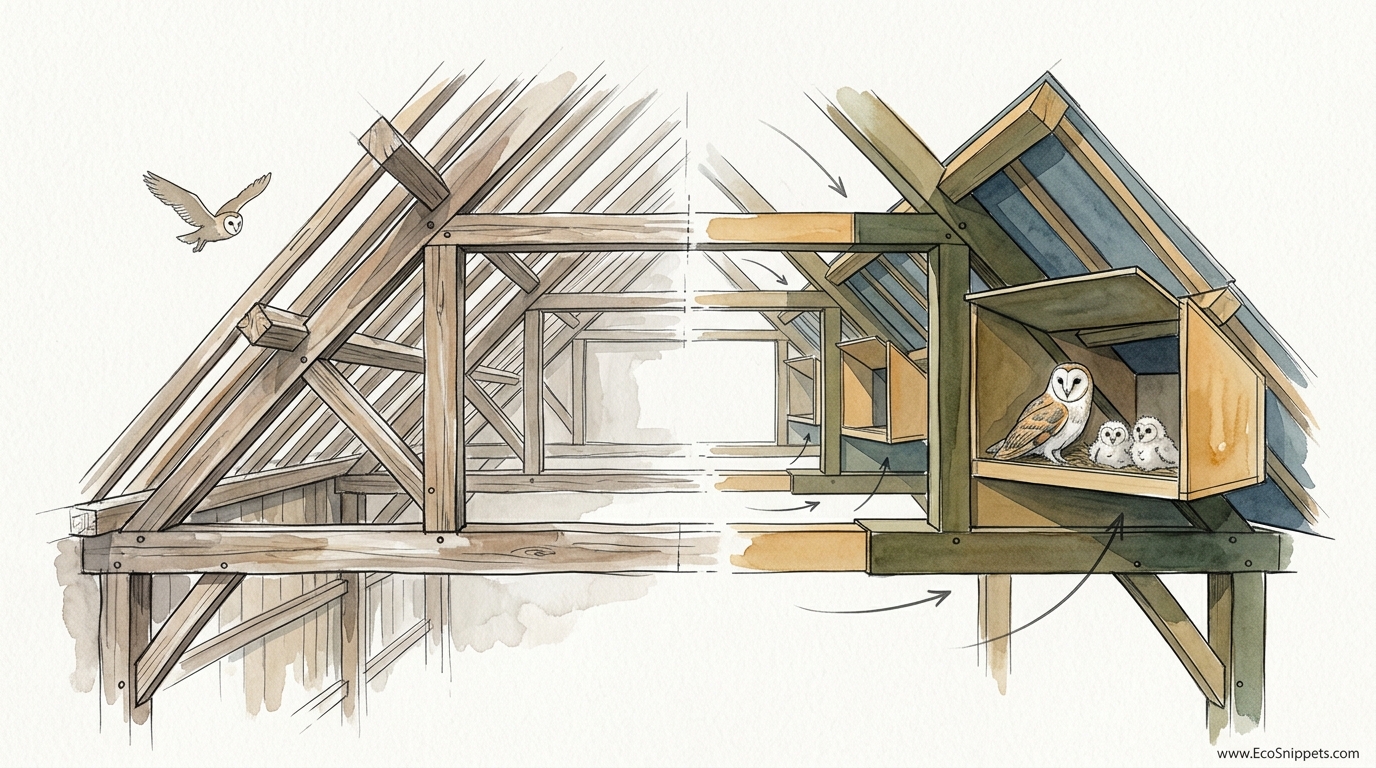
Exposed Barn Rafter vs Baffled Nest Sanctuary
Understanding why a box is superior to a simple rafter requires a look at the trade-offs. While owls have used barn rafters for centuries, modern agricultural buildings are often made of metal or lack the deep, protected nooks of old timber-frame barns.
| Feature | Exposed Barn Rafter | Baffled Nest Sanctuary |
|---|---|---|
| Predator Protection | Low; accessible to owls and raccoons. | High; internal wall blocks reach. |
| Light Levels | Variable; often too bright during day. | Total Darkness; mimics deep hollows. |
| Temperature Control | Poor; subject to drafts and roof heat. | Good; thick wood provides insulation. |
| Maintenance | Difficult; debris falls onto barn floor. | Organized; all debris kept in removable box. |
| Success Rate | Moderate; eggs may roll off rafters. | High; contained area prevents egg loss. |
The comparison shows that while the rafters provide a temporary roost, the baffled sanctuary is a specialized tool for reproduction. Serious practitioners always opt for the box to ensure the survival of the next generation.
Field Tactics: Best Practices for Placement
Height is your first consideration. Mount the box at least 12 to 20 feet (3.5 to 6 meters) above the ground. This height provides the owls with a sense of security and a clear “launching” point for their flight. If you are mounting on a pole, use a 4×4 or 6×6 pressure-treated post set at least 4 feet (1.2 meters) deep in concrete to ensure it doesn’t sway in the wind.
The orientation of the entrance hole should be away from the prevailing winds. In many regions, a North or East-facing entrance is ideal because it prevents the hot afternoon sun from shining directly into the hole and overheating the interior. If your area is prone to heavy storms from the West, ensure the box is shielded by a building or tree line.
Provide a “clearance zone” in front of the box. Barn owls need a straight flight path to enter the hole at high speed. Avoid placing the box where branches or wires are within 10 to 15 feet (3 to 4.5 meters) of the entrance. However, having a large “roosting tree” within 100 yards (91 meters) is beneficial, as it gives the parents a place to sit and watch the nest from a distance.
Bedding is a debated topic, but a layer of wood shavings (not cedar) or hardwood mulch can help. Some practitioners argue that owls don’t need it, but a 1-inch (2.5 cm) layer prevents eggs from rolling on a smooth plywood floor before the owls have had time to create their own pellet carpet. Avoid straw or hay, as these can harbor mold and moisture.
The Next Level: Advanced Nesting Features
Once you have mastered the basic box, you can look into enhancements that improve survival rates. Heat shields are a major addition for those in desert or high-heat climates. A heat shield is simply a secondary roof and side panel mounted with a 1-inch (2.5 cm) air gap. This allows air to circulate between the shield and the box, significantly lowering the internal temperature during 100-degree (38 Celsius) days.
Exercise platforms or “landing ledges” are also highly effective. These are small porches mounted just below the entrance hole. They give fledglings a safe place to stand and stretch their wings before their first flight. It also provides the parents with a “hand-off” point where they can drop food without fully entering the box.
Installing a nest camera is the ultimate way to monitor your progress. Low-light infrared cameras allow you to watch the nesting process without disturbing the birds. This data is invaluable for knowing exactly when the eggs hatch and how many rodents are being brought in each night. Seeing the “ghost birds” in their private moments is a powerful way to justify the labor of building the box.
Consider the “multi-box strategy.” Research suggests that for every 20 acres (8 hectares), you should have at least one or two boxes. Having multiple sites allows for the natural fluctuation of owl populations and ensures that if one box is taken over by honeybees or squirrels, the owls still have a backup sanctuary nearby.
Case Studies: Success in the Vineyard and Orchard
Consider a 40-acre (16-hectare) vineyard in Northern California that struggled with pocket gopher mounds disrupting the root systems of young vines. After installing a network of five baffled nest boxes, the vineyard owner saw occupancy within the first 14 months. By the second year, three of the boxes were active. The resulting count of owl pellets indicated that over 4,500 gophers had been removed from the property—at zero cost beyond the initial box construction.
In a different scenario, a small family orchard in a more suburban area used a single box mounted on a high pole. While they didn’t have 40 acres, they were surrounded by a public park and a golf course. The resident pair of owls used the orchard as their home base but hunted the surrounding open grass. The orchard owners reported a total disappearance of the rat problem in their potting sheds and tool barns within one season of the owls moving in.
These examples show that whether you are a large-scale producer or a dedicated homesteader, the principles of attraction remain the same. Provide the dark sanctuary, protect the flight path, and respect the bird’s need for a poison-free landscape. The results are not just theoretical; they are a measurable, observable shift in the balance of your local ecosystem.
Closing Thoughts
Building a home for barn owls is an act of partnership with the natural world. It moves us away from the “war” on pests and toward a “management” of the landscape. By providing the right room, you are tapping into a biological force that has been perfected over millions of years. The silent wing and the sharp talon are far more effective tools than any plastic trap or chemical bait.
Success in this endeavor requires patience and attention to detail. Every inch of that internal baffle and every foot of height on the mounting pole contributes to the safety of the brood. When you see those first pale feathers at the entrance of your box, you will know that you have successfully bridged the gap between modern land management and ancestral wisdom.
Encourage your neighbors to join in this effort. A network of owl boxes creates a corridor of safety that can transform an entire community’s approach to pest control. Start with one well-built box, follow the blueprint of the sanctuary, and let the owls do what they do best. The silence of your fields at night will be the surest sign that your new partners are hard at work.
