How To Become More Self-Sufficient Without Starting a Full-Blown Farm…
Want to start preserving your harvest, making your own soap, or building a backyard root cellar — but not sure where to begin? “Homesteading Advice” gives you instant lifetime access to 35+ practical homesteading books on food preservation, veggie gardening, DIY natural cleaning products (save over $250 per year with this skill alone), brewing, off-grid energy, and a whole lot more…
Click Here To Check It Out Now!
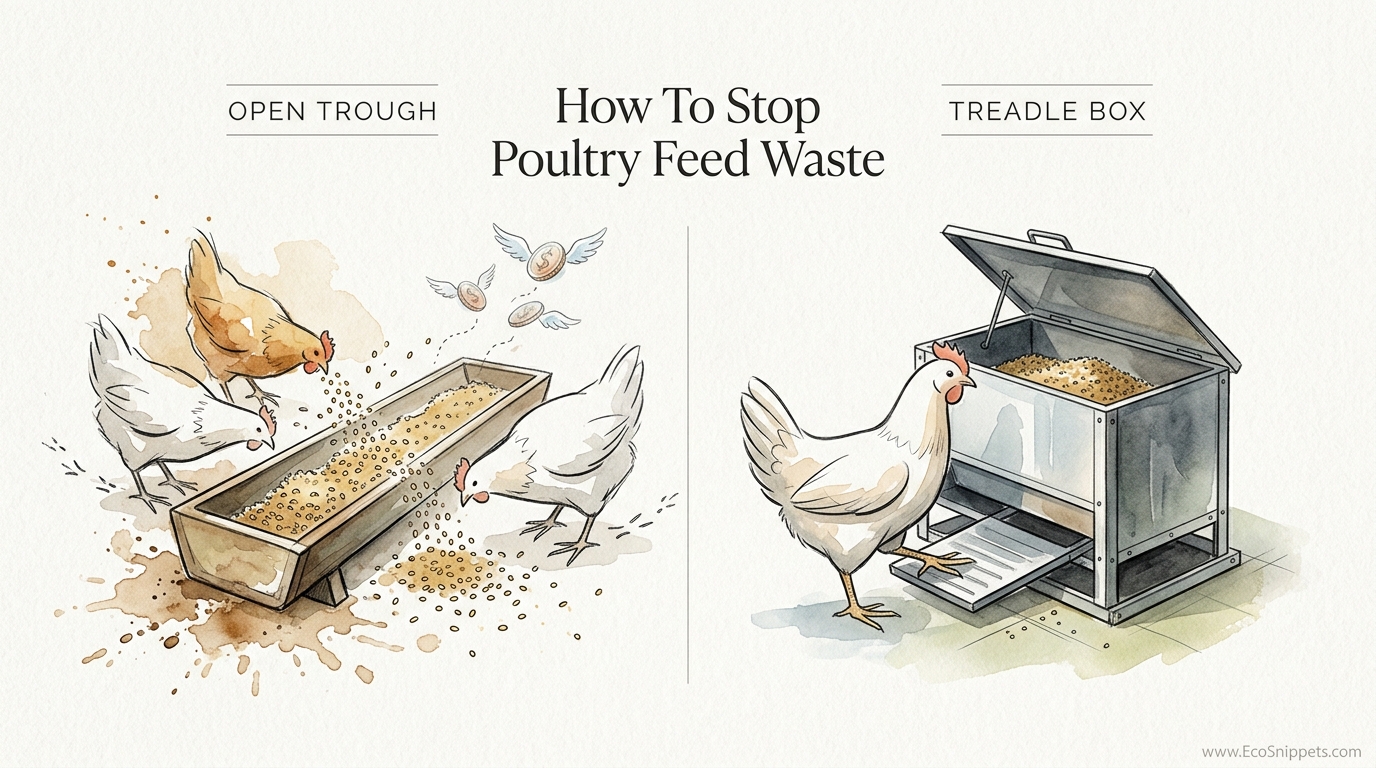
Are you feeding your chickens, or are you running a high-end buffet for the local rodent population? Static feeders are a magnet for pests and moisture. If the food is always sitting out, you’re losing 30% of your budget to the floor and the rats. A dynamic treadle feeder stays locked until a bird’s weight opens it, keeping your ‘gold’ dry, safe, and exclusive to your flock.
Every ounce of grain you bring onto your homestead represents hard-earned capital and energy. When that grain ends up trampled into the bedding or devoured by a midnight visitor, your self-reliance takes a hit. Managing a flock with wisdom means ensuring that every calorie you provide is converted into eggs or meat, not wasted in the dirt.
Modern poultry keeping often relies on convenience, but convenience frequently leads to waste. By returning to more deliberate, mechanical solutions like the treadle box, you reclaim control over your resources. This guide will walk you through the mechanics of feed preservation and the practical steps to ensure your birds are the only ones at the table.
Understanding the behavior of your birds and the biology of the pests you face is the first step toward a more efficient coop. Whether you are managing a handful of backyard hens or a larger heritage flock, these principles of waste reduction remain the same. Let’s look at how to secure your feed store and stop the drain on your homestead’s economy.
How To Stop Poultry Feed Waste
Stopping poultry feed waste is the practice of implementing physical barriers, behavioral training, and environmental controls to ensure chickens consume 100% of the feed provided. It is not just about the container; it is about managing the interaction between the bird, the feed, and the surrounding ecosystem. In the world of animal husbandry, “billing out” is the term used when birds use their beaks to flick feed onto the ground in search of specific morsels, a habit that can deplete a sack of grain faster than the birds can actually eat it.
In a real-world scenario, a standard open trough or gravity feeder allows wild birds, squirrels, and rats unrestricted access to the flock’s food. Beyond the direct loss of grain, these pests introduce diseases and parasites that can compromise the health of your birds. By securing the feed, you are not just saving money; you are creating a biosecurity barrier that protects your investment.
Think of your chicken feed as a stored form of sunshine and labor. If you left a stack of dollar bills in the middle of the yard, you wouldn’t expect them to stay there. Open feed is no different. Strategic waste reduction involves using equipment that responds to the bird’s presence and prevents the natural “scratching” instinct from moving the feed from the hopper to the floor. When feed is kept in a restricted, weight-activated space, the bird learns to eat efficiently rather than sorting through the pile.
This approach is used globally by smallholders who recognize that feed costs often account for 70% or more of the total expense of raising poultry. By cutting waste, you effectively increase your profit margin or reduce your cost of living without needing to buy cheaper, lower-quality grain. It is an exercise in efficiency that honors the animal and the resource.
How a Treadle Feeder Works
The core of a waste-proof system is the treadle feeder, a mechanical device that utilizes the weight of the chicken to grant access to the grain. It consists of a hopper—usually made of galvanized steel or heavy-duty aluminum—and a step plate (the treadle). When a bird of sufficient weight steps onto the plate, a linkage system lifts the lid or moves a shroud to reveal the feed tray. When the bird steps off, the lid drops back into place by gravity or spring tension.
The mechanics are simple but effective. Most quality feeders are adjustable, allowing you to set the tension so that a lightweight pest, like a sparrow or a small rat, cannot trigger the opening mechanism. Usually, the threshold is set at around 500 grams to 1 kilogram (approx. 1 to 2.2 pounds), which is well within the weight range of a standard laying hen but far above that of common grain thieves.
To implement this successfully, you must follow a specific training protocol. Chickens are creatures of habit and can be wary of moving parts. Start by propping the lid open with a block of wood or a specialized training bolt for several days. This allows the birds to identify the box as the source of food. Once they are comfortable eating from the open box, lower the lid halfway or engage the treadle so it moves only slightly. Eventually, the birds learn that their weight is the key to the “vault.”
Beyond the mechanical treadle, stopping waste involves the physical height of the feeder. If you are using a standard hanging feeder, it should be level with the birds’ “back” height. This prevents them from being able to easily swing their beaks through the feed. If the feeder is too low, they will treat it like the ground and scratch at it. If it is too high, they may knock it around trying to reach the grain, causing spills.
Step-by-Step Transition to a Secure Feeder
- Assessment: Observe your flock for 15 minutes. Note if they are flicking feed sideways or if wild birds are landing in the coop.
- Installation: Place the new feeder on a level, dry surface. A concrete paver is ideal to prevent the treadle from getting stuck in the mud or bedding.
- The “Open” Phase: Secure the lid in the fully open position. Remove all other food sources so the birds are motivated to explore the new box.
- The “Partial” Phase: After 3-5 days, move the lid to a position where it moves when stepped on but doesn’t close fully. This teaches them that movement is normal.
- The “Closed” Phase: Fully engage the mechanism. Monitor the birds to ensure the most timid members of the flock are getting enough to eat.
The Benefits of Securing Your Feed
The primary advantage of a closed-loop feeding system is the immediate reduction in overhead. Most homesteaders report a 20% to 40% reduction in feed consumption after switching from an open trough to a treadle feeder. This isn’t because the birds are eating less; it’s because the “invisible” consumers—the rodents and the wind—are no longer taking their share. Over a year, this can save hundreds of dollars/euros even for a small flock.
Another significant benefit is moisture protection. Feed that gets wet becomes a breeding ground for mold and Aspergillus, which can lead to respiratory issues or sudden death in poultry. A treadle feeder acts as a rain-proof bunker. Even in driving rain or heavy snow, the grain remains dry behind metal walls. This allows you to keep the feeder outdoors if necessary, freeing up space inside the coop and keeping the interior cleaner.
Furthermore, pest control becomes significantly easier. Rats are not just thieves; they are carriers of Leptospirosis and Salmonella. By removing the “free lunch,” you break the reproductive cycle of rodents on your property. If they can’t access the calorie-dense chicken feed, they will often move on to easier targets elsewhere. This creates a healthier environment for your family and your livestock.
Finally, there is the benefit of time. A high-capacity treadle feeder can hold 10 to 20 kilograms (22 to 44 pounds) of feed at once. Because the feed is protected from the elements and pests, you can fill it once a week rather than every morning. This “set and forget” reliability is essential for the modern homesteader who may have off-farm obligations or a busy daily schedule.
Common Challenges and Pitfalls
The most frequent mistake people make is rushing the training process. If you switch from an open bowl to a fully closed treadle feeder overnight, your birds may go hungry. Chickens are “neophobic,” meaning they have a natural fear of new things. If the lid slams shut with a loud metallic “clack” the first time a hen steps on it, she may be traumatized and refuse to go near it again. Patience is the key to success.
Another challenge is the “bully bird” syndrome. In some flocks, a dominant hen will stand on the treadle to eat and then chase away any other bird that tries to approach. This can lead to the lower-ranking birds losing weight. To avoid this, it is often better to have two medium-sized feeders placed apart rather than one giant feeder, ensuring that even the “omega” hens have a place to eat in peace.
Mechanical failure is also a possibility if the feeder is not maintained. Dust from the feed, feathers, and bedding can accumulate in the hinges or under the treadle plate. If debris builds up under the plate, it may not sink low enough to open the lid. Conversely, if the hinges rust, the lid may stay open, defeating the purpose of the device. A quick weekly check to clear out debris and an occasional drop of food-grade oil on the pivot points will prevent these issues.
Lastly, some people choose feeders that are too light. A cheap plastic treadle feeder can be easily tipped over by a large breed like a Brahma or a Jersey Giant. Ensure the feeder is heavy enough to remain stationary or bolt it down to a heavy wooden base or concrete slab. Stability is essential for the bird’s confidence.
Limitations and Environmental Constraints
While treadle feeders are superior in many ways, they are not a universal solution for every situation. For example, they are generally not suitable for very small chicks or lightweight bantams. A chick weighing only 100 grams (3.5 ounces) will not have the mass required to trigger the mechanism. You must wait until the birds are at least 8 to 10 weeks old, or until they have reached the minimum weight threshold of your specific feeder model.
In extremely cold climates where ice storms are common, the moving parts of a treadle feeder can freeze shut. If moisture gets into the hinges and then freezes, the birds will be locked out of their food. In these conditions, the feeder should be kept inside the coop or under a deep overhang where it is protected from freezing rain. If you live in a region with harsh winters, you must check the mechanism daily to ensure it still moves freely.
There is also the factor of flock size. If you have fifty or sixty birds, a single treadle feeder will cause significant stress and competition. The throughput of a treadle feeder is limited because usually only one or two birds can eat at a time. For larger operations, the cost of purchasing multiple high-quality metal feeders can be a significant initial investment, though the feed savings usually pay for the units within the first six months.
Finally, the type of feed matters. Very “dusty” mash can sometimes clog the gravity-flow aspect of the hopper, especially in humid environments where the dust turns into a paste. These feeders perform best with pellets or crumbles, which flow easily down the internal slopes of the bin. If you insist on using a fine mash, you may need to shake the feeder occasionally to ensure the grain continues to drop into the tray.
Comparing Feeder Systems
To understand why a dynamic system is often the best choice, it helps to compare the common options available to the modern poultry keeper. The following table breaks down the differences between traditional methods and the treadle box approach.
| Feature | Open Trough / Bowl | Gravity Pipe (PVC) | Treadle Box |
|---|---|---|---|
| Pest Resistance | None – Full Access | Low – Rats can climb in | High – Only birds trigger it |
| Waste Protection | Very Low – High Billing | Moderate | Very High – Enclosed |
| Weather Proofing | None | Moderate | High – Metal lid |
| Initial Cost | $ – Very Cheap | $$ – Moderate | $$$ – High Investment |
| Longevity | Short (Plastic/Wood) | Medium (PVC) | Long (Galvanized Steel) |
Practical Tips for Feed Management
Beyond the hardware, your management habits play a huge role in stopping waste. One of the best practices is to only feed your birds what they need. While the treadle feeder allows for “ad-libitum” (free choice) feeding, it is still a good idea to monitor their consumption. A standard laying hen typically eats about 120 grams (1/4 pound) of feed per day. If you notice the hopper is emptying significantly faster than that, you may have a leak or a very clever pest.
Consider the placement of your feeder. It should be kept away from the water source. Chickens are messy drinkers, and if they drip water into the feed tray, the moisture will travel up into the hopper via capillary action. Keep the water at least 2 meters (6.5 feet) away from the feed. This also encourages the birds to move, which is better for their overall health.
Another tip is to fermented your feed occasionally. While you can’t put wet, fermented feed into a mechanical treadle feeder, offering it in a separate bowl once a day can improve the birds’ gut health and nutrient absorption. When birds are better at absorbing nutrients, they naturally feel more satiated and may actually waste less of their dry pellets. It is a holistic approach to nutrition that pays dividends in egg quality.
Keep the area around the feeder “clean-scraped.” Even with a treadle feeder, a few stray crumbs might fall out. If you allow a deep layer of bedding to build up around the feeder, those crumbs become hidden and attract mice. By keeping the area under the treadle plate swept or on a solid surface, you ensure that the chickens can see and pick up every dropped pellet.
Advanced Considerations for the Serious Practitioner
For those looking to optimize their system further, consider the “narrowness” of the feed trough. Advanced practitioners often modify their feeders with internal baffles. These are small strips of metal or wood placed across the feed tray that break it into smaller compartments. This makes it physically impossible for a hen to “sweep” her beak left and right. She can only peck downward, which is the most efficient and least wasteful way to eat.
You should also think about the “Return on Investment” (ROI) of your feed choices. Buying grain in bulk (by the ton or half-ton) significantly reduces the price per pound, but it increases the risk of spoilage. A secure, rodent-proof feeding system is a prerequisite for bulk buying. Without it, the money you save on the bulk purchase will be lost to the pests you are now attracting with a larger “storehouse.”
If you are breeding birds, pay attention to the “heritability” of feeding behavior. Some strains of chickens are naturally more aggressive and wasteful than others. By observing your birds at the treadle feeder, you can identify the individuals that are calm and efficient. Over several generations, selecting for these traits can result in a flock that is genetically predisposed to be less wasteful, saving you money through the power of selection.
Finally, consider the seasonal caloric needs of your birds. In the winter (or the cold months of your region), chickens need more carbohydrates to maintain body heat. In the summer, they may need more minerals and lower protein to avoid heat stress. While the treadle feeder stays the same, the “fuel” you put inside it should change. A serious practitioner adjusts the ration based on the environment to ensure the birds are never over-consuming one nutrient while searching for another.
Example: The “Hidden Cost” Scenario
Let’s look at the math of waste. Imagine you have a flock of 20 hens. Each hen eats approximately 0.25 lbs (113 grams) of feed per day. That is 5 lbs (2.26 kg) of feed per day for the flock, or 150 lbs (68 kg) per month.
If you are using an open feeder with a 30% waste rate (common due to billing out and wild birds), you are actually going through 195 lbs (88.5 kg) of feed to get that 150 lbs into the chickens. You are essentially throwing away 45 lbs (20.5 kg) of feed every month. At a price of $0.50 per pound, that is $22.50 per month literally disappearing into the dirt.
A high-quality metal treadle feeder might cost you $150. In this scenario, the feeder pays for itself in less than 7 months. After that point, the $22.50 stays in your pocket every single month. Over the 10-year lifespan of a galvanized steel feeder, you will have saved $2,700 in feed costs. This is the difference between a homestead that is a “money pit” and one that is a sustainable, productive asset.
This example doesn’t even account for the potential savings in vet bills from reduced rodent-borne illnesses or the time saved by not having to clean up spilled, rotting grain. When you look at the numbers, the “expensive” feeder is actually the cheapest thing you can buy for your coop.
Final Thoughts
Reducing feed waste is one of the most effective ways to move toward true self-reliance. It requires a shift in perspective—from seeing feed as a cheap commodity to seeing it as a valuable resource that must be guarded. By investing in the right tools, such as a treadle feeder, and practicing patient training, you create a system that works for you rather than against you.
The wisdom of the past tells us that “a penny saved is a penny earned,” and in the poultry yard, a grain saved is an egg earned. Taking the time to secure your coop from pests and weather is an act of stewardship that benefits the birds, the land, and your bank account. It is about closing the loops on your homestead and ensuring that nothing goes to waste.
As you move forward, continue to observe your flock and refine your methods. Every coop is different, and what works in a dry, arid climate may need adjustment in a humid, temperate one. Stay curious, stay diligent, and remember that the best feed is the feed that actually ends up in the chicken. Your journey toward a more efficient, secure homestead starts with that first step onto the treadle.
