How To Become More Self-Sufficient Without Starting a Full-Blown Farm…
Want to start preserving your harvest, making your own soap, or building a backyard root cellar — but not sure where to begin? “Homesteading Advice” gives you instant lifetime access to 35+ practical homesteading books on food preservation, veggie gardening, DIY natural cleaning products (save over $250 per year with this skill alone), brewing, off-grid energy, and a whole lot more…
Click Here To Check It Out Now!
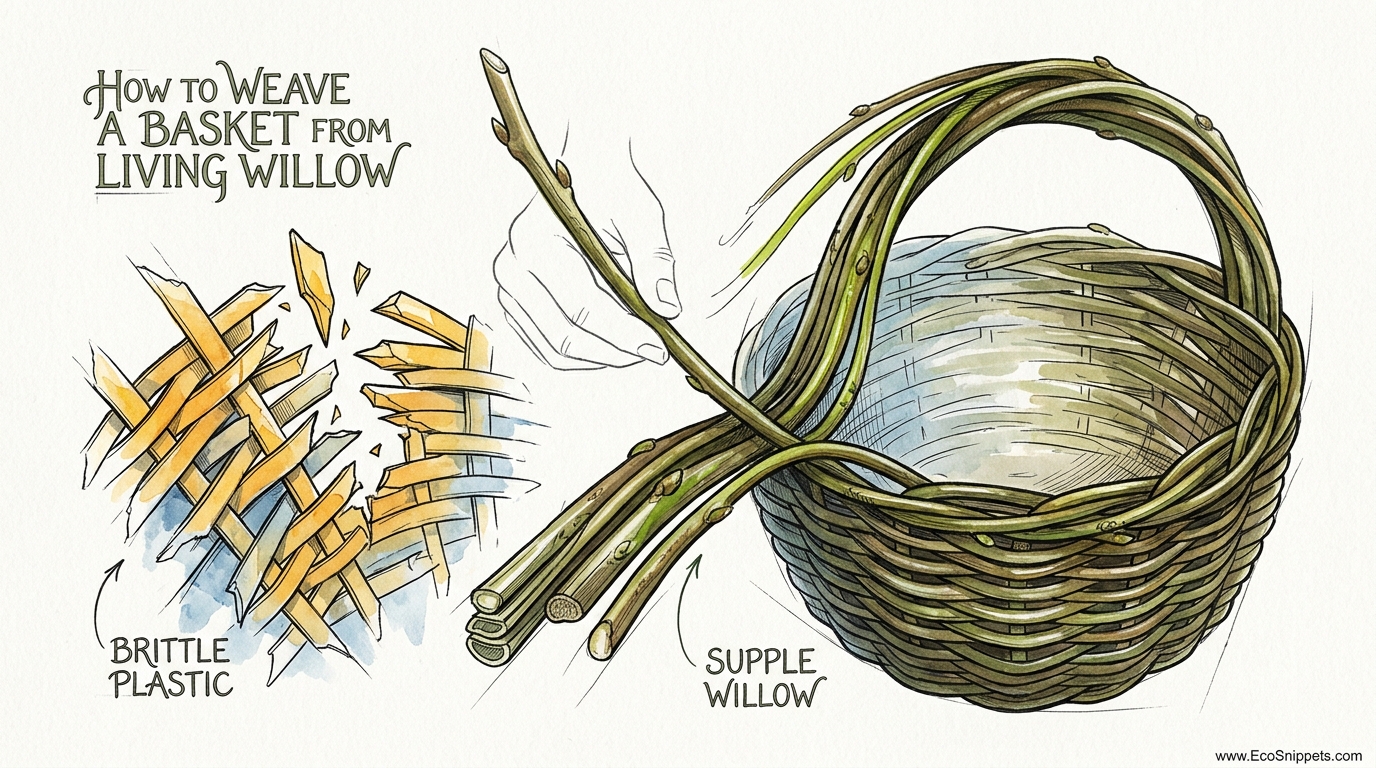
Plastic cracks under pressure, but living willow only gets stronger as it cures. Why are we carrying our organic produce in petroleum-based plastic that snaps after one winter? Willow is the ultimate homestead material—it’s flexible, renewable, and incredibly strong. When you weave your own basket, you aren’t just making a container; you’re participating in a 10,000-year-old biological partnership.
Working with willow is a lesson in patience and resilience. It requires you to look at the landscape not as a source of clutter, but as a harvest of potential. A willow rod is a living line of energy, ready to be coiled into something functional, beautiful, and entirely biodegradable.
This guide will walk you through the ancient craft of willow basketry. We will cover everything from selecting the right species in your local ecosystem to the rhythmic patterns that turn a bundle of sticks into a tool for the ages.
How To Weave A Basket From Living Willow
Willow basketry is a method of construction that uses the annual growth of Salix species to create sturdy vessels. On a homestead, these baskets serve as the primary movers of wood, vegetables, eggs, and laundry. Unlike modern containers, a willow basket is a “dynamic” structure—it flexes under load and tightens as the fibers age, making it uniquely suited for heavy agricultural work.
The craft exists because willow is one of the few woody plants that can be bent at a 90-degree angle without snapping, provided it is harvested and prepared correctly. This flexibility comes from the high concentration of salicin and long, straight-grained fibers. Historically, every village had a willow “plat” or “osier bed” where specific varieties were managed through a cycle of cutting and regrowth.
In a real-world setting, a well-woven willow basket can last for decades. If a handle breaks or the base wears thin, you simply weave in a new rod. This repairable nature stands in stark contrast to the disposable culture of brittle plastic. Whether you are foraging in a forest or carrying a harvest from your garden, a willow basket is a partner that grows more familiar with every use.
The Lifecycle of a Basket: From Stool to Harvest
The process begins long before you sit down to weave. It starts with the management of the willow plant itself. To get the long, unbranched “whips” or “rods” needed for basketry, you must practice the art of coppicing.
1. Harvesting in the Dormant Season
Harvesting must take place when the sap is down, typically between late autumn and early spring (Michaelmas to Candlemas in the Northern Hemisphere). This is the window after the leaves have fallen but before the buds begin to swell. Cutting during dormancy ensures the rods have the lowest moisture content and the highest structural integrity.
Use sharp secateurs or a billhook to cut the rods as close to the “stool” (the base of the plant) as possible. A clean, angled cut prevents water from pooling on the stump, which protects the plant from rot. A healthy willow stool can produce 20 to 40 usable rods per year and continue this cycle for over 30 years.
2. Sorting and Sizing
Once harvested, rods must be sorted by length and thickness. Professionals often use a “sorting barrel” or “sizing hole” to group rods into categories:
- Small (3–4 feet / 0.9–1.2 meters): Used for fine weaving and delicate borders.
- Medium (5–6 feet / 1.5–1.8 meters): The workhorse rods for siding and handles.
- Large (7+ feet / 2.1+ meters): Used for structural stakes or “living willow” garden furniture.
3. Drying and Rehydrating
Freshly cut willow is called “green” willow. While you can weave with it immediately, the basket will shrink significantly as it dries, leading to a loose, wobbly weave. For a professional result, the rods should be dried completely for several months until they are brittle.
To bring them back to life, you must soak them. The general rule for “brown” willow (dried with bark on) is one day of soaking per foot of rod length. A 4-foot rod needs 4 days submerged in a trough or pond. After soaking, the rods need to “mellow”—wrapped in a damp cloth for 24 hours—to allow the moisture to migrate into the core of the wood.
The Anatomy of a Stake-and-Strand Basket
The most common technique for homesteaders is the “stake-and-strand” method. This creates a round or oval basket with a solid base and vertical supports.
The Slath (The Foundation)
The base begins with the “slath.” This is a cross-shaped frame made of thick rods. You take six or eight thick pieces (about the diameter of a pencil) and split three of them down the middle with a bodkin or knife. The other three are threaded through these splits to form a cross.
To lock this frame, you use two long, thin “weavers.” These are twisted around the arms of the cross in a “pairing” weave—one goes over an arm while the other goes under. After two rounds, you spread the arms out like spokes on a wheel and continue weaving until the base reaches the desired diameter.
Staking Up and Upsetting
Once the base is finished, you insert the “side-stakes.” These are thick, straight rods sharpened at the butt end and pushed deep into the weave of the base next to each spoke.
The most dramatic moment in weaving is “upsetting.” You use a bodkin to kink the stakes upward at a 90-degree angle. These vertical rods are then tied together at the top to hold the shape of the basket while you weave the sides.
The Siding (Filling the Walls)
The walls of the basket are built using various weaving patterns.
- Randing: A single rod goes in front of one stake and behind the next. This is fast but less structural.
- Waling: Three or more rods are used simultaneously. Each rod goes over two stakes and behind one. This creates a thick, rope-like band that provides immense strength to the bottom and rim of the basket.
- French Rand: A more decorative and efficient technique where one rod is added for every stake, creating a beautiful diagonal texture.
Benefits of Willow over Brittle Plastic
The shift back to organic materials is not just about aesthetics; it is about performance and sustainability.
| Feature | Willow Basket | Plastic Container |
|---|---|---|
| Durability | Flexes under load; gets stronger as it ages. | Hardens and cracks over time, especially in UV light. |
| Breathability | Natural gaps allow airflow, preventing rot in produce. | Traps moisture; promotes mold and heat buildup. |
| Lifecycle | 100% biodegradable and compostable. | Ends up in a landfill or as microplastics. |
| Repair | Broken pieces can be woven out and replaced. | Non-repairable; usually discarded when damaged. |
Challenges and Common Mistakes
The learning curve of willow weaving is steep because you are working with a living, variable material.
1. Using “Green” Willow for Structural Work: The most common error is weaving a heavy-duty basket from fresh-cut willow. As the water evaporates (willow can be 50% water by weight), the rods shrink. A tight, beautiful basket made on Monday will be loose and “rattly” by the following month. Always dry and re-soak for structural items.
2. Kinking the Rods: Beginners often try to force a rod around a corner using only their fingers. This creates a “hinge” or a snap. Instead, use your thumb as a fulcrum and “roll” the rod around the stake. The pressure should be distributed, not concentrated.
3. Poor Tension: If you weave too loosely, the basket will lack structural integrity. If you weave too tightly, the stakes will pull inward, and your basket will look like a funnel rather than a cylinder. Consistent tension is a rhythm that only comes with practice.
Limitations: When Willow Isn’t Ideal
Despite its versatility, willow has constraints. It is not suitable for holding fine grains or liquids unless it is lined with fabric or sealed with pitch.
In extremely arid environments, willow can become overly brittle if not used regularly. It thrives on “work”—the movement of the fibers keeps them from becoming dusty and snapping. Furthermore, if left in standing water for weeks, even the best-woven basket will eventually rot. It is a biological material that requires air and a moderate amount of moisture to stay healthy.
Practical Tips for the Aspiring Weaver
- Keep a “Damp Box”: While weaving, keep your soaked rods wrapped in a damp towel or a piece of old carpet. If they dry out mid-weave, they will snap.
- The 90-Degree Rule: Before you start a project, take a random rod and bend it to 90 degrees around your thumb. If it cracks, it hasn’t soaked long enough or the variety is too brittle.
- Weight Your Base: When starting the sides, put a heavy stone or a “basket weight” inside the base. This keeps the basket from sliding around your workbench while you apply tension to the stakes.
- Mind the “Butt” and “Tip”: Every rod has a thick end (the butt) and a thin end (the tip). Alternate them as you add new rods to ensure your basket stays level. If you always start with the butts on one side, the basket will grow lopsided.
Advanced Considerations: Choosing Your Species
Experienced practitioners don’t just use “willow”; they select specific cultivars for specific results.
- Salix purpurea (Purple Willow): Known for its slender, bitter-tasting rods (which prevents livestock from eating them). It is excellent for fine, tight weaving.
- Salix viminalis (Common Osier): Produces very long, vigorous rods. It is the gold standard for large baskets and garden structures but can be a bit coarse for small work.
- Salix triandra (Black Maul): A favorite of commercial weavers for its suppleness and beautiful dark bark when steamed.
Consider the “tannin” content as well. If you are weaving a basket for laundry, you might prefer “white willow”—rods that have had the bark stripped off—so the tannins do not stain your linens.
Example Scenario: The Foraging Basket
Imagine you want to weave a simple 30 cm (12-inch) round basket for gathering mushrooms. You will need:
- 6 thick rods (1 cm diameter) for the slath.
- 24 stakes (approx. 5 mm diameter).
- Roughly 100 thin weaving rods (3 mm diameter).
You begin by tying the slath, then “staking up” with your 24 uprights. You use a 3-rod wale at the base to set the shape, then proceed with French randing for the sides. After reaching a height of 15 cm (6 inches), you finish with a “behind two, under one” border. The result is a tool that weighs less than a kilogram but can carry five kilograms of mushrooms without straining.
Final Thoughts
Living willow is a bridge to our ancestors. It is a material that requires no factory, no fossil fuels, and no complex machinery. By learning to weave, you are reclaiming a piece of human history that was nearly lost to the convenience of the plastic era.
The beauty of a willow basket is that it is never truly “finished” until it returns to the earth. It is a temporary vessel for a permanent skill. As you work the rods, you will find your own hands becoming more capable, your movements more rhythmic, and your connection to the land more profound.
Start small. Plant a few cuttings in a wet corner of your property. In a year or two, you will have your first harvest. In three years, you will have a basket. And in a decade, you will wonder how you ever settled for the soulless snap of plastic when you could have been carrying the strength of the willow.
