How To Become More Self-Sufficient Without Starting a Full-Blown Farm…
Want to start preserving your harvest, making your own soap, or building a backyard root cellar — but not sure where to begin? “Homesteading Advice” gives you instant lifetime access to 35+ practical homesteading books on food preservation, veggie gardening, DIY natural cleaning products (save over $250 per year with this skill alone), brewing, off-grid energy, and a whole lot more…
Click Here To Check It Out Now!
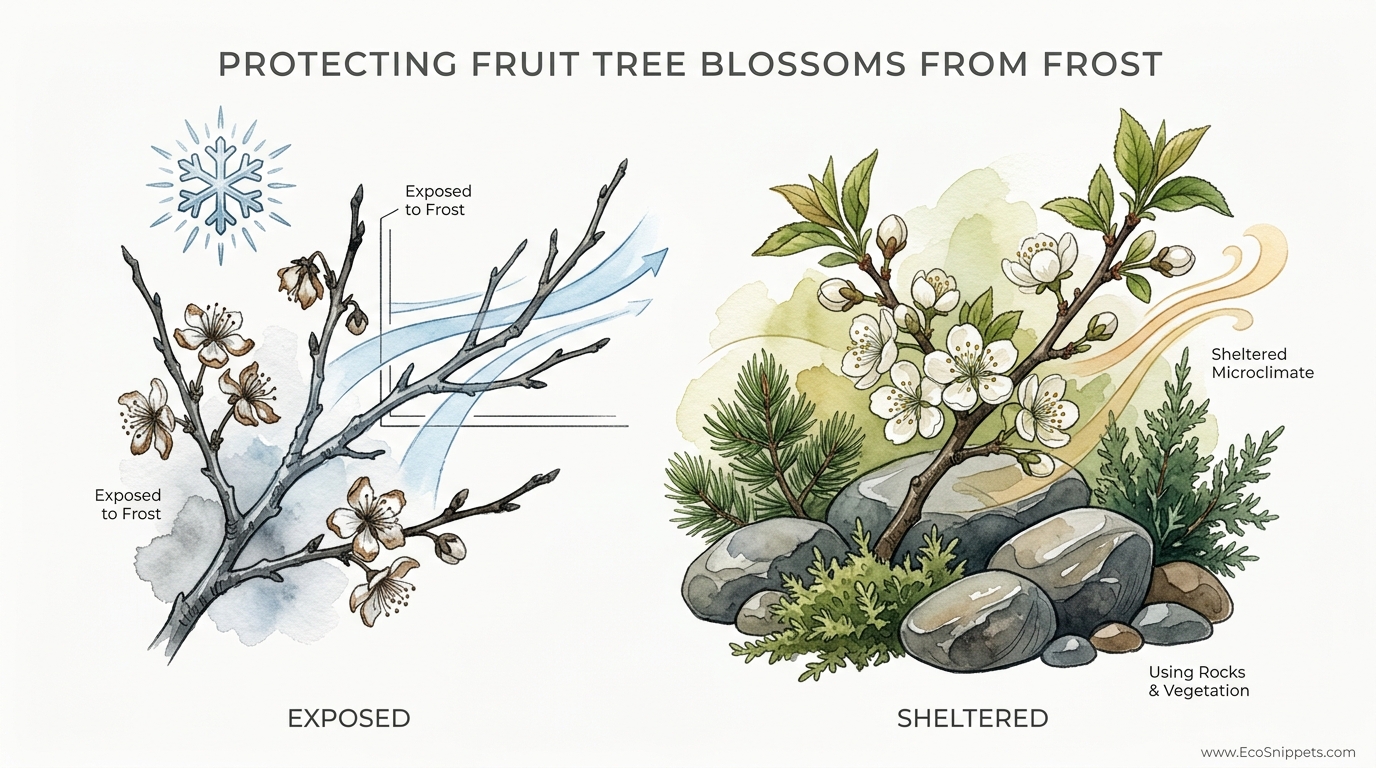
One late frost can steal a year of food – is your orchard wearing a shield? Planting a tree in the middle of a lawn is like putting a baby in a wind tunnel. Creating a ‘sheltered’ microclimate using thermal mass and windbreaks can keep your blossoms safe and your fruit sweet.
Every gardener knows the heartbreak of waking up to a white, shimmering lawn in late spring when the apple trees are in full bloom. That beautiful frost is often a silent thief, turning vibrant pink and white blossoms into brown, shriveled mush overnight. For those of us living on the land, this isn’t just a minor setback; it is the loss of a year’s worth of cider, preserves, and fresh eating.
Understanding how to guard these delicate flowers is one of the most critical skills a self-reliant grower can master. It requires more than just luck; it requires a deep understanding of thermodynamics, local geography, and the ancient wisdom of those who farmed before the era of climate-controlled grocery stores.
Protecting Fruit Tree Blossoms From Frost
Protecting fruit tree blossoms involves managing the environment around the tree to prevent the temperature of the delicate flower tissues from dropping below their lethal threshold. When a tree blooms, it transitions from a dormant state, where it can withstand sub-zero temperatures, into a vulnerable state of active growth. The water-filled cells of the blossom are highly susceptible to freezing. If the water inside the cells turns to ice, it expands, rupturing the cell walls and effectively killing the flower.
This protection is a necessity in temperate climates where spring weather is notoriously fickle. A sudden warm spell can trick a tree into blooming early, followed by a “polar vortex” or a clear, cold night that drops the mercury. We see this most often in “marginal” growing zones or in valleys where cold air settles like water in a bowl.
Real-world frost protection ranges from simple physical barriers to complex systems involving latent heat and air movement. Whether you are managing a single peach tree in a backyard or a multi-acre heirloom apple orchard, the principles remain the same: trap existing heat, add new heat, or move the air to prevent “frost pockets” from forming.
The Science of the Freeze: Radiation vs. Advection
Before you can effectively defend your orchard, you must know what kind of enemy you are facing. Frost events generally fall into two categories: radiation frosts and advection frosts.
Radiation frosts occur on clear, calm nights. As the sun sets, the earth begins to lose the heat it absorbed during the day. This heat radiates upward into the cold, clear sky. Because cold air is denser and heavier than warm air, it flows downhill and settles in the lowest points of the landscape. This creates a “temperature inversion,” where the air at the ground level is significantly colder than the air just thirty feet (9 meters) above it. If you can break this inversion or trap the ground’s heat, you can save your crop.
Advection frosts, often called “wind freezes,” are much more dangerous. These happen when a massive, cold air body moves into a region, usually accompanied by wind. In this scenario, there is no warm air nearby to pull from, and there is no inversion layer to exploit. The wind strips heat away from the trees through convection. Most traditional methods, like smudge pots or wind machines, struggle to combat advection frosts because the cold air is constantly being replaced by even colder air.
How to Create a Sheltered Microclimate
Creating a sheltered microclimate is the first line of defense and should be planned before the first tree ever hits the soil. A well-designed orchard uses the landscape and physical structures to create a “bubble” of warmth that can be several degrees higher than the surrounding fields.
Site Selection and Air Drainage
Cold air behaves like water; it flows downhill and pools in depressions. Planting an orchard in a valley floor is a recipe for disaster. Instead, aim for the mid-slope of a hill. This allows the heavy, cold air to “drain” past your trees and settle in the valley below.
If your land is flat, look for obstacles that might be trapping cold air. A solid fence or a dense hedge at the bottom of a slope can act like a dam, causing cold air to back up into your orchard. Removing a few boards from the bottom of a fence or thinning the lower branches of a hedge can allow that cold air to escape, significantly reducing frost risk.
Utilizing Thermal Mass
Thermal mass refers to materials that can absorb heat during the day and release it slowly at night. Water is the most effective form of thermal mass available to the home grower. Placing 55-gallon (200-liter) drums filled with water around the base of your trees can provide a significant buffer.
During the day, the sun warms the water. As temperatures drop at night, the water stays warmer than the air and radiates that heat directly toward the tree. For the best results, use dark-colored barrels to maximize heat absorption and place them on the south side of the tree (in the Northern Hemisphere) to catch the most sunlight.
Stone walls and brick structures also serve this purpose. In European “walled gardens” of the 19th century, fruit trees were often “espaliered” (trained flat) against south-facing brick walls. The bricks would soak up the sun all day and keep the trees cozy through the night.
The Role of Windbreaks
A windbreak is a physical barrier, usually made of trees or shrubs, that slows the wind and protects the orchard from the “wind tunnel” effect. While you want air to move slowly to prevent stagnation, you do not want high-velocity winter winds stripping heat from your blossoms.
A good windbreak should be semi-permeable. A solid wall creates turbulence on the leeward side, which can actually dump cold air back onto your trees. A staggered row of evergreens, such as Cedar or Spruce, filters the wind, slowing it down without stopping it entirely. This creates a calm zone on the protected side where heat can accumulate more effectively.
How to Protect Blossoms: Active Techniques
When a frost warning is issued and your trees are already in bloom, it is time to move from passive microclimate management to active protection.
The Magic of Irrigation and Latent Heat
One of the most effective, albeit counterintuitive, methods of frost protection is to spray your trees with water. As the water turns to ice on the branches, it releases a small amount of energy called “latent heat of fusion.” This process keeps the temperature of the plant tissue at exactly 32°F (0°C).
As long as you keep the water running and the ice stays wet, the blossoms inside will not drop below freezing. This method requires a constant application of water—about 0.1 to 0.15 inches (2.5 to 3.8 mm) per hour. You must start the sprinklers before the temperature hits the freezing mark and continue until the ice begins to melt naturally the next morning.
Stopping too early is a common mistake. If the water stops while the air is still below freezing, the ice will begin to evaporate. Evaporation is an endothermic process, meaning it strips heat away from the tree, which can cause the blossoms to freeze even faster than if they had been dry.
Covering and Insulation
For smaller trees, physical covers are highly effective. Using “frost blankets” or heavy burlap can trap the heat rising from the soil. The key is to drape the cover all the way to the ground and secure it. This creates a tent that captures the earth’s warmth.
Avoid using plastic directly against the blossoms. Plastic is a poor insulator and can conduct the cold directly to any tissue it touches. If you must use plastic for waterproofing, place a layer of fabric (like an old bedsheet) underneath it to provide an air gap.
Adding Heat: Smudge Pots and Heaters
Historically, orchardists used smudge pots—small oil-burning heaters—to create a blanket of smoke and heat. While the smoke was once thought to help, we now know it is the actual heat that makes the difference.
Small propane heaters or even “burn barrels” filled with hardwood can be placed throughout the orchard. It is better to have many small heat sources rather than one large fire. Placing these on the windward side of the orchard allows the heat to drift through the trees. Be mindful of local fire regulations and never leave open flames unattended.
Critical Temperatures for Fruit Tree Blossoms
Not every frost is a death sentence. The level of damage depends entirely on the stage of the blossom’s development. A tree in the “silver tip” stage can handle much colder temperatures than a tree in “full bloom.”
| Fruit Type | Bud Stage | 10% Kill Temp (°F / °C) | 90% Kill Temp (°F / °C) |
|---|---|---|---|
| Apple | Green Tip | 18°F / -8°C | 10°F / -12°C |
| Apple | Full Bloom | 28°F / -2°C | 25°F / -4°C |
| Peach | Pink Bud | 25°F / -4°C | 15°F / -9°C |
| Peach | Full Bloom | 27°F / -3°C | 24°F / -4.5°C |
| Cherry (Sweet) | White Bud | 27°F / -3°C | 19°F / -7°C |
| Cherry (Sweet) | Full Bloom | 28°F / -2°C | 25°F / -4°C |
| Apricot | Full Bloom | 27°F / -3°C | 24°F / -4.5°C |
As the table shows, once the blossoms are fully open, a drop of just a few degrees can mean the difference between a 10% loss and a total 90% wipeout. Monitoring the specific stage of your trees is vital for deciding when to deploy your protective measures.
Benefits of Proactive Frost Protection
Investing time in frost protection yields more than just a bowl of fruit in the autumn. It builds the long-term resilience of your homestead and ensures a reliable food supply regardless of erratic spring weather patterns.
Consistent yields are the primary advantage. A tree that loses its crop to frost every other year is a poor return on the labor of pruning and mulching. By protecting the blossoms, you ensure that the tree’s energy is successfully converted into calories for your family.
Healthier trees are another benefit. While a frost might only “kill the flowers,” severe freezes can also damage the cambium layer of young branches or cause “sunscald” on the trunk. The same microclimate strategies used for blossoms—like windbreaks and thermal mass—also protect the structural integrity of the tree during the harsh winter months.
Self-reliance is the ultimate goal. Learning to read the clouds, the wind, and the dew point allows you to work with nature rather than being a victim of it. There is a profound sense of satisfaction in sitting by a fire on a frosty night, knowing your orchard is tucked safely behind its “shield.”
Challenges and Common Mistakes
The biggest mistake many growers make is relying on a single method. Nature is complex, and a “one-size-fits-all” approach usually fails when the weather turns extreme.
The “Mulch Trap”
Many gardeners believe that a thick layer of mulch around the base of a tree will protect it from frost. In reality, during a radiation frost, mulch can be a disadvantage. Bare, moist soil is an excellent heat sink; it absorbs solar energy all day and radiates it back out at night. A thick layer of straw or wood chips acts as an insulator, preventing the soil’s heat from reaching the blossoms. During the bloom period, it is often better to keep the ground under the trees clear and well-watered.
The Plastic Touch
Draping plastic directly over a tree is a frequent error. Because plastic has almost no insulating value, it quickly reaches the ambient air temperature. If it touches a blossom, it will conduct the cold directly into the plant tissue, often causing more damage than if the tree had been left uncovered. Always use a framework of stakes or hoops to keep the covering away from the foliage.
The Early Shutdown
Shutting off the water or removing covers too early in the morning is a common pitfall. The coldest hour of the night is often just after sunrise. This is when the last of the earth’s heat has dissipated, and the sun hasn’t yet begun to warm the air. Wait until the sun is high and the air temperature is well above freezing before you deactivate your systems.
Limitations of Frost Protection
While we can do a lot to mitigate the cold, there are realistic boundaries to what is possible. No system is 100% foolproof, and acknowledging these limitations is part of being a seasoned practitioner.
Advection frosts (wind freezes) are the most significant limitation. When a 20-mph (32-km/h) wind is blowing air that is 20°F (-7°C), most home-scale methods will fail. The wind carries away any heat you add before it can warm the blossoms. In these cases, the only real protection is having chosen late-blooming varieties or hardier species to begin with.
The weight of ice is another concern when using irrigation. If a freeze lasts for several days, the accumulation of ice can become so heavy that it snaps major scaffold branches, potentially ruining the structure of the tree for years to come. This method is best suited for “flash” frosts that last only a single night.
Physical labor and cost are also factors. Moving 50-gallon barrels, setting up sprinklers, and staying up all night to monitor temperatures is exhausting. For larger orchards, the cost of propane or the water required for irrigation can become prohibitive.
Practical Tips for the Modern Orchardist
If you are looking to improve your orchard’s defenses this season, here are several actionable steps you can take immediately:
- Monitor the Dew Point: The dew point is a better indicator of frost risk than the simple air temperature. If the dew point is low (below freezing), the temperature will drop much more rapidly once the sun goes down.
- Keep Grass Short: Long grass acts like mulch, trapping heat in the ground. Mowing the orchard floor before the bloom period allows the soil to absorb more solar radiation.
- Hydrate Your Trees: Wet soil holds more heat than dry soil. If a frost is forecast, give your trees a deep watering in the afternoon. This moisture will help stabilize the ground temperature overnight.
- Use Incandescent Lights: Old-fashioned (non-LED) Christmas lights can provide just enough warmth to save a small tree. String them through the branches and cover the tree with a light sheet to trap the heat.
- Paint Your Barrels: If you use water barrels for thermal mass, paint them matte black. This increases their heat absorption by up to 40% compared to light-colored plastic.
Advanced Considerations: Going Beyond the Basics
For those who want to take their frost protection to the professional level, consider exploring “latent heat of condensation” and advanced site engineering.
Understanding the Inversion Layer
On calm, frosty nights, there is often a layer of air 30 to 50 feet (9 to 15 meters) up that is 5°F to 10°F (3°C to 6°C) warmer than the air at the ground. Commercial orchards use massive “wind machines” to pull this warm air down and mix it with the cold air at the tree level. While a home grower might not buy a $20,000 wind machine, you can achieve a similar effect on a small scale using a powerful pedestal fan or even a leaf blower directed upward during the coldest part of the night.
The Promise of Cellulose Nanocrystals (CNC)
New research in agricultural science is exploring the use of cellulose nanocrystals—essentially a sprayable “thermal jacket” for blossoms. These non-toxic, wood-derived sprays can improve a blossom’s cold tolerance by several degrees by creating a microscopic insulating layer. While still in the early stages of commercial availability, keep an eye out for “frost protection sprays” that utilize this technology.
Delayed Bloom Strategy
Instead of fighting the cold, some practitioners choose to delay the bloom itself. Applying a thick layer of mulch *only after the ground has frozen solid* in winter can keep the root zone cold longer in the spring. This can sometimes trick the tree into staying dormant for an extra week or two, potentially missing the window of the last late frost.
Example Scenario: Saving a High-Value Peach Tree
Imagine you have a prized ‘Reliance’ peach tree that is in full bloom. The forecast predicts a clear, still night with a low of 26°F (-3°C). Since the 90% kill temperature for a peach in full bloom is around 24°F (-4.5°C), you are in the danger zone.
A seasoned grower would take the following steps:
1. **Afternoon:** Saturate the soil around the base of the tree to increase its heat-holding capacity.
2. **Evening:** Place four 5-gallon (20-liter) buckets of hot water near the trunk.
3. **Sunset:** Set up a simple tripod of 2×4 boards over the tree and drape a heavy canvas tarp or several old wool blankets over the frame, ensuring the edges reach the ground and are weighted down with stones.
4. **Dawn:** Check the temperature inside the “tent.” If it is still dropping, you might carefully slide a small, low-wattage incandescent lamp under the cover, ensuring it doesn’t touch the fabric.
5. **Morning:** Once the sun is up and the air is 35°F (2°C), remove the covers to allow pollinators access to the blossoms.
By combining thermal mass, soil hydration, and physical insulation, you have successfully raised the temperature inside the canopy by 4°F to 6°F, moving the tree from the “90% kill” zone to safety.
Final Thoughts
Protecting fruit tree blossoms is a dance with the seasons. It requires us to pay attention to the subtle shifts in the wind and the clarity of the night sky. While a late frost is a formidable opponent, it is not an invincible one. By understanding the principles of thermal mass, air drainage, and latent heat, you can tip the scales in favor of your orchard.
Every tree you save is a testament to the value of ancestral wisdom and self-reliance. The tools we use—water barrels, burlap, and well-placed windbreaks—are simple, but the result is the miracle of a heavy harvest. Do not be discouraged by a single cold snap; instead, use it as a teacher to refine your methods and strengthen your “orchard shield.”
Experiment with different techniques on your own land. Each microclimate is unique, and what works on a windy hilltop may differ from what works in a sheltered suburban backyard. Stay curious, stay prepared, and your blossoms will reward you with a bounty that lasts long after the spring frost has been forgotten.
