How To Become More Self-Sufficient Without Starting a Full-Blown Farm…
Want to start preserving your harvest, making your own soap, or building a backyard root cellar — but not sure where to begin? “Homesteading Advice” gives you instant lifetime access to 35+ practical homesteading books on food preservation, veggie gardening, DIY natural cleaning products (save over $250 per year with this skill alone), brewing, off-grid energy, and a whole lot more…
Click Here To Check It Out Now!
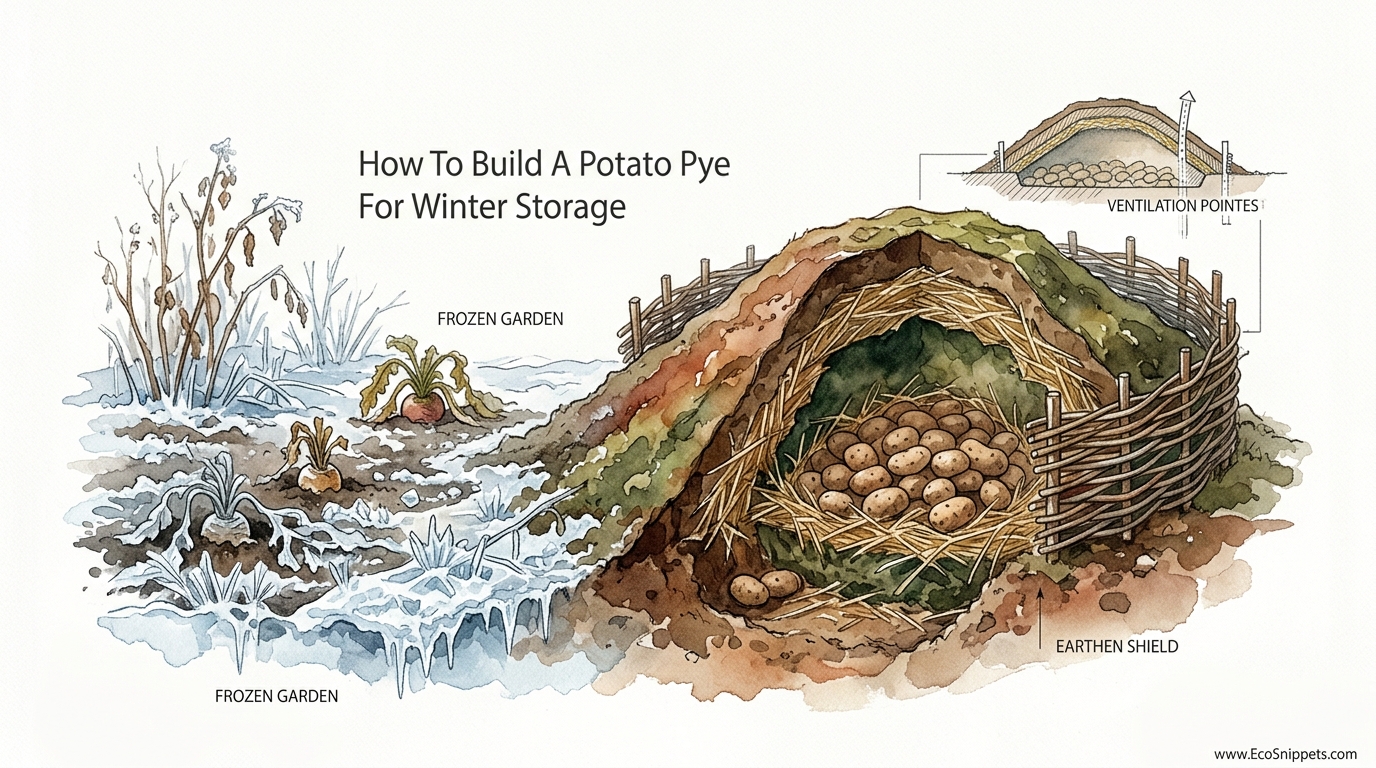
You don’t need a basement to keep your harvest from freezing – you just need the logic of the mound. If you have more potatoes than pantry space, look to the ‘Pye’ (or Root Clamp). This ancient British method uses a thick layer of straw and a cap of heavy earth to create a frost-proof, breathable bunker right in the middle of your garden. It protects your food from the elements and pests all winter long using only the materials under your feet.
Building a Pye is an exercise in working with the earth rather than against it. While modern refrigerators rely on electricity and mechanical parts, the Pye relies on the thermal mass of the soil and the insulating properties of dry stalks. It is a way to extend the life of your hard-earned harvest well into the spring, ensuring that not a single tuber goes to waste.
When you walk out to your garden in the dead of January, the ground may be frozen solid, but inside that mound, your potatoes remain in a state of perfect, chilly dormancy. It is a reliable, time-tested system that has fed families through world wars and lean winters for centuries.
How To Build A Potato Pye For Winter Storage
A Potato Pye, also known as a root clamp or a potato grave, is a traditional agricultural structure designed for the long-term outdoor storage of root crops. At its simplest, it is a carefully constructed pile of vegetables protected by thick layers of insulation. It exists as a low-cost, off-grid alternative to a root cellar, making it ideal for gardeners who lack indoor storage space.
The Pye works by utilizing the ground’s natural heat. Even when the air temperature drops below freezing, the earth a few inches down remains relatively stable. By stacking your potatoes on a bed of straw and covering them with a heavy earthen “pie crust,” you trap that ground heat and create a microclimate that hovers just above freezing.
In the real world, this method was the backbone of rural food security across Britain and Europe for hundreds of years. It allowed farmers to store thousands of pounds of potatoes right in the fields where they were grown, removing the need for massive, expensive barns. Today, it remains a vital skill for anyone pursuing self-reliance or looking to reduce their dependence on the power grid.
Visualize the Pye as a natural thermos. The potatoes are the contents, the straw is the vacuum seal that prevents heat transfer, and the soil is the protective outer casing. When built correctly, it is virtually impenetrable to frost, rain, and the prying teeth of hungry rodents.
The Anatomy of a High-Performance Root Clamp
Before you move a single shovelful of dirt, you must understand the principles of moisture and temperature control. A successful Pye must stay cool enough to prevent sprouting but warm enough to prevent freezing. It also needs to breathe. Potatoes are living organisms; they respire, releasing carbon dioxide and moisture. If that moisture cannot escape, the entire pile will turn into a fermented mess within weeks.
First, you must select the right site. Look for the highest, driest point in your garden. Avoid any area where water pools after a heavy rain. Standing water at the base of your Pye is the fastest way to lose your entire harvest. Ideally, the ground should be well-drained and sheltered from the most punishing winter winds.
The preparation of the potatoes is just as important as the structure itself. Never store potatoes immediately after digging. They need to be “cured.” Curing involves letting the potatoes sit in a cool, dry, dark place for 7 to 14 days. This allows the skins to thicken and any small nicks or scratches to heal over. This simple step can double the storage life of your crop.
Once cured, the potatoes must be sorted with brutal honesty. A single bruised or diseased tuber can act as a “rot bomb,” spreading decay throughout the entire mound. Only the most perfect, blemish-free potatoes should earn a spot in the Pye. Any that are damaged by the garden fork, chewed by slugs, or showing signs of blight should be used immediately or discarded.
Building the Pye Step-by-Step
Begin by marking out the footprint of your mound. A circular Pye is common for small harvests, while a long, “A-frame” rectangular shape is better for larger quantities. If you are building a circular clamp, a diameter of 1.5 meters (5 feet) is a manageable starting point.
The Foundation and Base
Dig a shallow depression about 10 to 15 centimeters (4 to 6 inches) deep. This isn’t strictly necessary if your soil is very well-drained, but it helps stabilize the base of the pile. Line this area with a 20-centimeter (8-inch) layer of clean, dry straw. Do not use hay, as it contains seeds and can attract more rodents. Straw or dry bracken (ferns) are the traditional choices.
Stacking the Harvest
Pile your potatoes onto the straw bed. Aim for a pyramid shape, keeping the base wide and the top narrow. The largest potatoes should go at the bottom to provide a stable foundation. Avoid making the pile taller than 1 meter (3.3 feet), as the weight of the potatoes at the bottom could lead to bruising or restricted airflow.
The Insulating Layer
Cover the entire pile with another thick layer of straw. This layer should be at least 15 to 20 centimeters (6 to 8 inches) thick. Ensure the straw is tucked in tightly at the base; this is where frost often tries to “creep” in. Think of this as the primary blanket for your potatoes.
The Earthen Cap
Dig a trench around the base of your mound, about 30 centimeters (1 foot) away from the straw. Use the soil you excavate to cover the straw layer. Start at the bottom and work your way up, patting the soil down firmly with the back of a spade. You want a smooth, angled surface that will shed rainwater like a roof. The soil layer should be at least 15 centimeters (6 inches) thick, though in very cold climates, you may need up to 30 centimeters (12 inches).
The Ventilation Chimney
This is the most critical feature. At the very peak of the mound, leave a handful of straw poking through the soil cap. This acts as a chimney, allowing the heat of respiration and excess moisture to escape. Without this vent, the humidity inside the Pye will skyrocket, leading to rapid rot. In very large clamps, some practitioners also insert a perforated pipe along the base to increase airflow.
Benefits of the Pye Method
Choosing a Pye over a modern refrigerator or even a basement pantry offers several distinct advantages. It is the ultimate low-tech solution for high-volume storage.
- Zero Energy Costs: The Pye requires no electricity, making it immune to power outages and perfect for off-grid living.
- Superior Humidity: Potatoes thrive in 90-95% humidity. While a refrigerator or a heated home is often too dry, the natural moisture in the soil keeps the tubers plump and prevents shriveling.
- Scaleability: You can build a Pye as small as a bucket or as long as a field. It adapts to the size of your harvest without the need for additional furniture or equipment.
- Space Management: By moving your storage outdoors, you free up valuable indoor space for other preserves or household needs.
- Natural Dormancy: The consistent, cool temperatures of the earth help keep the potatoes in deep dormancy, delaying sprouting longer than a typical basement might.
Challenges and Common Mistakes
While the logic of the Pye is sound, execution is where many beginners stumble. The most common cause of failure is moisture management. If the straw becomes saturated with water, it loses its insulating properties and turns into a cold, wet sponge that rots the potatoes. This is why a smooth earthen cap and a proper drainage trench are non-negotiable.
Another frequent error is storing “dirty” potatoes. While you should never wash potatoes before storage—as this introduces moisture into the pores—you should gently brush off any large clumps of wet soil. Wet soil stuck to a potato provides a perfect breeding ground for fungus once it is trapped inside the warm, humid environment of the mound.
Rodents are the final major hurdle. Rats and mice find the warmth and food of a Pye very attractive. To mitigate this, some gardeners line the base of their Pye with fine hardware cloth (metal mesh). Others rely on the “spade-finished” soil cap; a hard, smooth surface is much more difficult for small animals to penetrate than loose, fluffy dirt.
Limitations of Root Clamps
The Pye is not a universal solution. Its effectiveness depends heavily on your local climate and soil type. If you live in an area with a very high water table, or if your soil is heavy clay that stays waterlogged for months, an in-ground clamp is likely to fail. In these cases, building the Pye on top of a raised bed or a wooden pallet may be necessary.
Environmental extremes also play a role. In regions with exceptionally mild winters where the ground never freezes, a Pye might actually stay too warm, causing the potatoes to sprout prematurely. Conversely, in sub-arctic climates where the frost line reaches several feet deep, a standard 6-inch soil cap will not be enough to prevent the harvest from turning into “potato stones.”
Finally, there is the issue of accessibility. Once you “seal” the Pye for the winter, it is not as convenient as walking into a pantry. Every time you open the mound to take out a bag of potatoes, you break the thermal seal. This makes the Pye better suited for bulk storage—where you might open it only once or twice a winter—rather than as a daily-access larder.
Root Clamp vs. Root Cellar
Deciding between a Pye and a root cellar often comes down to cost and permanency.
| Factor | Potato Pye (Clamp) | Root Cellar |
|---|---|---|
| Initial Cost | Near Zero (Labor and Straw) | High (Construction materials) |
| Maintenance | Annual build/teardown | Minimal structural upkeep |
| Accessibility | Difficult (Requires digging) | Easy (Walk-in) |
| Capacity | Flexible, easily expanded | Fixed square footage |
| Pest Protection | Moderate (Depends on build) | High (Sealed structure) |
The Pye is the “Earth Shield” approach—it is temporary, tactical, and uses existing resources. The Root Cellar is a long-term investment. If you are on a temporary homestead or have an unexpected bumper crop, the Pye is the superior choice.
Practical Tips and Best Practices
If you want to maximize your success with a Potato Pye, consider these refinements.
- Use Maincrop Varieties: Early potatoes do not store well. Varieties like ‘Russet Burbank’, ‘Kennebec’, or ‘King Edward’ have thick skins and long dormancy periods specifically suited for winter clamping.
- Temperature Monitoring: If you are nervous about your first Pye, bury a remote thermometer probe (protected in a small plastic bag) in the center of the potato pile. This allows you to monitor the internal temperature from your house.
- The “February Check”: It was traditional for gardeners to open the Pye in late February or early March. This is when the weather begins to fluctuate. Removing any sprouts or “sleepy” potatoes at this stage can extend the remaining harvest by several weeks.
- Double Insulation: In particularly brutal winters, you can add an extra layer of “insurance” by throwing a tarp or a thick layer of loose leaves over the entire finished mound. Just ensure you don’t block the straw chimney at the top.
- Mark the Spot: A snow-covered garden can make it surprisingly difficult to find your mound. Plant a tall stake in the center of the Pye during construction so you know exactly where to dig when the snow is knee-deep.
Advanced Considerations for the Serious Practitioner
For those who have mastered the basic mound, there are ways to optimize the Pye for even greater efficiency. One advanced technique involves using a “Sand Core.” Instead of piling potatoes directly on straw, you layer them with slightly damp sand. The sand provides a secondary barrier against rot, as it wicks moisture away from individual tubers while maintaining the high humidity potatoes need.
Another consideration is gas exchange. Potatoes naturally produce ethylene gas, which can trigger sprouting. If you are storing other root crops like carrots or parsnips in the same Pye, be aware that the ethylene from the potatoes can cause carrots to become bitter. Professional practitioners often build separate, smaller clamps for different vegetable types to prevent cross-contamination of gases.
If you are dealing with very large volumes—into the thousands of pounds—the shape of the clamp becomes a matter of physics. A long, narrow ridge (resembling a tent) is much easier to ventilate than a massive circular mound. These ridges are typically built along a north-south axis to ensure even sun exposure on both sides of the earthen cap, preventing one side from freezing while the other side thaws.
Example Scenario: The Winter of 100 Bushels
Imagine a gardener in a temperate climate (Zone 5 or 6) who has harvested 200 kilograms (about 440 lbs) of ‘Yukon Gold’ and ‘Red Pontiac’ potatoes. Their small basement is already full of canned goods, and they don’t have a root cellar.
They select a spot on the south side of their garden, where the soil is sandy and drains well. They dig a shallow trench 2 meters long and 1 meter wide. They lay down 20 centimeters of dry wheat straw. They pile the potatoes into a ridge-shaped mound, about 80 centimeters high.
They cover the pile with another 20 centimeters of straw, ensuring it is packed tightly. They dig a drainage ditch around the perimeter and use that soil to build a 15-centimeter thick cap over the straw. They leave three “straw tufts” along the ridge line for ventilation.
When the first deep freeze hits in December, the outside of the mound is hard as stone. Inside, however, the temperature stays at a steady 4°C (39°F). By March, they open one end of the clamp and find the potatoes as firm and fresh as the day they were dug, with only minimal sprouting on the very top layer.
Final Thoughts
The Potato Pye is more than just a pile of dirt and straw. It is a connection to a lineage of self-reliance that stretches back centuries. It teaches us that nature provides the tools for preservation if we only know how to arrange them. By utilizing the simple logic of the mound, you can secure your food supply without a single cent spent on utilities.
It takes a bit of grit to head out into a freezing garden with a shovel, but there is a profound satisfaction in pulling fresh, cool potatoes out of the earth in the middle of winter. It is a reminder that the land is always working, even when it appears to be asleep under a blanket of frost.
Experiment with your first Pye this season. Start small, pay close attention to your drainage, and trust in the ancestral wisdom of the “earth shield.” Once you master the art of the clamp, you will never look at a surplus harvest as a burden again—it is simply a Pye waiting to be built.
