How To Become More Self-Sufficient Without Starting a Full-Blown Farm…
Want to start preserving your harvest, making your own soap, or building a backyard root cellar — but not sure where to begin? “Homesteading Advice” gives you instant lifetime access to 35+ practical homesteading books on food preservation, veggie gardening, DIY natural cleaning products (save over $250 per year with this skill alone), brewing, off-grid energy, and a whole lot more…
Click Here To Check It Out Now!
We traded 100 years of durability for 10 minutes of convenience, and now our clothes are just future landfill waste. Fast fashion is designed to fall apart in six months so you have to buy more. Our ancestors spent weeks at the loom because they knew that a single well-made cloak could protect three generations. It’s time to stop being a consumer of clothes and start being a producer of warmth.
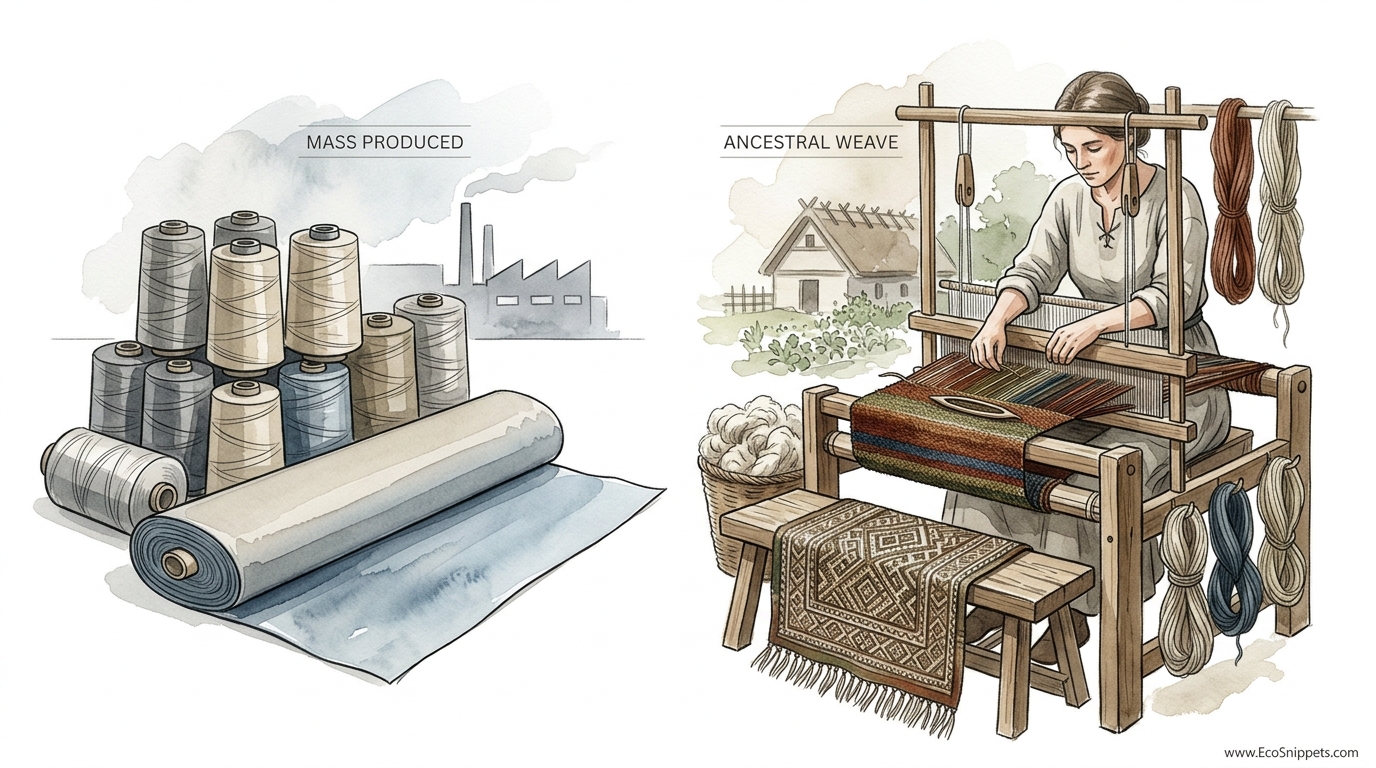
When you hold a piece of modern, mass-produced fabric, you are holding a product of high-speed industrial tension and synthetic shortcuts. In contrast, the ancestral weave is a slow, intentional process that respects the natural integrity of the fiber. For the modern homesteader, reclaiming this skill isn’t just about making clothes; it is about securing a fundamental pillar of self-reliance that most of the modern world has completely forgotten.
Ancestral Weaving Techniques For Homesteaders
Ancestral weaving is the process of interlacing two distinct sets of threads—the warp and the weft—to create a stable, durable fabric. On a homestead, this is rarely a standalone hobby. It is the final stage of a long cycle that begins with the soil or the sheep. Whether you are growing flax for linen or raising sheep for wool, weaving is how you transform that raw biological harvest into a functional tool for survival.
Historically, weaving techniques were adapted to the resources available in a specific region. In mountainous areas, weavers focused on heavy, fulled wools that could shed rain and block wind. In river valleys, the focus shifted to the laborious but rewarding process of turning flax into cool, crisp linen. These techniques were never about “fast” or “efficient” in the modern sense; they were about creating a textile that could withstand decades of hard labor, repeated washing, and the harsh elements of a life lived outdoors.
Today, homesteaders use these same principles to opt out of the disposable clothing cycle. By using manual looms, such as the rigid heddle loom or the traditional floor loom, you are applying lower mechanical tension to the fibers. This allows the yarn to retain its natural elasticity and strength, resulting in a cloth that actually grows softer and more resilient with every decade of use.
How It Works: From Raw Fiber to Finished Fabric
The journey to a handwoven garment is a multi-stage process that requires patience and a deep understanding of your materials. You cannot simply buy a bag of yarn and call yourself a producer of warmth. True self-reliance starts much further back in the production chain.
Stage 1: Preparing the Harvest
If you are working with wool, the process begins with skirting the fleece. After shearing, you must spread the raw wool out and remove the “tags”—the dirty, matted, or heavily soiled bits from the edges. Once skirted, the wool undergoes scouring, which is a gentle wash in hot water (about 60°C or 140°F) with a specialized soap to remove the lanolin grease without felting the fibers.
If you are growing flax, the path is even more labor-intensive. You must pull the flax by the roots to preserve the longest possible fibers. After drying, the stalks undergo retting—a controlled rot where moisture breaks down the pectins holding the fibers to the woody core. This is followed by breaking and scutching, where you literally beat the woody “shives” away from the flax fibers until only the long, golden “line flax” remains.
Stage 2: Spinning the Yarn
Before the loom can be dressed, the fiber must be spun. Using a drop spindle or a spinning wheel, you draw out the fibers and twist them together. The amount of twist you apply determines the strength and drape of the final fabric. For a heavy cloak, you might spin a thicker, high-twist yarn. For a summer shirt, you would aim for a fine, consistent thread. This is where the producer of warmth truly begins to customize their gear for the specific needs of their climate.
Stage 3: Dressing the Loom
Warping the loom is the most technical and often the most frustrating part of the process. You must measure out dozens or hundreds of parallel threads—the warp—and thread them through the loom’s internal components (the heddles and the reed). Every single thread must be under identical tension. If one thread is loose, your fabric will have a “smile” or a dip; if it is too tight, it may snap under the pressure of the shuttle.
Stage 4: The Weaving Process
Once the loom is dressed, the actual weaving begins. You open a “shed”—a tunnel between the warp threads—and pass the weft thread through using a shuttle. After each pass, you “beat” the weft into place. The rhythm of the loom is a meditative practice, but it is also a physical one. You are essentially building a structure, one thread at a time, ensuring that the selvedges (the edges of the cloth) remain straight and even.
Benefits of Ancestral Weaving
Choosing the ancestral path over the mass produced alternative offers more than just a sense of historical pride. The practical benefits are measurable in the longevity and performance of the clothing.
- Extreme Durability: Handwoven fabrics are often denser and more stable than industrial knits. Because the fibers haven’t been subjected to the high-heat, high-speed chemical treatments of modern factories, they retain their structural integrity for generations.
- Superior Thermal Regulation: Natural fibers like wool and linen “breathe” in a way that synthetics cannot. A handwoven wool tunic can keep you warm when wet and cool when you are working hard, thanks to the air pockets created by the manual weaving process.
- Ease of Repair: When you weave the cloth yourself, you possess the exact yarn and the knowledge required to mend it. A “darned” handwoven garment isn’t a ruined piece of clothing; it is a reinforced tool that continues to serve.
- Environmental Independence: By producing your own textiles, you eliminate the massive carbon footprint associated with global shipping and the toxic dyes used in the fast fashion industry. Your clothes can eventually return to the earth as compost, completing the circle of the homestead.
Challenges and Common Mistakes
The transition from a consumer to a producer is not without its pitfalls. Most beginners fail because they underestimate the amount of preparation required before the first thread is even thrown.
Inconsistent Tension: This is the most frequent error for new weavers. If your warp tension is uneven, the fabric will pucker or “hourglass” (narrowing in the middle). This usually happens because the weaver was in a hurry to get the loom “dressed” and didn’t take the time to wind the warp onto the back beam with proper spacers like cardboard or wood slats.
Over-Beating the Weft: It is tempting to hammer the weft thread into place to make the fabric “strong.” However, over-beating creates a stiff, cardboard-like cloth that is uncomfortable to wear. A balanced weave—where the warp and weft have equal space—is the goal for most garments.
Neglecting the Fiber Prep: You cannot weave high-quality cloth from poor-quality yarn. If your spinning is inconsistent or your wool wasn’t properly scoured, the loom will reveal every flaw. Ancestral weaving is a “garbage in, garbage out” system; you must respect every stage of the process.
Limitations: When This May Not Be Ideal
While ancestral weaving is the gold standard for self-reliance, it has realistic constraints that every homesteader must acknowledge.
First, the time investment is massive. It can take 40 to 60 hours of labor to produce enough fabric for a single pair of trousers when you include the fiber preparation and spinning. For a busy homesteader, this means weaving is often a winter activity, performed when the garden is dormant and the livestock require less intensive care.
Second, the space requirement is significant. A floor loom can take up as much space as a small dining table. While a rigid heddle loom is more portable, it limits the width and complexity of the fabric you can produce. You must balance your desire for production with the physical reality of your living space.
Finally, climate and resource access play a role. If you live in a tropical environment, raising wool-bearing sheep is impractical. Conversely, if you live in a short-growing season area, you may struggle to get a flax crop to mature for high-quality linen. You must weave what your land allows you to harvest.
Comparison: Mass Produced vs. Ancestral Weave
To understand the value of this skill, we must look at how modern manufacturing stacks up against the traditional loom.
| Feature | Mass Produced (Fast Fashion) | Ancestral Weave (Homespun) |
|---|---|---|
| Expected Lifespan | 6 to 12 months | 20 to 100 years |
| Production Tension | High-speed mechanical (weakens fiber) | Low-speed manual (preserves fiber) |
| Material Purity | Often synthetic blends (microplastics) | 100% natural (biodegradable) |
| Repairability | Disposable (difficult to mend) | Lifetime mending (simple to darn) |
| Cost Over Time | Expensive (constant replacement) | Economical (one-time effort) |
Practical Tips for the Aspiring Weaver
If you are ready to start being a producer of warmth, follow these best practices to ensure your first projects don’t end up in the scrap pile.
- Start with a Rigid Heddle Loom: These are affordable, portable, and much easier to learn than a 4-shaft floor loom. You can weave beautiful scarves, towels, and even fabric for simple tunics on a 60 cm (24 inch) rigid heddle loom.
- Use a “Temple” or Stretcher: To keep your selvedges from pulling in and narrowing your fabric, use a wooden temple. This tool clips to the edges of the cloth and holds it at a consistent width as you advance the warp.
- Sampling is Mandatory: Before committing to a large project, weave a 10 cm by 10 cm (4 inch by 4 inch) sample. Wash it exactly how you intend to wash the final garment. This will tell you the “shrinkage rate” and the final “hand” or feel of the fabric.
- Maintain Your Equipment: Wooden looms are living tools. If you live in a dry climate, the wood can shrink; in a humid one, it can swell. Use a light application of beeswax or furniture oil once a year to keep the components moving smoothly.
Advanced Considerations: Fulling and Dyeing
Once you master the basic plain weave, you can begin exploring the advanced techniques that define the ancestral weave.
Fulling (The Secret to Waterproof Wool): Historical wool cloaks were not just woven; they were fulled. This involves taking the finished cloth and agitating it in hot, soapy water. The wool fibers interlock and shrink, creating a dense, felt-like surface that is nearly windproof and sheds water. A well-fulled piece of wool fabric is what allowed our ancestors to survive sub-zero winters without modern Gore-Tex.
Natural Dyeing: A producer of warmth also understands the chemistry of the land. Using mordants like alum or iron, you can fix colors from local plants onto your yarn. Black walnut husks provide a rich, permanent brown; goldenrod offers a vibrant yellow; and madder root provides the classic “pioneer red.” Dyeing your yarn before weaving allows you to create intricate patterns like tartan or twill.
Example Scenario: The Three-Generation Cloak
Imagine you have a small flock of three sheep. In the spring, you shear them and harvest roughly 9 kg (20 lbs) of raw grease wool. After skirting and scouring, you are left with about 5 kg (11 lbs) of clean fiber. Over the summer evenings, you spin this into a medium-weight 2-ply yarn.
In the autumn, you dress a floor loom with a 150 cm (60 inch) wide warp. You weave 5 meters (roughly 5.5 yards) of a 2/2 twill pattern. Once off the loom, you “scour and full” the fabric in a large tub, shrinking it by 15% to increase its density. You sew this into a heavy, hooded cloak.
This cloak doesn’t just look “rustic.” Because of the twill structure and the fulling process, it is three times more durable than a store-bought wool coat. When it catches on a bramble while you are hauling wood, the weave doesn’t unravel; it holds. When you pass it down to your child twenty years from now, the fabric will be softer, more molded to the human form, and just as capable of blocking the winter wind as the day it was finished.
Final Thoughts
Reclaiming the art of weaving is a radical act of independence. It forces us to slow down and acknowledge the immense effort required to provide for our most basic needs. When you wear a garment you have produced from the ground up, you are no longer just a spectator in your own life. You are a participant in a lineage of craftsmanship that spans ten millennia.
Start small. Find a local fleece, buy a simple spindle, and feel the weight of the fiber in your hands. There is a profound satisfaction in knowing that your warmth is not dependent on a global supply chain, but on your own grit and the ancient wisdom of the loom. As you move from consumer to producer, you will find that the clothes you make are not just “fabrics”—they are the tangible evidence of your commitment to a self-reliant life.
Experiment with the fibers your region provides, and don’t be afraid of the inevitable mistakes. Every snapped warp thread is a lesson, and every finished yard of cloth is a victory. It’s time to weave your own story, one thread at a time.
