How To Become More Self-Sufficient Without Starting a Full-Blown Farm…
Want to start preserving your harvest, making your own soap, or building a backyard root cellar — but not sure where to begin? “Homesteading Advice” gives you instant lifetime access to 35+ practical homesteading books on food preservation, veggie gardening, DIY natural cleaning products (save over $250 per year with this skill alone), brewing, off-grid energy, and a whole lot more…
Click Here To Check It Out Now!
Stop weeding the gaps and start planting the ‘Living Umbrella’ that does the work for you. If you can see bare soil, you’re inviting weeds to dinner. Strategic hexagonal spacing mimics nature’s canopy, shading the ground to lock in moisture and starve out weeds before they even sprout. It’s the difference between a high-maintenance chore and a self-regulating system.
In a world where industrial agriculture has taught us to plant in straight, lonely rows, we have forgotten the efficiency of the wild. Our ancestors knew better. They observed the honeycomb, the way leaves overlap in a forest, and the strength of a cluster. This guide is about reclaiming that wisdom through bio-intensive techniques that turn a small patch of earth into a powerhouse of production.
By shifting your mindset from “rows” to “canopies,” you are not just growing food; you are building an ecosystem. Whether you have a single raised bed or a sprawling homestead, understanding the geometry of growth will change how you view every square inch of your soil.
Bio-Intensive Hexagonal Plant Spacing Guide
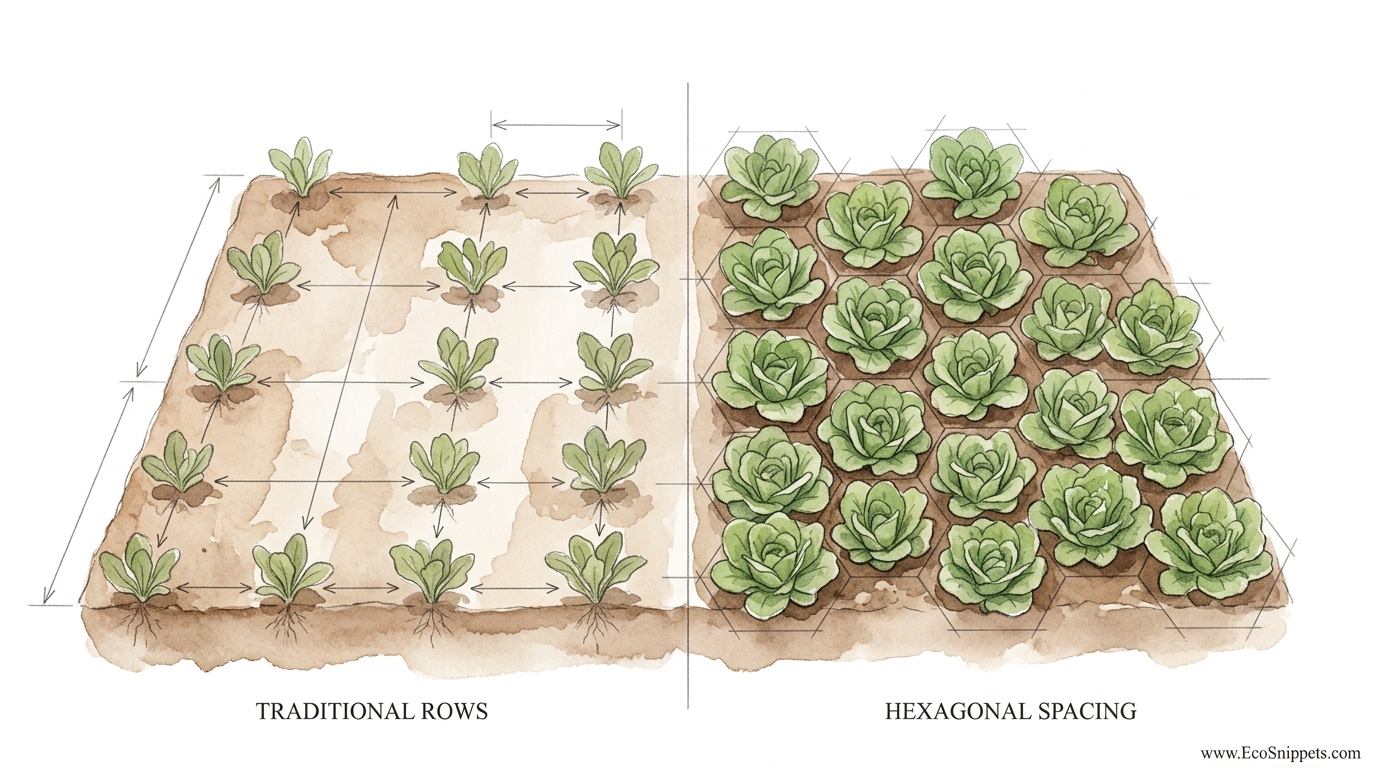
Bio-intensive hexagonal plant spacing, often called triangular spacing or offset planting, is a method where plants are placed in a staggered, equilateral triangle pattern rather than a square grid. In this system, every plant is the same distance from all of its neighbors. This arrangement is the most efficient way to pack circles (the root and leaf zones of plants) into a flat area.
This technique is a cornerstone of the GROW BIOINTENSIVE® method popularized by John Jeavons and the French Intensive gardening tradition of the 19th century. In those historic Parisian market gardens, farmers managed to feed millions using small, hand-tended plots by maximizing every possible inch of space.
The goal of hexagonal spacing is to create a “Living Umbrella.” As the plants mature, their leaves should barely touch, creating a micro-canopy over the soil. This canopy protects the delicate microbial life beneath the surface, maintains a consistent soil temperature, and prevents the sun from reaching weed seeds. It is a system built on the principle of cooperation rather than competition.
How to Implement Hexagonal Spacing Step-by-Step
Transitioning to a hexagonal layout requires a slight shift in how you measure your garden beds. Instead of looking at a bed as a series of rows, you view it as a continuous lattice.
1. Prepare the Soil
For intensive spacing to work, your soil must be exceptionally deep and rich. Bio-intensive practitioners often use “double-digging,” a process of loosening the soil to a depth of 24 inches (60 cm). This allows roots to grow vertically rather than spreading horizontally, which is what makes close spacing possible without the plants starving each other.
2. Determine Your Spacing
Find the recommended “in-row” spacing for your crop. For example, if a lettuce variety requires 10 inches (25 cm) of space, that will be the length of every side of your equilateral triangles.
3. Create Your Template
Many gardeners find it helpful to create a physical guide. You can cut a triangle out of scrap wood or heavy cardboard where each side equals your chosen spacing. For a more permanent solution, some gardeners build a “planting board” with holes drilled in a hexagonal pattern.
4. The Offset Planting Process
Start your first row at the corner of your bed, placing plants at your chosen interval (e.g., every 10 inches / 25 cm). For the second row, do not start directly across from the first plant. Instead, offset the row so the first plant sits in the “gap” between the first two plants of row one. If your spacing is 10 inches, this second row will be approximately 8.6 inches (22 cm) away from the first row to maintain the 10-inch distance between all individual plants.
5. Transplanting Over Direct Sowing
To ensure a perfect “Living Umbrella,” transplanting started seedlings is often superior to direct sowing. This allows you to choose the healthiest plants and ensures there are no “gaps” in the canopy caused by poor germination.
The Measurable Benefits of Hexagonal Spacing
The transition to hexagonal spacing offers practical, measurable advantages that go beyond simple aesthetics.
Increased Yield Density
Using a hexagonal pattern allows for approximately 10% to 15% more plants in the same area compared to a standard square grid. Because you are not wasting space on paths between every row, a standard 4-foot (1.2 m) wide bed can produce significantly more food than several narrow rows with walking paths between them.
Water Conservation
Research into bio-intensive methods has shown that these systems can use 67% to 88% less water than conventional agricultural methods. The “Living Umbrella” prevents the sun and wind from evaporating moisture directly from the soil surface. This creates a self-shading microclimate that keeps the root zone cool and hydrated.
Natural Weed Suppression
Weeds are opportunistic; they thrive on bare soil and sunlight. By timing your planting so that the leaves of your crops touch at maturity, you “starve” weeds of the light they need to germinate. This reduces the need for manual hoeing and prevents the soil disturbance that often brings new weed seeds to the surface.
Soil Health Preservation
The micro-canopy protects the soil from the “capping” effect of heavy rain and the baking effect of the sun. This keeps the soil loose and friable, preserving the habitat for earthworms and the trillions of microbes that convert organic matter into plant-available nutrients.
Common Pitfalls and Challenges
While the hexagonal method is highly efficient, it is not without its traps for the unwary.
The “Too Close” Trap
The most common mistake is crowding plants too tightly. If leaves overlap significantly rather than just touching, airflow is restricted. In humid climates, this can lead to fungal diseases like powdery mildew or botrytis. Always use the “center-to-center” measurement from the plant’s stem, and adjust for your local climate—wider spacing may be needed in very humid regions.
Inconsistent Spacing
If your triangles are “squashed” or irregular, the canopy will have holes. These holes become nurseries for weeds and areas of high evaporation. Using a template or a pre-marked measuring stick is essential until you develop an “eye” for the pattern.
Neglecting Soil Fertility
You cannot plant twice as many crops in a bed and expect them to thrive on the same amount of compost. Bio-intensive spacing is a high-output system that requires high-input soil care. If you don’t replenish the organic matter annually, your yields will quickly decline as the soil becomes exhausted.
Limitations of the Hexagonal Method
Hexagonal spacing is a tool for the hand-scale gardener, not the industrial farmer. It is important to know when this method may not be the best choice.
Mechanization Constraints
If you rely on large tillers or tractors for cultivation, hexagonal spacing is nearly impossible to manage. The offset nature of the plants means there are no straight “alleys” for wheels or blades to pass through without damaging the crop.
Large Vining Crops
Plants that have a massive, sprawling habit—such as indeterminate pumpkins or large winter squash—do not benefit as much from precise hexagonal spacing. These “ramblers” will find their own way to cover the soil, and trying to plot them into a 12-inch (30 cm) grid is a futile exercise.
Accessibility and Reach
Because hexagonal spacing is best used in “wide beds” (usually 3 to 5 feet / 0.9 to 1.5 m wide), you must be able to reach the center of the bed from the sides. If you have mobility issues or very wide beds, you may struggle to harvest or tend the plants in the middle without stepping on the soil and compacting it.
Traditional Rows vs. Hexagonal Spacing
Understanding the difference between these two systems helps you choose the right one for your specific needs.
| Feature | Traditional Row Spacing | Bio-Intensive Hexagonal |
|---|---|---|
| Plant Density | Lower; space wasted between rows. | 10–15% higher in the same area. |
| Weed Control | Requires frequent hoeing or mulching. | Self-weeding via “Living Umbrella.” |
| Water Use | High; bare soil loses water to air. | Low; soil is shaded and protected. |
| Labor Type | Suited for machinery/long-handled tools. | Best for hand tools and intensive care. |
| Skill Level | Beginner-friendly; simple layout. | Intermediate; requires precise layout. |
Practical Tips for Success
To get the most out of your hexagonal garden, consider these refinements used by experienced practitioners.
- Use a Multi-Sized Template: Keep a set of equilateral triangles in your garden shed. Common sizes include 4, 6, 8, 12, and 15 inches (10, 15, 20, 30, and 38 cm). Having these ready makes transplanting a breeze.
- Mark the Bed Borders: Use string lines to define the edges of your beds. This keeps your “hexagons” from drifting into the pathways and ensures your spacing remains consistent across the entire bed.
- Eyeball for Speed: Once you are comfortable, you can “eyeball” the staggering. Simply look at the previous row and place the new plant in the center of the “V” created by the two plants before it.
- Water at Ground Level: Because the canopy will be very dense, overhead watering can sometimes fail to reach the soil. Use a soaker hose or aim your wand at the base of the plants to ensure the water gets where it’s needed.
Advanced Considerations: Calorie and Carbon Farming
For those looking to move beyond simple vegetable production toward true self-reliance, the hexagonal method integrates perfectly with Calorie and Carbon Farming. John Jeavons suggests a “60/30/10” rule for sustainable homesteading.
60% Carbon Crops: These are high-biomass crops like corn, wheat, or sunflowers. Spaced hexagonally, they provide massive amounts of organic matter for your compost pile, which is essential for maintaining the high fertility required by intensive spacing.
30% Calorie Crops: These are calorie-dense root crops like potatoes or leeks. Hexagonal spacing is particularly effective for potatoes, as the dense canopy keeps the soil cool, which is vital for tuber development.
10% Vitamin Crops: These are your standard garden vegetables like peppers, tomatoes, and leafy greens. These are the “finishers” that provide the necessary minerals and vitamins to your diet.
Examples in Practice
Let’s look at a 100-square-foot (9.3 sq meter) bed of lettuce to see the difference.
In a traditional row system, you might plant lettuce in rows 12 inches (30 cm) apart, with 10 inches (25 cm) between plants in the row. In a 5-foot by 20-foot bed, you would have 5 rows with 24 plants each, totaling 120 plants. Much of the soil between those rows would be bare and prone to weeds.
In a hexagonal system, with the same 10-inch (25 cm) spacing between every plant in all directions, you would fit approximately 138 plants. Not only do you get 18 more heads of lettuce, but by week four, the soil is completely invisible under a carpet of green. You stop weeding three weeks earlier than the row gardener, and you water half as often.
Final Thoughts
The bio-intensive hexagonal method is more than just a planting pattern; it is a philosophy of stewardship. It recognizes that the soil is a living organism that thrives when protected and fails when exposed. By using the “Living Umbrella” approach, you are working with the natural tendencies of plants to seek community and shelter.
While the initial setup—the double-digging and the careful measuring—requires more effort than scratching a line in the dirt, the rewards are long-lasting. You will find yourself spending less time fighting nature and more time observing its abundance.
Experiment with one bed this season. Watch how the micro-climate develops and how the soil remains moist even on the hottest afternoons. Once you see the power of the hexagon, you may never go back to the lonely row again.
