How To Become More Self-Sufficient Without Starting a Full-Blown Farm…
Want to start preserving your harvest, making your own soap, or building a backyard root cellar — but not sure where to begin? “Homesteading Advice” gives you instant lifetime access to 35+ practical homesteading books on food preservation, veggie gardening, DIY natural cleaning products (save over $250 per year with this skill alone), brewing, off-grid energy, and a whole lot more…
Click Here To Check It Out Now!
A lonely pond is just a mosquito nursery, but a connected pond is a biological battery for your entire farm. Why treat your pond and your livestock as two separate chores? Integrating them with a simple gravity siphon allows you to use pond overflow to keep your animals hydrated and your pastures fertilized automatically. This approach taps into the natural forces of gravity and biology to create a resilient, self-sustaining loop that mimics ancestral wisdom.
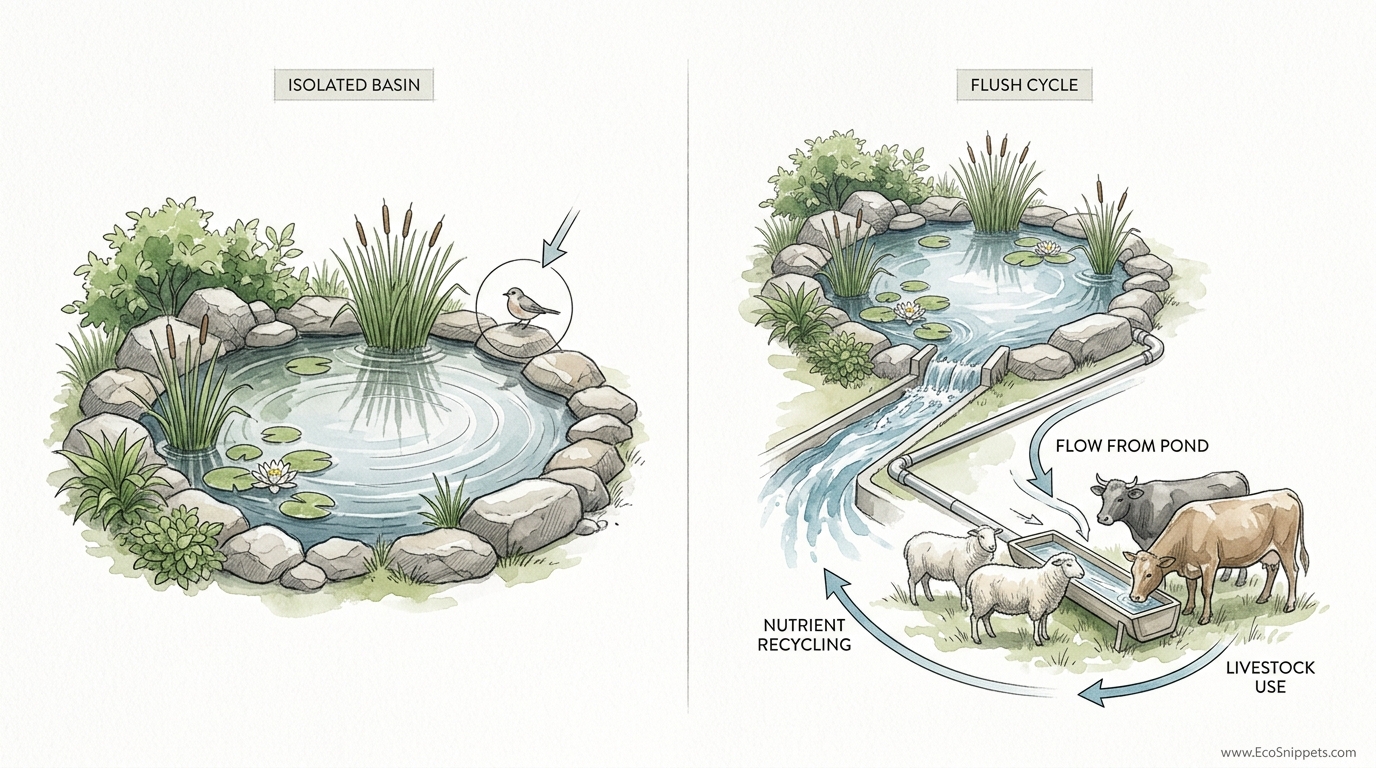
Effective water management is the backbone of a productive homestead. Moving water from a high point to a lower one without electrical pumps reduces your reliance on fragile infrastructure. It also ensures that your livestock have access to water that is often more mineral-rich and biologically active than treated municipal sources. This guide walks you through the transition from a static, isolated basin to a dynamic flush cycle system.
Connecting Backyard Ponds To Livestock Systems
Connecting backyard ponds to livestock systems is the practice of using gravity-fed plumbing to deliver water from a central reservoir to troughs or irrigation lines. This setup moves the watering point away from the pond itself, which protects the pond’s structural integrity and water quality. Instead of letting animals trample the banks and defecate in the water, you bring the water to them in a controlled, clean environment.
This system exists because livestock health and pond longevity are often at odds when direct access is allowed. Ponds used for direct watering frequently suffer from bank erosion, high turbidity, and nutrient overloading from manure. Relocating the water access to a lower elevation using a siphon or a through-dam pipe solves these issues while maintaining the pond as a “biological battery” that stores both hydration and nutrients.
In the real world, this is used extensively by regenerative farmers and homesteaders who want to minimize electricity costs. A pond located on a hill or an upper terrace becomes a potential energy source. The weight of the water creates the pressure needed to move it hundreds of feet or meters down to the valley floor. It is an elegant, quiet, and reliable method that has served agrarian societies for generations.
The Mechanics of the Gravity Siphon
A gravity siphon works on the principle of atmospheric pressure and the weight of the water column. The system consists of a continuous pipe that travels from the pond, over the dam or embankment, and down to a lower discharge point. Once the pipe is completely filled with water and the air is removed, the weight of the water falling on the downhill side pulls more water up and over the high point from the pond side.
Maintaining this flow requires that the outlet be lower than the water surface in the pond. Even a small elevation difference of 3 to 5 feet (0.9 to 1.5 meters) is sufficient to create a steady flow. Larger drops increase the pressure and flow rate significantly. Using a larger pipe diameter, such as 1.25 inches to 2 inches (3.1 to 5 cm), reduces friction loss and ensures that the system can handle the peak drinking demands of a thirsty herd.
Priming the siphon is the most critical step. This involves filling the entire line with water to eliminate any air pockets. Installing a “T” fitting with two valves at the highest point of the line allows you to pour water in until the pipe is full. Closing these priming valves and opening the outlet valve at the trough triggers the continuous flow. Air bubbles are the enemy of this system, as they can collect at the high point and eventually break the suction.
How to Install an Integrated Pond-Watering System
Installing a reliable system starts with the intake at the pond. Positioning the intake 1.5 to 3 feet (0.45 to 0.9 meters) below the surface prevents it from sucking in floating debris or bottom sediment. Some practitioners use a perforated plastic pail filled with clean river rocks as a pre-filter. This keeps fish and large organic matter out of the pipe while allowing water to seep in freely.
Trenching the pipe is the next phase. Burying the line at least 3 to 4 feet (0.9 to 1.2 meters) deep protects it from both freezing in the winter and UV damage during the summer. If the pipe must pass through the pond dam, anti-seep collars are mandatory. These flat plates are attached to the exterior of the pipe to stop water from “piping” or eroding a path along the smooth surface of the plastic, which could eventually cause the dam to fail.
The final stage is the watering trough or reservoir. Installing a high-quality float valve ensures the trough stays full without overflowing. If the system is designed for a “flush cycle,” where water constantly moves to prevent freezing or stagnation, an overflow pipe must be included. This overflow should lead to a secondary irrigation ditch or a swale, carrying the nutrient-rich water into the pasture to act as a liquid fertilizer.
Biological Benefits and the Nutrient Cycle
Pond water is more than just H2O; it is a complex soup of minerals, microbes, and organic matter. This makes it a “biological battery.” In an integrated system, the pond acts as a collection point for rainwater and runoff, which carries trace minerals and nutrients from the surrounding landscape. When livestock drink this water, they are often getting a broader spectrum of minerals than they would from distilled or highly filtered sources.
Moving from an isolated basin to a flush cycle increases the oxygen levels in the water. Constant movement reduces the risk of blue-green algae (cyanobacteria) blooms, which thrive in stagnant, warm water. These blooms can be toxic to cattle, sheep, and dogs. A system that keeps water moving from the pond to a trough and then out to the field ensures that the water remains fresh and aerated.
Pastures benefit immensely from the overflow of these systems. This water often contains nitrogen-fixing algae and dissolved organic matter from fish or waterfowl living in the pond. Directing the trough overflow into a food forest or a vegetable garden turns a waste product into a valuable input. This “fertigation” loop reduces the need for synthetic fertilizers and mimics the natural flood cycles that have historically kept river valleys fertile.
Challenges and Common Mistakes
Losing the prime is the most frequent challenge with siphon-based systems. Tiny leaks at joints or valves allow air to seep in over time. Even if the leak is too small to drip water out, it can be large enough to let air in when the system is under vacuum. Using a single, continuous run of high-density polyethylene (HDPE) pipe instead of multiple sections of PVC can minimize the number of joints and potential failure points.
Silt and sediment buildup can also choke the line. If the intake is placed too close to the bottom of the pond, it will eventually suck in fine mud. This mud settles in the low points of the pipe, reducing flow or blocking it entirely. Checking the intake screen every season and ensuring it is elevated off the pond floor is a necessary maintenance task.
Freezing remains a major concern in colder climates. While the buried pipe is protected, the exposed portions at the trough are vulnerable. Some farmers use “freeze-proof” tanks that are partially buried and use the ground’s thermal mass to keep the water liquid. Others allow a small, continuous trickle of water to run through the trough, as moving water is much harder to freeze than a standing pool.
Limitations and Environmental Constraints
Topography is the primary constraint. If your pond is at the lowest point of your property, a gravity-fed system is physically impossible without a pump. You must have a downward slope from the pond’s surface to the rim of the watering trough. In flat landscapes, you may need to build an elevated reservoir or use a solar-powered pump to lift the water to a header tank before letting gravity take over for the final distribution.
Stocking density also plays a role in system design. A large herd of cattle can drink thousands of gallons or liters in a single afternoon. If your pipe diameter is too small or your pond’s recharge rate is too slow, the animals may drain the trough faster than it can refill. You must calculate the daily water needs of your specific species and ensure your reservoir can handle the peak demand.
Environmental regulations vary by region. Some jurisdictions have strict rules about diverting surface water or placing structures near wetlands. Always check local water rights and environmental codes before installing a permanent through-dam pipe. While siphons are often seen as less invasive, they still represent a modification of the natural water flow on your land.
Comparison: Siphon vs. Direct Pond Access
| Feature | Direct Access | Integrated Siphon |
|---|---|---|
| Water Quality | Poor (Turbid, Manure) | High (Filtered, Aerated) |
| Pond Longevity | Reduced (Erosion) | Increased (Stable Banks) |
| Installation Cost | None | Moderate (Pipe, Valves) |
| Maintenance | Low | Moderate (Intake Cleaning) |
| Animal Health | Risk of Foot Rot/Parasites | Lower Pathogen Risk |
Practical Tips for System Longevity
Selection of pipe materials determines the lifespan of your system. High-density polyethylene (HDPE) is superior to standard PVC for underground runs because it is flexible and can withstand the expansion of freezing water without shattering. It also comes in long rolls, which eliminates the need for joints that often serve as leak points in a siphon system.
Protecting the discharge point is just as important as the intake. Livestock can be destructive, and they will rub against pipes or stomp on valves. Always encase exposed plumbing in heavy-duty sleeves or bury it behind a protective barrier of large stones or timber. A heavy-duty concrete or rubber-tire trough is often the best choice for larger animals like cattle and horses.
Monitoring the water level in the pond is a seasonal requirement. During a drought, the water level may drop below your intake pipe. Designing an adjustable intake that can be lowered further into the pond ensures that your “biological battery” doesn’t run dry when you need it most. Keeping a backup manual pump or a portable tank can provide peace of mind during extreme weather events.
Advanced Considerations for the Serious Practitioner
Scaling this system for a larger farm involves calculating head pressure and flow rates with more precision. For every 2.31 feet (0.7 meters) of vertical drop, you gain approximately 1 pound per square inch (psi) of pressure. If you have a 46-foot (14-meter) drop, you will have 20 psi at the trough—enough to run simple sprinklers or a complex network of float valves.
Integrating the pond system with swales or “Keyline” design can revolutionize your pasture management. Instead of just watering the animals, the overflow from your troughs can be directed into a series of level-bottomed ditches (swales) that traverse the hillside. This allows the water to soak into the soil slowly, recharging the groundwater and keeping the grass green long after the rains have stopped.
Automating the system with smart valves or timers can further reduce labor. Solar-powered controllers can manage the “flush” intervals, ensuring that the water in the troughs remains fresh without wasting the pond’s reservoir. Some practitioners even use the moving water to drive a small hydro-ram pump, which can lift a portion of the water to an even higher elevation without any electricity.
Examples of Integrated Pond Systems
In a typical beef cattle scenario, a producer might fence off a 2-acre (0.8-hectare) pond and install a 2-inch (5-cm) HDPE siphon line. This line runs 300 feet (91 meters) down a gentle slope to a 500-gallon (1,900-liter) concrete trough. By moving the watering point, the producer prevents the cattle from muddying the pond, allowing them to stock the pond with fish for additional food or recreation.
A smaller homestead might use a 1/4-acre (0.1-hectare) duck pond located near the garden. A 1-inch (2.5-cm) siphon line delivers water to a poultry waterer. The overflow from this waterer, rich in duck manure and nutrients, is directed into a berry patch. This simple loop ensures the ducks have clean water to drink while the berries receive a steady supply of natural liquid fertilizer.
Final Thoughts
Building a bridge between your pond and your livestock is one of the most effective ways to increase the self-reliance of your land. Moving from a passive, isolated basin to an active flush cycle transforms a simple water feature into a vital organ of the farm’s ecology. This shift requires some initial labor and a basic understanding of physics, but the rewards are measured in healthier animals, better soil, and reduced overhead.
Treating the farm as an interconnected whole allows you to stop fighting against nature and start working with it. Gravity never takes a day off, and a well-designed siphon will work silently for decades. Embrace the grit required to install these systems, and your land will repay you with a level of resilience that few modern operations can claim.
Experimenting with different intake designs or overflow routes will help you find the perfect balance for your specific topography. Every farm is unique, but the laws of gravity and biology are universal. Tapping into these forces ensures that your pond remains a productive battery, powering the growth and health of everything it touches. HTML article ends.
