How To Become More Self-Sufficient Without Starting a Full-Blown Farm…
Want to start preserving your harvest, making your own soap, or building a backyard root cellar — but not sure where to begin? “Homesteading Advice” gives you instant lifetime access to 35+ practical homesteading books on food preservation, veggie gardening, DIY natural cleaning products (save over $250 per year with this skill alone), brewing, off-grid energy, and a whole lot more…
Click Here To Check It Out Now!
Your ‘modern’ plastic storage bins are secretly acting as an incubator for rot and mold. We traded the ‘wild’ wisdom of breathable natural fibers for the convenience of airtight plastic. Now, we wonder why our potatoes turn to mush by December. Your harvest needs to breathe to survive. Discover why woven systems are the ultimate bio-tech for food preservation.
When you pull a potato from the earth, it doesn’t stop living. It is a dormant organism, a living battery of energy waiting for the right signal to sprout or the wrong environment to decay. Most modern gardeners make the mistake of treating their harvest like inert hardware, stacking it in non-porous containers that suffocate the very life they are trying to preserve.
The transition from traditional storage to modern convenience has come at a high price. We have lost the nuance of airflow and the science of respiration. To keep a harvest through the dark months, you must understand that the container is more than just a box; it is an extension of the vegetable’s own skin.
This guide will walk you through the transition from suffocating storage to breathable, living systems. Whether you are stocking a professional root cellar or a small apartment pantry, the principles of gas exchange and humidity management remain the same. Let’s look at how to build a storage system that honors the biology of your food.
Best Containers For Long Term Root Vegetable Storage
The term “best” in the context of food preservation is dictated entirely by the biological needs of the vegetable. Root vegetables like potatoes, carrots, beets, and parsnips are high-moisture organisms that require high humidity to stay turgid but constant airflow to prevent the buildup of pathogens. The ideal container acts as a regulator, holding enough moisture to prevent shriveling while allowing metabolic gases to escape.
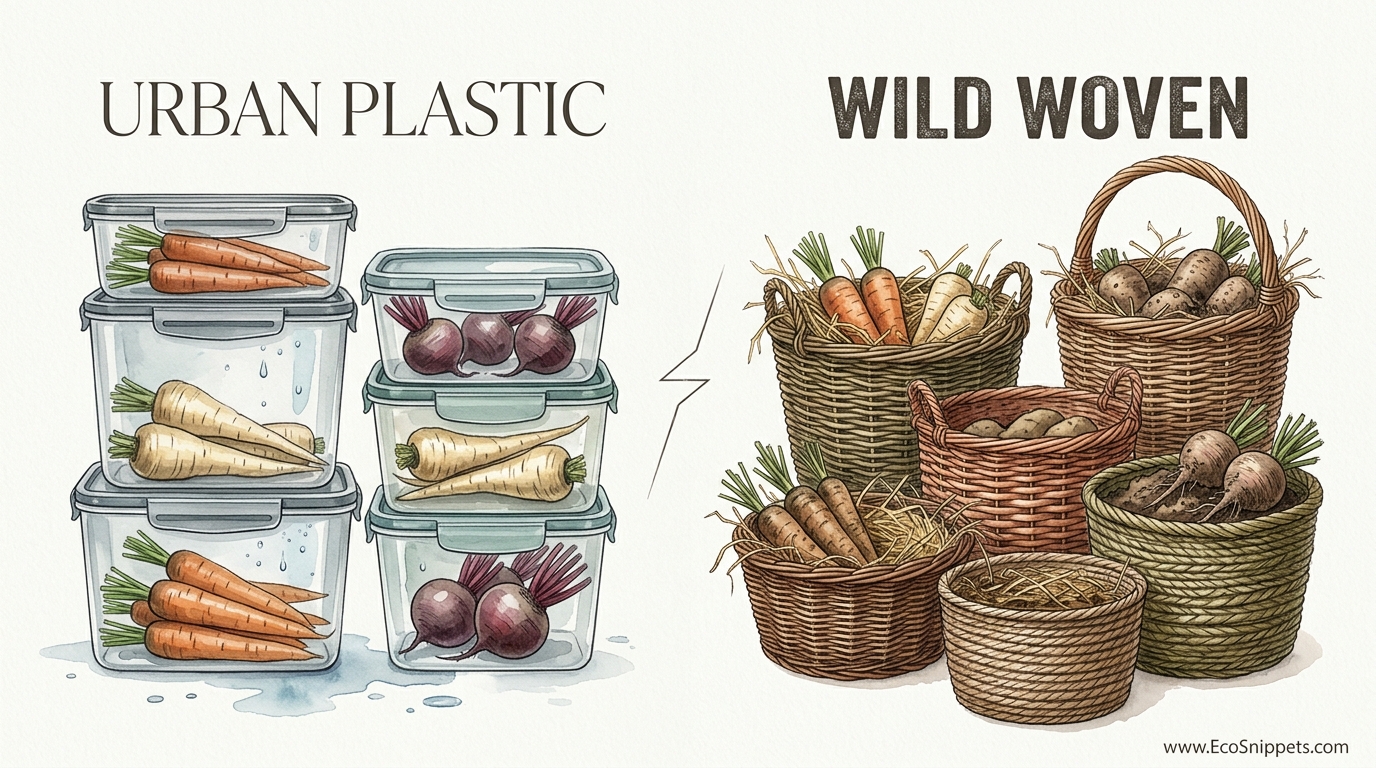
In the world of preservation, we often see a clash between URBAN PLASTIC and WILD WOVEN systems. Plastic is non-porous, waterproof, and sterile. While these traits seem beneficial, they are the primary cause of “anaerobic rot,” where moisture trapped against the skin of a vegetable creates a localized environment for bacteria to thrive. Conversely, woven systems made of willow, rattan, or wood slats mimic the natural environment of the soil—providing structure while remaining completely permeable.
Real-world storage scenarios usually fall into two categories: cold/moist storage for roots and cool/dry storage for bulbs. A container that works for a carrot will likely destroy an onion. Understanding these distinct micro-climates is the first step in selecting the right vessel for your winter larder. We aren’t just looking for a place to “put” things; we are selecting a life-support system for our food.
How Respiration and Gas Exchange Work in Storage
Every root in your cellar is breathing. This process, known as respiration, involves the vegetable taking in oxygen and breaking down its stored sugars to stay alive. As a byproduct, it releases carbon dioxide, water vapor, and heat. In an airtight plastic bin, these byproducts have nowhere to go. The water vapor condenses on the plastic walls, dripping back onto the produce and triggering fungal growth.
Furthermore, many vegetables produce ethylene gas, a natural ripening hormone. If this gas is trapped within a container, it accelerates the aging process. A potato stored in a sealed environment will think it is time to sprout or rot much faster than one kept in a breathable crate. This is why ventilation is the most critical factor in long-term success.
To manage this, follow a three-step container strategy:
- Curing: Before vegetables ever touch their long-term container, they must be cured. For potatoes, this means 7 to 14 days in a dark, room-temperature (15°C to 20°C / 60°F to 68°F) area with high humidity to toughen the skin and heal harvest nicks.
- Layering: In the container, roots should ideally not touch each other directly. Traditional methods use “packing mediums” like damp sand or sawdust to create a physical barrier while maintaining the 90-95% relative humidity that carrots and beets crave.
- Air-Stacking: Containers must be designed to allow air to flow under and around them. Flat-bottomed plastic bins sitting on a concrete floor create a “cold bridge” and trap moisture at the base. Woven baskets or slatted wooden crates naturally prevent this.
Benefits of Breathable Woven and Natural Systems
Woven systems, such as willow baskets or burlap sacks, provide a level of “passive intelligence” that plastic cannot match. These materials are hygroscopic, meaning they can absorb and release small amounts of moisture. This helps buffer the environment, preventing the rapid swings in humidity that lead to produce stress.
The structural benefits are also significant. A well-made willow basket or a heavy-duty wooden crate can support the weight of 20 kg (44 lbs) of potatoes without buckling, yet it remains light enough to move. Unlike plastic, which can become brittle and crack in the freezing temperatures of a root cellar, natural fibers and wood maintain their integrity for decades. Many traditional farms still use “bushel crates” that have been in service for three generations.
Using natural containers also reduces the risk of chemical leaching. Many “utility” plastic bins are not food-grade and may contain BPA or phthalates that can migrate into the food, especially in the high-humidity environment of a cellar. Choosing untreated wood or natural fibers ensures your harvest remains as clean as the day it was pulled from the dirt.
Challenges and Common Mistakes to Avoid
The most frequent error in vegetable storage is washing the harvest before putting it away. While it is tempting to have clean vegetables, washing removes the “probiotic shield”—the natural soil bacteria and the waxy cuticle that protect the root from rot. Always gently brush off large clumps of soil, but leave the fine dust intact. Moisture is the enemy of storage; a vegetable must be bone-dry on the surface before it enters its winter home.
Another mistake is the “mixed marriage” of produce. Storing apples in the same bins as potatoes is a recipe for disaster. Apples release high amounts of ethylene gas, which will cause your potatoes to sprout and your carrots to turn bitter. Keep fruit and vegetables in separate zones, or at the very least, in containers that are far apart and well-vented.
Over-filling containers is also a common pitfall. In a large bin, the vegetables at the bottom are subjected to immense pressure and very little airflow. This creates “hot spots” where respiration heat builds up, triggering rot that can quickly spread to the rest of the bin. Use smaller, stackable units rather than one giant vat to ensure every root has access to fresh air.
Limitations and Environmental Constraints
While woven and slatted systems are superior for airflow, they offer little protection against rodents. Rats and mice can easily chew through wicker or burlap to reach your winter calories. In areas with high pest pressure, you may need to use wire mesh baskets or “rat-proof” your entire storage room with hardware cloth. Using a hybrid system—placing breathable bags inside a ventilated metal locker—can offer the best of both worlds.
Environmental humidity also dictates your container choice. If you live in an exceptionally dry climate (below 40% humidity), a fully open woven basket might allow your carrots to shrivel into leather in a matter of weeks. In these specific cases, you must use a packing medium like damp sand inside a sturdier wooden box, or use perforated plastic liners that hold just enough moisture while still allowing minimal gas exchange.
Temperature control is the final boundary. No container can save a potato from a hard freeze. If your storage area drops below 0°C (32°F), the water inside the vegetable cells will expand and rupture the cell walls, turning the produce into a watery mess once it thaws. Containers should be kept off the floor and away from exterior walls to avoid these temperature extremes.
Comparison of Storage Container Materials
| Material | Airflow | Moisture Control | Longevity | Best For |
|---|---|---|---|---|
| Woven Willow/Rattan | Excellent | High (Breathable) | Decades | Potatoes, Garlic, Squash |
| Slatted Wood Crates | High | Medium | 10-20 Years | Apples, Cabbage, Potatoes |
| Burlap / Jute Sacks | Moderate | Can be misted | 3-5 Years | Bulk Potatoes, Carrots |
| Plastic Bins (Solid) | Zero | Traps Condensation | 5-10 Years (Cracks) | Not recommended for roots |
| Sand-Filled Boxes | Low | Very High | Indefinite | Carrots, Beets, Parsnips |
Practical Tips for Immediate Application
If you currently have your harvest in solid plastic tubs, the quickest fix is to drill ventilation holes. Use a 1-inch (25mm) spade bit to create at least 12 holes on the sides and bottom of each bin. This isn’t as good as a woven system, but it will provide the “emergency exit” that metabolic gases need to escape.
For those using baskets or crates, consider a “check-and-sort” schedule. Once every two weeks, spend ten minutes looking through your bins. A single soft potato can release enough ethylene and moisture to trigger a rot-cascade in the entire basket. Removing one “bad apple” truly does save the bunch.
Use darkness as a secondary container. If your containers are breathable but your room has windows, your potatoes will turn green and become toxic (solanine buildup). Cover your woven baskets with a layer of breathable burlap or heavy black cloth. This keeps the light out while allowing the air in.
Advanced Considerations for the Serious Practitioner
Serious food preservationists look at the thermal mass of their containers. Materials like thick wood or heavy ceramic crocks provide thermal inertia, protecting the vegetables from small spikes in temperature when you open the cellar door. This stability is key to keeping the vegetables in a deep “sleep” state.
When scaling up, consider the “stacking effect.” In a large storage room, the air at the ceiling is often 3-5 degrees warmer than the air at the floor. Store your most sensitive items—like carrots and beets—in sand-filled boxes on the cooler floor. Place hardier items like squash and onions on higher shelves where the air is slightly warmer and drier.
Humidity can be precisely tuned using a “wicking system.” If your cellar is too dry, you can hang wet burlap sheets from the ceiling. The natural evaporation from the fibers will raise the relative humidity without ever making the vegetables themselves “wet.” This is an old world technique that outperforms any modern humidifier in reliability.
Example Scenario: The Winter Potato Cache
Imagine a harvest of 50 kg (110 lbs) of Yukon Gold potatoes. Using an URBAN PLASTIC approach, a gardener puts them in two large 50-liter plastic totes with lids. Within three weeks, condensation forms on the underside of the lid. By December, the bottom layer of potatoes is sitting in 2 cm of anaerobic “slop.” The harvest is a total loss.
Now, consider the WILD WOVEN approach. The same 50 kg of potatoes is cured in a dark garage for 10 days until the skins are papery and tough. They are then moved into five shallow willow baskets, each holding 10 kg. The baskets are stacked on wooden pallets in a cool basement. A single layer of burlap is draped over the top to block light. Because the air can move freely through the weave of the baskets, the respiration heat is carried away. In March, the gardener is still eating firm, sweet potatoes with no signs of rot.
This difference in outcome isn’t luck; it is the direct result of matching the storage vessel to the biological reality of the crop. One system works against nature; the other works with it.
Final Thoughts
Rethinking your storage containers is one of the most effective ways to increase your food security. Moving away from airtight plastic and back toward breathable, natural materials allows you to work in harmony with the natural respiration of your harvest. It is a transition from “storing” to “preserving.”
Start small by replacing one or two bins with woven baskets or slatted crates this season. Pay attention to how the vegetables feel, smell, and taste after a month in their new home. You will likely find that the ancestral wisdom of breathable fibers is far superior to any modern synthetic solution.
Your harvest represents months of hard work and resources. Don’t let it suffocate in the dark. Give your food the air it needs to survive, and it will reward you with freshness that lasts until the first greens of spring appear.
