How To Become More Self-Sufficient Without Starting a Full-Blown Farm…
Want to start preserving your harvest, making your own soap, or building a backyard root cellar — but not sure where to begin? “Homesteading Advice” gives you instant lifetime access to 35+ practical homesteading books on food preservation, veggie gardening, DIY natural cleaning products (save over $250 per year with this skill alone), brewing, off-grid energy, and a whole lot more…
Click Here To Check It Out Now!
Your roof is a massive collection plate – are you throwing its energy away or putting it to work? Most homeowners treat rain as a problem to be drained away as fast as possible. Smart farmers treat it as a dynamic energy source that can oxygenate ponds and feed nitrogen to your most demanding plants.
This shift in perspective transforms every storm from a liability into a windfall. Instead of watching precious resources flood your foundation, you can harness the natural momentum of falling water. This guide will show you how to move beyond simple storage and into the world of active, living water systems.
Traditional rain barrels are a start, but they represent a static approach to resource management. A dynamic system views rainwater as a living medium that carries atmospheric nutrients and kinetic energy directly to your landscape. You are not just saving water for a dry day; you are orchestrating a biological boost for your entire property.
By understanding the principles of flow, filtration, and aeration, you can build a system that works with nature rather than against it. Whether you have a small suburban plot or a sprawling homestead, the wisdom of the collection plate remains the same. Let us explore how to capture this liquid gold and put it to its highest use.
Dynamic Rainwater Management Systems
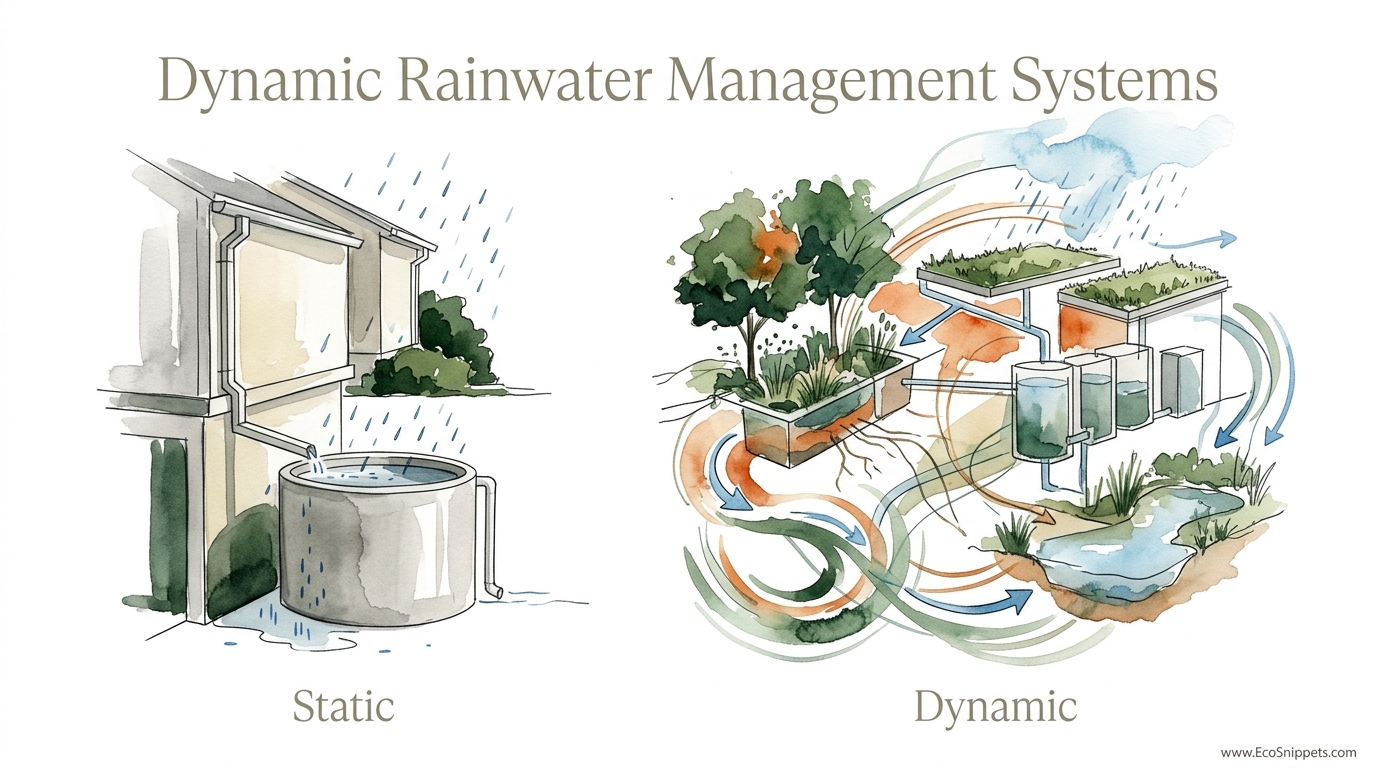
A dynamic rainwater management system is an integrated network designed to capture, treat, and distribute water in a way that preserves its biological energy. Unlike static systems that simply hold water in a tank, dynamic systems focus on the movement and quality of the water. They utilize gravity, natural filtration, and atmospheric interaction to improve the health of ponds and gardens.
These systems exist to bridge the gap between “dead” stored water and the “living” water found in natural streams. In a real-world setting, a dynamic system might involve a roof catchment that feeds into a series of tiered ponds or a gravity-fed irrigation network. This approach ensures that the water remains oxygenated and nutrient-dense from the moment it hits the shingles to the moment it touches the soil.
Think of a static rain barrel as a battery that sits on a shelf, slowly losing its charge. A dynamic system is more like a water wheel—it uses the inherent energy of the rain to perform work as it passes through the property. This work includes scrubbing nitrogen from the air, agitating pond surfaces to prevent stagnation, and flushing salts from the root zones of your plants.
In permaculture and sustainable farming, these systems are used to create resilience against drought while simultaneously building soil fertility. They allow a grower to automate the delivery of “sky-born” fertilizer without relying on expensive pumps or municipal chemicals. By keeping the water moving, you also eliminate common issues like mosquito breeding and foul odors associated with stagnant tanks.
How It Works: From Sky to Soil
The process begins with the catchment area, typically your roof, which serves as the primary gathering point for every drop. As rain falls through the atmosphere, it undergoes a process called atmospheric scrubbing. This is where raindrops absorb nitrogen in the form of nitrates and ammonium, effectively becoming a mild, natural liquid fertilizer.
During a lightning storm, the intense heat breaks the strong bonds of nitrogen molecules in the air. These molecules then combine with oxygen to form nitrogen oxides, which dissolve into the rain and fall to the earth. This is why plants often look remarkably greener after a thunderstorm compared to a session with a garden hose.
Once the water hits the roof, it must be channeled through a “first flush” diverter. This mechanical component ensures that the initial, dirtiest runoff—carrying bird droppings, dust, and debris—is sent away from your main storage or pond. Only after the roof has been “washed” does the clean, nutrient-rich water enter your dynamic system.
From there, gravity becomes your primary engine. By positioning storage tanks or ponds at higher elevations than your garden beds, you create potential energy. As water flows through the system, it can be passed through venturi aerators or over small waterfalls. This movement pulls oxygen from the air into the water, a process vital for healthy fish and the aerobic bacteria that break down pond muck.
Benefits of the Dynamic Approach
The most immediate benefit is the delivery of bio-available nitrogen directly to the roots of your plants. Municipal tap water often contains chlorine and fluoride, which can be toxic to sensitive plant tissues over time. Rainwater is naturally soft, slightly acidic (pH 5.5 to 6.5), and free of the sodium that can damage soil structure.
Dynamic systems provide a continuous supply of oxygenated water to ponds, which is essential for maintaining a healthy aquatic ecosystem. High dissolved oxygen levels support the beneficial microorganisms that process fish waste and prevent the buildup of toxic ammonia. This reduces the need for artificial filters and expensive chemical treatments to keep the water clear.
Moving water also provides a significant advantage in flood mitigation and soil health. By slowing the flow of water across your property through swales and tiered ponds, you prevent the erosion that strips away fertile topsoil. Instead of a destructive torrent, the rain becomes a gentle, managed resource that recharges the local groundwater table.
From a self-reliance standpoint, these systems reduce your dependence on external infrastructure. During a power outage or a municipal water restriction, your gravity-fed dynamic system continues to function. It provides a reliable source of water for livestock, gardens, and even emergency cleaning, all powered by the simple laws of physics.
Challenges and Common Mistakes
One of the most frequent errors is neglecting the “first flush” stage. Without a way to divert the initial roof wash, your ponds and tanks will quickly fill with organic sludge. This “muck” consumes oxygen as it decomposes, which can lead to anaerobic conditions and unpleasant smells that counteract the benefits of the system.
Another common pitfall is underestimating the weight of stored water. A single gallon of water weighs approximately 8.34 pounds (3.78 kilograms), meaning a 500-gallon (1,892-liter) tank weighs over two tons. Failing to provide a level, reinforced foundation can lead to tank failure or dangerous structural collapses near your home.
Maintenance of the filtration screens is often overlooked until the system fails. Debris like pine needles and leaves can quickly clog downspout filters, causing water to bypass the collection system entirely. You must establish a routine to clear these screens before and after every major storm season to ensure the collection plate remains open.
Finally, many people fail to plan for the “overflow.” Even the largest tanks will eventually fill during a heavy storm. If the overflow is not directed to a safe location, such as a rain garden or a well-designed drainage swale, it can cause localized flooding and foundation damage. Always ensure your system has a clear, armored exit path for excess water.
Limitations and Environmental Constraints
Geographic location plays a massive role in the effectiveness of dynamic rainwater systems. In arid regions with long dry spells, the “dynamic” part of the system may sit idle for months, requiring you to supplement with other sources to keep ponds from drying out. You must size your storage capacity to last through your region’s typical drought cycle.
Winter climates present a unique set of challenges regarding freezing pipes and tanks. If water is allowed to sit in exposed PVC or metal lines during a hard freeze, it will expand and shatter the plumbing. Owners in cold regions must design their systems with “dry” lines that drain completely or bury them below the frost line to prevent seasonal damage.
Roof material also dictates the quality of the water you can safely collect. While metal roofs are excellent for clean collection, older asphalt shingles or roofs treated with moss-killing chemicals can leach heavy metals and toxins. If your catchment surface is compromised, the water may only be suitable for ornamental plants rather than edible crops or sensitive fish.
Urban environments may also face limitations due to air pollution. In areas with high industrial activity, the rain can absorb significant amounts of sulfur or particulate matter. While the soil can filter many of these out, a dynamic system in a polluted city requires more robust filtration and monitoring to protect the health of the local ecosystem.
Comparison: Static vs. Dynamic Systems
| Feature | Static (Barrels) | Dynamic (Integrated) |
|---|---|---|
| Water Quality | Can become stagnant and anaerobic. | High dissolved oxygen; fresher biological state. |
| Nutrient Delivery | Minimal; nutrients settle to the bottom. | Actively flushes atmospheric nitrogen to soil. |
| Maintenance | Low; cleaning occasional sediment. | Moderate; requires screen and filter checks. |
| Pest Risk | High mosquito risk if not perfectly sealed. | Low; moving water discourages breeding. |
| Energy Efficiency | None; purely for storage. | High; uses kinetic energy for aeration. |
Practical Tips for Implementation
Start by maximizing your gutter capacity. Use 5-inch (12.7 cm) or 6-inch (15.2 cm) K-style gutters to ensure that heavy downpours don’t simply overshoot the collection area. A wider gutter allows for more volume and reduces the chance of debris causing a localized blockage during the most productive part of a storm.
Install a leaf power-head or a high-quality rain head at the top of your downspout. These devices use a fine mesh screen angled outward to shed leaves and large debris while allowing the water to pass through. This is your first line of defense against “muck” and is far easier to clean than a tank bottom.
Use food-grade materials for all plumbing and storage components. Even if you aren’t drinking the water, UV-stabilized, NSF-certified PVC or polyethylene prevents chemicals from leaching into your garden soil. Dark-colored tanks are also preferable as they block sunlight and prevent the growth of algae inside your storage units.
Consider the “head pressure” when designing your distribution lines. For every 2.31 feet (70.4 cm) of vertical drop, you gain approximately 1 PSI of pressure. By elevating your storage tanks just 5 to 10 feet (1.5 to 3 meters) above your garden, you can effectively run drip irrigation systems without ever needing an electric pump.
Advanced Considerations for Practitioners
Serious practitioners often integrate venturi aerators into their gravity-fed lines. A venturi is a simple T-junction that uses the vacuum created by flowing water to suck air into the stream. This allows you to oxygenate a pond using nothing but the pressure of the falling rain, providing a massive boost to aquatic life during storm events.
Implementing a “wet” piping system can allow you to place your storage tanks far away from your house. In a wet system, the pipes are buried underground and remain full of water at all times. When it rains, the pressure from the roof downspouts pushes new water through the buried line and up into the tank, allowing for much cleaner aesthetics and more flexible site planning.
You can also explore the use of biological “polishing” ponds. Instead of sending water directly to a tank, it first passes through a shallow, heavily planted basin. These plants act as a living filter, removing fine sediment and any residual pollutants before the water moves to your primary storage or fish pond.
Automated siphons are another advanced tool for managed drainage. A bell siphon can be designed to allow a pond or tank to fill to a specific level and then automatically flush a large volume of water at once. This “surge” irrigation can be used to deep-water orchards or mimic natural flood cycles in a controlled environment.
Scenario: The 1,000 Square Foot Harvest
Imagine a standard home with a 1,000 square foot (92.9 square meter) roof section. During a 1-inch (2.54 cm) rain event, this roof will collect approximately 623 gallons (2,358 liters) of water. In many regions, a single afternoon storm can provide more water than a gardener would use in an entire week of manual watering.
Instead of letting this 600+ gallons dump into the driveway, a dynamic system directs it through a first-flush diverter. After the first 5 gallons (19 liters) are diverted, the remaining clean water flows into a 500-gallon (1,892-liter) header tank. This tank is elevated on a simple timber frame, providing enough pressure to reach the back of the property.
As the tank overflows, the excess water travels through a 4-inch (10 cm) pipe to a small backyard pond. The pipe ends in a small decorative waterfall, which splashes onto a flat stone. This agitation increases the dissolved oxygen in the pond, supporting a small population of goldfish and water lilies that would otherwise struggle in stagnant water.
Finally, the pond’s own overflow is directed into a series of mulch-filled swales. These swales hold the water long enough for it to soak deep into the soil, reaching the roots of fruit trees. In this single event, the roof has acted as a collection plate that fertilized the garden, aerated the pond, and recharged the soil—all without a single watt of electricity.
Final Thoughts
Dynamic rainwater management is about more than just saving a few dollars on a utility bill. It is about reclaiming the ancestral wisdom that recognized water as a moving, living force. By building systems that honor the natural qualities of rain, we create landscapes that are more resilient, more productive, and more deeply connected to the seasons.
Every roof is an opportunity to participate in the water cycle rather than simply being a bystander. When you take the time to set up a collection plate that works with gravity and biology, you are investing in the long-term health of your soil and spirit. The grit required to maintain these systems pays off in the form of lush gardens and vibrant, healthy ponds.
Do not be overwhelmed by the complexity of large-scale systems. Start with a single downspout, a good filter, and a plan for where that water will go. As you watch your plants respond to the nitrogen-rich gift from the sky, you will find yourself looking for more ways to put every drop to work. Experiment, observe, and let the rain teach you the art of flow.
