How To Become More Self-Sufficient Without Starting a Full-Blown Farm…
Want to start preserving your harvest, making your own soap, or building a backyard root cellar — but not sure where to begin? “Homesteading Advice” gives you instant lifetime access to 35+ practical homesteading books on food preservation, veggie gardening, DIY natural cleaning products (save over $250 per year with this skill alone), brewing, off-grid energy, and a whole lot more…
Click Here To Check It Out Now!
Plants don’t want to be prisoners; they want to be part of a community that feeds and protects them. When you plant a tree in a lawn, you’re forcing it to fight for its life. In a permaculture guild, every plant has a job: one mines minerals, one attracts bees, and another confuses pests. The result? Zero fertilizer and massive yields.
Modern landscaping has taught us to isolate our fruit trees in a sea of mowed grass. This creates a perpetual state of war where the tree competes with the grass for every drop of water and every ounce of nitrogen. Our ancestors didn’t garden this way. They understood that a tree is not an island; it is the heart of a complex, living network. By mimicking the layering of a natural forest, you can create an orchard that largely manages itself.
This guide will walk you through the grit and wisdom of designing a fruit tree guild. We are moving away from chemical sprays and toward biological alliances. You are about to learn how to build a system where the soil gets richer every year and the harvest requires less of your labor.
Fruit Tree Guild Design For Beginners
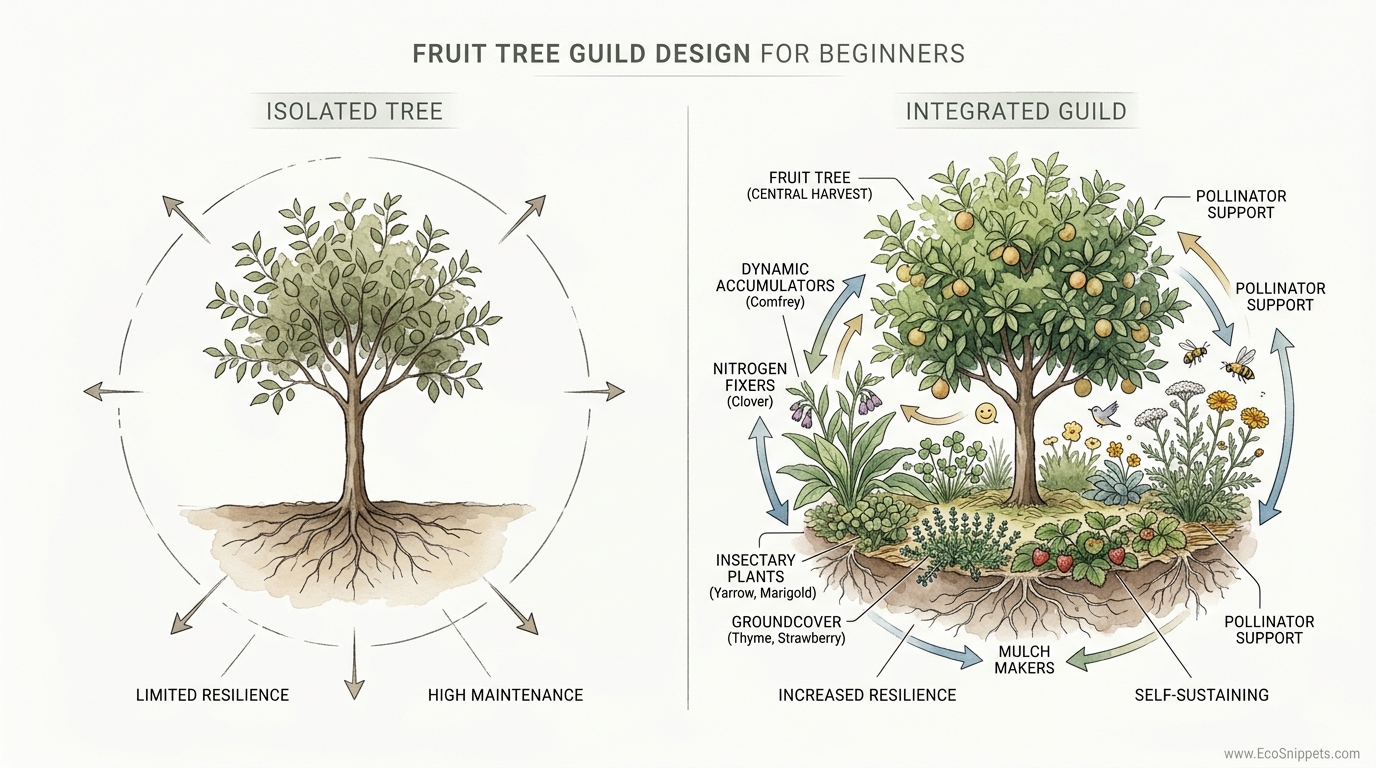
A fruit tree guild is a purposeful community of plants clustered around a central fruit or nut tree. This concept comes from permaculture, a design system that looks at how nature organizes itself and tries to do the same in a backyard or farm setting. In the wild, you will never find a lone apple tree surrounded by five acres of perfectly manicured Kentucky Bluegrass. You find it surrounded by shrubs, herbs, wildflowers, and fungi.
Think of a guild as a “work crew” for your tree. Instead of you doing all the fertilizing, weeding, and pest control, you hire plants to do it for you. One plant might be a “nitrogen fixer” that pulls fertilizer out of the air and puts it into the ground. Another might be a “dynamic accumulator” with a root like a drill bit, pulling minerals from deep in the subsoil up to the surface.
This approach is used in food forests and sustainable homesteads worldwide. It turns a high-maintenance orchard into a resilient ecosystem. For a beginner, the beauty of a guild is that it solves problems before they start. If you plant enough aromatic herbs around a peach tree, the smell confuses the pests that would otherwise find and destroy your fruit. You are creating a “living shield” that grows stronger as the years pass.
The Functional Members of a Guild
Designing a guild requires more than just throwing seeds on the ground. You must understand the roles that different plants play. Each species in your guild should serve at least two or three functions. This is the hallmark of an efficient, self-reliant system.
Nitrogen Fixers
Nitrogen is the primary fuel for leaf and wood growth. Most plants cannot use the nitrogen that makes up 78% of our atmosphere. Nitrogen fixers, however, have formed a partnership with specialized soil bacteria called Rhizobia. These bacteria live in nodules on the plant’s roots and “fix” atmospheric nitrogen into a form the tree can actually eat.
When you prune these plants or when they die back in the winter, that nitrogen is released into the soil for the fruit tree. Common examples include white clover, lupines, beans, and peas. In larger systems, shrubs like goumi or silverberry act as permanent fertilizer factories for the surrounding trees.
Dynamic Accumulators
These are the “miners” of the garden. Plants like comfrey, borage, and yarrow have incredibly deep taproots. They reach down into the subsoil where your fruit tree’s roots might not go, sucking up potassium, calcium, and magnesium. These minerals are stored in their leaves.
Practitioners often use a technique called “chop and drop.” You simply cut the leaves of the comfrey and lay them on the ground as mulch. As they rot, they deliver a high-potassium “tea” directly to the tree’s root zone. Comfrey is often considered the most important plant in a guild because it can be harvested multiple times a season without dying.
Pest Repellents and Confusion Plants
Strong-smelling plants are your first line of defense. Pests like aphids or fruit moths often find their targets by scent. If you surround your tree with a thicket of garlic, chives, onions, or marigolds, you create a “scent screen” that makes it much harder for the bad guys to find the fruit.
Daffodils are another classic repellent. Planting them in a ring at the “drip line” (the circle where rain drips off the outer leaves) creates a bulb barrier that keeps grass and burrowing rodents like voles away from the tree’s sensitive root collar.
Pollinator and Predator Attractors
A healthy guild must be loud with the sound of insects. You want plants that provide nectar and pollen throughout the entire growing season. Yarrow, dill, and fennel have tiny, umbrella-shaped flowers that attract “parasitic wasps.” Don’t worry—these wasps don’t sting humans, but they are deadly to the caterpillars and aphids that want to eat your leaves.
How to Design and Plant Your First Guild
Building a guild starts with observation and preparation. You cannot simply dig a hole and hope for the best. Success in the orchard is earned in the months before the first tree even arrives.
Step 1: Choose Your Central Element
The fruit tree is the anchor. You must select a variety that is suited to your climate and soil. If you have a small backyard, a dwarf or semi-dwarf tree is often the better choice because it leaves more room for the understory. Hardiness is key; look for “disease-resistant” varieties that won’t require constant intervention.
Step 2: Prepare the Ground with Sheet Mulching
Grass is the enemy of a young fruit tree. To kill it without chemicals or back-breaking tilling, use sheet mulching. Lay down a thick layer of plain, brown cardboard over the area where your guild will live. Wet it down thoroughly. This cardboard chokes out the grass while providing a feast for earthworms.
Cover the cardboard with 10–15 centimeters (4–6 inches) of high-quality compost, then top it with a layer of wood chips or straw. This “lasagna” of organic matter will break down over time, creating a rich, spongy soil that holds water like a reservoir.
Step 3: Planting in Rings
Plant your tree in the center of your prepared area. Once the tree is in, you can begin adding the support species. A common pattern is to plant in concentric circles or “rings.”
- The Inner Ring: Focus on pest repellents like garlic and chives right near the trunk.
- The Mid Ring: Place your dynamic accumulators like comfrey and yarrow here, where they can be easily accessed for “chop and drop.”
- The Drip Line: Plant a barrier of daffodils and nitrogen-fixing clovers here to mark the edge of the guild and repel grass.
Step 4: Water and Observe
Newly planted guilds need consistent moisture for the first year. Since the plants are grouped together, they help each other by shading the soil and reducing evaporation. Every few weeks, walk through your guild. Look for signs of stress or pests. If you see aphids, don’t reach for a spray; wait a few days to see if the ladybugs and wasps you’ve attracted show up to do the job for you.
Benefits of a Fruit Tree Guild
Transitioning to a guild-based orchard offers measurable advantages over traditional monoculture rows. These benefits are both ecological and practical.
Resilience to Drought
Dense plantings create a “living mulch.” The ground covers and low-growing herbs protect the soil from the sun’s direct heat, which can easily bake the life out of exposed dirt. In a well-established guild, the soil temperature remains significantly lower, and the high organic matter content acts as a sponge, holding liters of water for weeks after a rainstorm.
Natural Nutrient Cycling
Relying on synthetic fertilizers creates a “boom and bust” cycle for the tree. In a guild, the nutrients are released slowly as leaves decompose. This mimics the forest floor. The dynamic accumulators and nitrogen fixers ensure that the tree has a constant, steady diet of the minerals it needs to produce sweet, nutrient-dense fruit.
Reduced Maintenance Over Time
Initially, a guild requires more work to design and plant. However, as the plants fill in, they leave no room for weeds. The system reaches a “steady state” where your primary job is simply harvesting and occasionally pruning. You are no longer a slave to the lawnmower or the fertilizer spreader.
Challenges and Common Mistakes
Even the best-laid plans can go awry if you ignore the basic laws of biology. Many beginners encounter hurdles that can be avoided with a bit of foresight.
Over-Crowding and Competition
Plants need light. If you plant a large shrub too close to a young fruit tree, the shrub might grow faster and shade out the tree. Always research the “mature width” of every plant you put in the guild. Give the central tree the space it needs to be the king of its domain.
Using Invasive Species
Some permaculture favorites, like Autumn Olive (Elaeagnus umbellata), are fantastic nitrogen fixers but are considered highly invasive in many regions. They can escape your garden and wreck local ecosystems. Always check with your local agricultural extension to ensure your support plants are safe for your area.
Ignoring the “Drip Line”
Roots often grow further than you think. If you plant aggressive spreaders like mint directly at the base of a young tree, they may compete for water during the tree’s most vulnerable years. Keep the area immediately around the trunk clear of aggressive competition until the tree is well-established.
Limitations: When a Guild May Not Be Ideal
A fruit tree guild is a powerful tool, but it is not a universal solution for every situation. There are times when a different approach might be necessary.
In very cramped urban spaces, such as a tiny 2-meter by 2-meter (6-foot by 6-foot) courtyard, a full guild might be too much. You might be limited to just a few companion herbs in pots. Additionally, if you live in an area with extremely high humidity and fungal pressure, you must be careful about airflow. A guild that is too “lush” can trap moisture around the trunk, leading to root rot or scab. In these cases, you may need to prune your understory more aggressively to ensure the wind can move through the system.
Practical Tips and Best Practices
Success in the orchard is found in the details. These tips will help you fine-tune your guild for maximum performance.
- Use “Bocking 14” Comfrey: This specific cultivar of Russian comfrey is sterile. It will not spread by seed and take over your entire yard, which is a common complaint with “True Comfrey.”
- Plant Native Species: Whenever possible, use nitrogen fixers and flowers that are native to your region. They will be more resistant to local weather and more attractive to local beneficial insects.
- Chop and Drop Regularly: Don’t let your dynamic accumulators get too woody. Cut them back two or three times a year and lay the greens directly under the tree. This is “free” fertilizer that keeps the soil food web active.
- Label Your Plants: It is easy to forget what is a “weed” and what is a “medicinal herb” when things start growing fast in the spring. Small metal or stone markers can save you from accidentally pulling up your yarrow.
Advanced Considerations: The Soil Food Web
Serious practitioners eventually look beneath the surface. The true power of a guild lies in the relationship between roots and fungi.
Mycorrhizal fungi are the invisible threads that connect your guild. These fungi attach to the tree’s roots and extend into the soil, effectively increasing the root’s surface area by hundreds of times. They trade minerals and water for the sugars produced by the tree through photosynthesis.
When you plant a diverse guild, you attract a diverse range of these fungi. Different plants provide different “exudates”—sugary secretions from their roots—that feed different microbial communities. This biodiversity creates a “biological insurance policy.” If one species of microbe fails due to a dry spell, another is there to take its place. Avoiding tilling and synthetic chemicals is vital because both can shatter these delicate fungal networks.
Example Scenario: The Classic Apple Guild
To see how this works in practice, let’s look at a standard design for a temperate climate apple tree.
| Role | Plant Choice | Quantity/Position |
|---|---|---|
| Central Tree | Enterprise Apple (Semi-Dwarf) | Center |
| Nitrogen Fixer | White Clover | Ground cover throughout |
| Dynamic Accumulator | Russian Comfrey (Bocking 14) | 3 plants, 1 meter from trunk |
| Pest Repellent | Garlic and Chives | Ring around the trunk (30cm away) |
| Grass Barrier | Daffodils | Ring at the drip line |
| Insectary | Dill and Yarrow | Scattered on the sunny southern side |
In this scenario, the garlic protects the tree from borers, the comfrey provides potassium for fruit production, the clover keeps the soil cool and nitrogen-rich, and the dill brings in the predatory wasps. The gardener spends their time picking apples rather than spraying poison.
Final Thoughts
Designing a fruit tree guild is a return to a more thoughtful, observant way of living with the land. It requires us to stop seeing our gardens as a collection of individual objects and start seeing them as a web of relationships. Every time you plant a nitrogen fixer or a pollinator attractor, you are signing a contract with nature to work together rather than in opposition.
Building these systems takes patience. Your guild might look like a messy collection of weeds for the first season or two. However, as the roots deepen and the layers fill in, the true genius of the design will reveal itself. You will see more birds, more bees, and eventually, more fruit than you ever thought possible from a single tree.
Start small. Plant one tree and three or four companions. Watch how they interact. Learn which plants thrive in your specific soil and which ones struggle. This is the path to true self-reliance—a garden that grows stronger with every passing season.
