How To Become More Self-Sufficient Without Starting a Full-Blown Farm…
Want to start preserving your harvest, making your own soap, or building a backyard root cellar — but not sure where to begin? “Homesteading Advice” gives you instant lifetime access to 35+ practical homesteading books on food preservation, veggie gardening, DIY natural cleaning products (save over $250 per year with this skill alone), brewing, off-grid energy, and a whole lot more…
Click Here To Check It Out Now!
Stop shaking that sifter – your chickens have been looking for this exact job all morning. We often treat our compost and our chickens as two separate chores. But a chicken’s primary instinct is to scratch and sift. By integrating a simple sifting tray into their run, you turn their natural behavior into a high-efficiency processing machine. They get the bugs; you get the black gold.
Modern homesteading often forgets the ancestral wisdom of multi-functional systems. Every creature on a farm should have more than one purpose. While we value hens for their eggs, their legs are actually high-torque tilling tools designed by nature to move organic matter. A chicken-powered compost sifter is simply a device that puts those tools to work for your benefit and theirs.
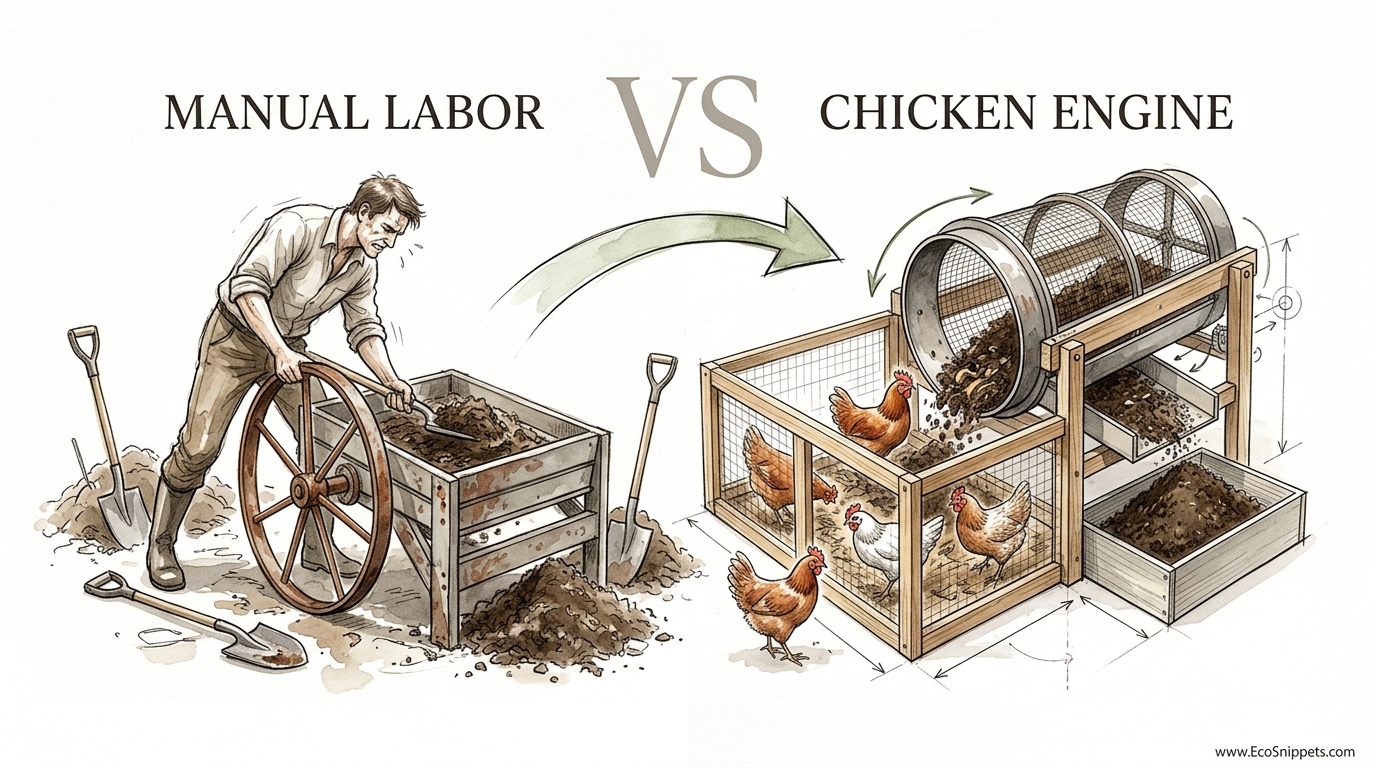
Traditional sifting involves back-breaking labor, standing over a screen and shaking it until your shoulders burn. You end up with a pile of rocks and twigs while your chickens watch from the fence, bored and looking for trouble. Integrating the birds into the workflow changes the entire dynamic of the garden.
This system turns the “waste” of a chicken run—the endless scratching and digging—into a deliberate manufacturing process. Instead of fighting their nature, you are directing it. Every time a hen kicks her feet back, she is performing a task that would take a human minutes of manual effort. Over the course of a day, a small flock can process hundreds of pounds of material.
How To Build A Chicken-powered Compost Sifter
A chicken-powered sifter is essentially a sturdy wooden frame fitted with a wire mesh bottom, designed to hold semi-finished compost at a height that encourages chickens to forage through it. It exists to bridge the gap between “raw” organic waste and the “black gold” required for seed starting and top-dressing garden beds. In the real world, this setup is used by permaculture practitioners and self-reliant gardeners to speed up the composting cycle while reducing the cost of supplemental poultry feed.
Think of the sifter as a “biological engine” where the fuel is your kitchen scraps and the output is garden fertility. It is most commonly placed directly inside the chicken run or attached to the side of a coop. The design varies from simple trays resting on the ground to elevated platforms that drop sifted material into a waiting wheelbarrow.
The core materials are straightforward and often found as scrap around a homestead. You will need:
- Lumber: Use 2×4 (38 x 89 mm) or 2×3 (38 x 64 mm) boards. Cedar is the gold standard for rot resistance, but heat-treated pine works well if kept relatively dry.
- Hardware Cloth: This is the “sieve.” Most builders prefer 1/2-inch (12.7 mm) mesh for general garden use or 1/4-inch (6.35 mm) mesh for fine seed-starting mix.
- Fasteners: 3-inch (76 mm) exterior-grade wood screws and heavy-duty staples (T50 or similar).
- Bracing: Small triangular scrap pieces of plywood to reinforce the corners, as chickens scratching create a surprising amount of lateral force.
Building the frame involves cutting your lumber to the desired dimensions—typically a 2-foot by 3-foot (60 cm x 90 cm) rectangle is manageable for most people and fits over a standard wheelbarrow. Screw the boards together using butt joints, ensuring you pre-drill the holes to prevent the wood from splitting. Once the frame is square, stretch the hardware cloth across the bottom and staple it every 2 to 3 inches (5 to 7 cm).
To make the sifter truly “chicken-powered,” you must elevate it. Resting the frame on four legs or mounting it to the side of the coop at about knee height—roughly 18 to 24 inches (45 to 60 cm)—allows the birds to reach the material easily while leaving space underneath for the sifted humus to accumulate. This elevation is the secret to the “Chicken Engine” efficiency; gravity handles the collection while the hens handle the labor.
How It Works: The Mechanics of the Chicken Engine
The process begins with shoveling partially decomposed material onto the tray. This material should be “semi-finished,” meaning the large recognizable food scraps are gone, but the compost still contains twigs, shells, and clumps of carbon. This stage of compost is usually teeming with red wrigglers, grubs, and black soldier fly larvae—all of which are high-protein delicacies for your flock.
When you add a fresh pile of compost to the sifter, the chickens will immediately fly up or reach in to investigate. Their keen eyesight picks up the slightest movement of a worm. To get to the prize, they must use their powerful legs to kick the material backward. This scratching action breaks up clumps and forces the smaller, finished particles through the wire mesh.
Underlying this system is the principle of “incentivized labor.” You are not forcing the chickens to work; you are providing a rewarding environment that satisfies their foraging instinct. As they work through the pile, the fine, nutrient-dense humus falls through the screen and piles up on the ground or in a container below. The larger debris stays on top, where the chickens continue to shred it further with their beaks.
Actionable advice for the setup includes:
- The Primer: If your compost is “cold” and lacks bugs, sprinkle a handful of scratch grain or sunflower seeds into the sifter. This “primes” the engine and gets the hens moving.
- Moisture Control: The material should be like a wrung-out sponge. If it is too wet, it will clog the mesh. If it is too dry, it creates dust that can irritate the chickens’ respiratory systems.
- Rotation: Once the tray is empty of fine material, dump the remaining large debris back into the main compost pile. These “overs” are now inoculated with chicken manure and will break down much faster in the next cycle.
The Benefits of Animal-Integrated Systems
The primary advantage of a chicken-powered sifter is the dramatic reduction in human labor. Sifting a cubic yard of compost manually can take hours of grueling physical work. The “Chicken Engine” does the same job over the course of a day while you attend to other homestead tasks.
Practical, measurable benefits include:
- Nutrient Density: As the chickens sift, they are also adding their own nitrogen-rich manure directly into the finished product. This creates a “fortified” compost that is superior to what you can buy in a bag.
- Feed Cost Reduction: Chickens that have access to a constant supply of compost-dwelling insects and sprouted seeds require significantly less commercial feed. In many cases, you can reduce your feed bill by 20% to 30%.
- Bird Health: The mental stimulation and physical exercise provided by the sifter lead to a healthier, happier flock. Bored chickens are prone to pecking each other; working chickens have a job to focus on.
- Aeration: The act of scratching aerates the compost far more effectively than a pitchfork. This keeps the process aerobic, preventing the foul smells associated with anaerobic decomposition.
Challenges and Common Mistakes
Building a sifter is simple, but there are pitfalls that can stall your “Chicken Engine.” One of the most frequent errors is using the wrong mesh size. Beginners often choose 1/8-inch (3 mm) mesh, thinking they want the finest soil possible. However, 1/8-inch mesh clogs almost instantly with even the slightest moisture, leading to frustration for both the human and the hens.
Another common mistake is neglecting the structural integrity of the frame. A 2×4 frame filled with damp compost can weigh 50 pounds (22 kg) or more. If you use flimsy staples or small screws, the weight of the compost combined with the vigorous scratching of multiple heavy birds will pull the mesh right off the bottom. Always use “sandwich” construction: staple the mesh to the frame, then screw a thin lath of wood (like a 1×2 or a lath strip) over the top of the staples to lock the wire in place.
Why do these mistakes happen? Usually, it’s a desire to save money by using “too-small” scraps or over-optimism about how dry the compost will be. To avoid these, build for the “worst-case” scenario—heavy birds and wet, heavy soil.
Limitations of the Chicken Engine
While the chicken-powered sifter is a revolutionary tool for the small-scale homestead, it is not without constraints. It is essentially a “batch” processor and may not be ideal for those dealing with massive volumes of material (e.g., more than 10 cubic yards per year). In those cases, a motorized trommel sifter may still be necessary to handle the bulk.
Environmental limitations play a role as well. In regions with harsh winters, the compost pile and the sifter will freeze solid. Unless your chickens are in a heated environment, the sifter becomes an ice block for several months of the year. Conversely, in extremely arid climates, the material dries out so fast that the chickens can create a dangerous amount of dust.
Practical boundaries also include the size of the flock. A sifter requires at least three to four active hens to be effective. If you only have two geriatric birds, they may not have the stamina or the interest to process a full tray of compost in a timely manner.
Comparison: Manual Labor vs. Chicken Engine
| Feature | Manual Sifting | Chicken Engine |
|---|---|---|
| Physical Effort | High (lifting/shaking) | Low (shoveling only) |
| Speed | Fast (short bursts) | Steady (throughout the day) |
| Cost | Low (screen only) | Negative (saves on feed) |
| Maintenance | Minimal | Moderate (checking wire/cleaning) |
| End Product | Clean compost | Manure-fortified humus |
Practical Tips and Best Practices
If you want to apply this immediately, start with a “Stationary Elevated Tray.” This is the easiest version to build and use. Place it in a corner of the run where it won’t get in the way of the chickens’ daily traffic but is still easy for you to reach with a shovel.
Consider these optimization techniques:
- The Slope Method: Instead of a flat tray, build the sifter at a 30-degree angle. As the chickens scratch at the top, the gravity helps move the “overs” down to a collection point at the bottom, making it a semi-continuous flow system.
- Hardware Cloth Safety: Always file down the sharp edges of the wire after cutting. Chickens have delicate feet, and a stray wire can cause bumblefoot or other infections.
- Covering the Sifter: If your run is open to the elements, build a simple plywood “lid” for the sifter. This prevents heavy rain from turning your compost into a muddy mess that won’t sift.
- Multiple Trays: If you have a large flock, use two trays with different mesh sizes. The first tray at 1/2-inch (12.7 mm) removes the big sticks, and the second at 1/4-inch (6.35 mm) produces fine potting soil.
Advanced Considerations for Serious Practitioners
For those who want to go beyond the basics, scaling this system involves integrating the sifter into a “Compost Lane” system. In this setup, raw waste enters at one end of a long run and is progressively moved toward the sifter by the chickens themselves. By the time the material reaches the sifter, it is biologically “hot” and ready for the final mechanical separation.
Another advanced strategy is the use of “Inoculated Biochar.” You can place a layer of biochar (fine charcoal) in the collection bin underneath the sifter. As the finished compost and chicken manure fall onto the charcoal, the porous structure of the biochar absorbs the nutrients and microbes, creating a “super-charged” soil amendment that lasts for years in the garden.
Performance improvements can also be made by selecting specific chicken breeds. While all chickens scratch, heavier “dual-purpose” breeds like Orpingtons or Plymouth Rocks have more leg power than lighter Mediterranean breeds like Leghorns. If your primary goal is compost production, choose a flock with a high “scratching drive.”
Example Scenario: The 10-Minute Morning Routine
Imagine a small backyard homestead with six Rhode Island Red hens. The gardener has a 2-foot by 3-foot sifter mounted inside the run. Every Saturday morning, the gardener shovels three buckets of semi-finished compost onto the sifter tray.
Within seconds, the hens are on top of the pile, lured by the scent of earth and the movement of pillbugs. While the gardener goes to the house to have breakfast, the “Chicken Engine” begins to hum. By the time the gardener returns with a wheelbarrow, the hens have kicked through the entire pile.
The gardener simply slides the wheelbarrow under the tray, scrapes the pile of fine, black humus into it, and takes it directly to the raised beds. The remaining “clinkers” (stones and uncomposted corn cobs) are dumped back into the main pile. Total human labor: 10 minutes. Total compost produced: 15 gallons (56 liters). Total happy chickens: 6.
Final Thoughts
The chicken-powered compost sifter is a testament to the efficiency of working with nature rather than against it. It transforms a tedious, dusty chore into a moment of connection between the gardener, the soil, and the livestock. You are no longer a solitary laborer; you are the manager of a highly effective biological workforce.
Integrating this system into your homestead reinforces the values of self-reliance and resourcefulness. It turns “waste” into “wealth” and ensures that nothing on your property goes to waste—not even the natural energy of a scratching hen.
Encourage yourself to experiment with the design. Whether you build a simple tray or a sophisticated sloped system, the result will be the same: better soil, healthier birds, and a deeper understanding of the cycle of life on your land. Start small, use what you have, and let the chickens show you how it’s done.
