How To Become More Self-Sufficient Without Starting a Full-Blown Farm…
Want to start preserving your harvest, making your own soap, or building a backyard root cellar — but not sure where to begin? “Homesteading Advice” gives you instant lifetime access to 35+ practical homesteading books on food preservation, veggie gardening, DIY natural cleaning products (save over $250 per year with this skill alone), brewing, off-grid energy, and a whole lot more…
Click Here To Check It Out Now!
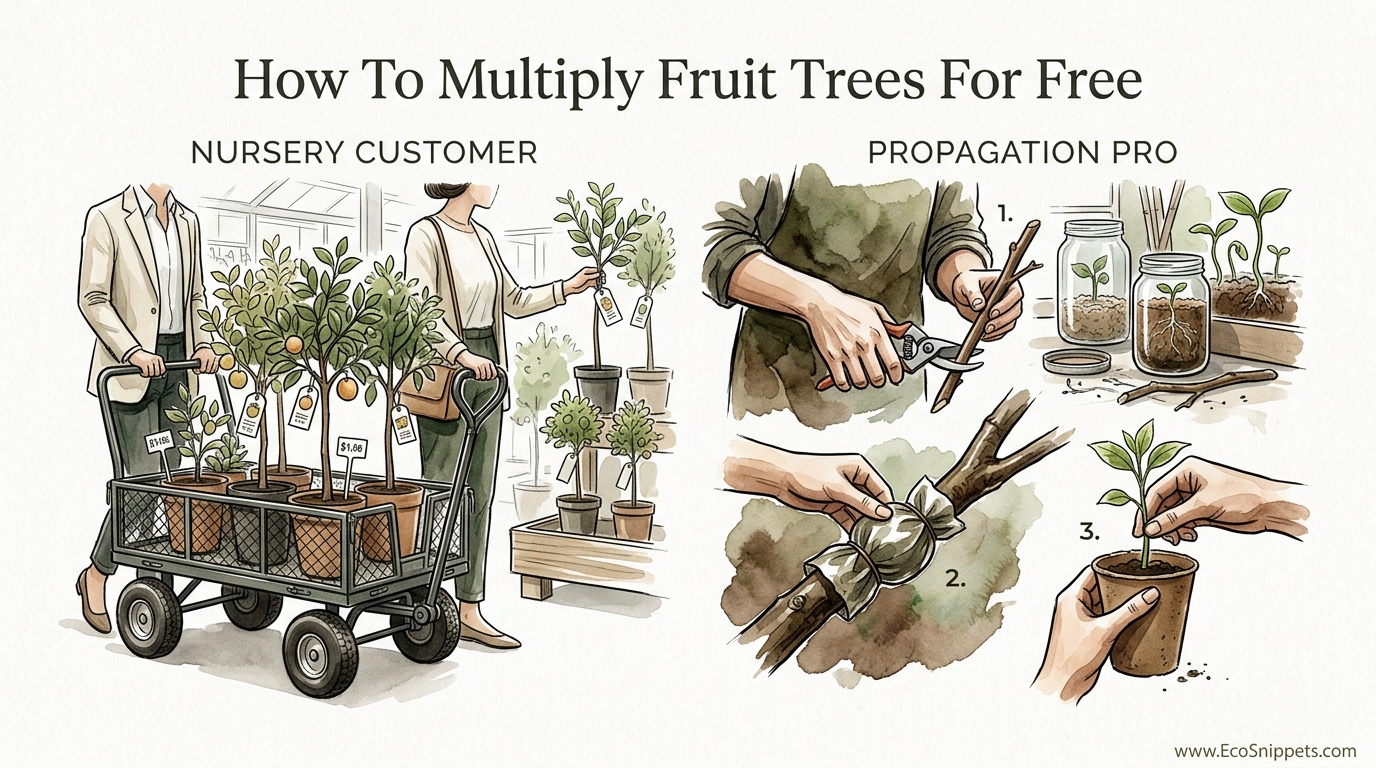
Why are you still paying retail prices for a forest that wants to grow itself for free? Most people think a food forest costs thousands in nursery fees. The truth? One healthy branch and a bit of sand can turn a single tree into an entire orchard by next spring. Here is how we stopped being plant consumers and started being plant producers.
Creating a self-sustaining food system requires a shift in mindset. Instead of looking at a tree as a single purchase, start seeing it as a mother plant—a source of infinite potential. Ancestral wisdom teaches us that nature is inherently abundant, provided we know how to work with her cycles. Taking control of your plant supply chain ensures that you have resilient, locally-adapted stock that hasn’t been pampered in a climate-controlled greenhouse.
Mastering the art of propagation is the ultimate skill for any homesteader or forest gardener. It allows you to expand your orchard at zero cost, preserve rare heirloom varieties, and even trade with neighbors to diversify your landscape. This guide will walk you through the grit and grace of multiplying your fruit trees using the same techniques used by our ancestors for centuries.
How To Multiply Fruit Trees For Free
Propagation is the process of creating new plants from a variety of sources, such as seeds, cuttings, or other plant parts. In the context of fruit trees, we focus primarily on vegetative propagation. This method ensures that the new tree is a genetic clone of the parent, carrying the exact same fruit quality, disease resistance, and growth habits.
When you plant a seed from a grocery store apple, the resulting tree is a genetic lottery. It will likely produce small, sour “crab” apples because fruit trees are heterozygous. Vegetative propagation bypasses this uncertainty. We take a piece of a “mother” tree and encourage it to grow its own roots or fuse it onto an existing root system. This allows us to replicate a perfect Fig or a prize-winning Mulberry infinitely.
The real-world application of these methods is what built the great orchards of the past. Farmers didn’t order “units” from a catalog; they shared scion wood and took cuttings during the dormant season. Understanding the cambium layer—the thin green ring of life just beneath the bark—is the secret to all successful multiplication. This is where the magic of cell division happens, turning a wounded branch into a thriving new organism.
Methods of Multiplication: Cuttings, Layering, and Grafting
Every tree species has a “preferred” way of being born. Some, like the Fig (Ficus carica) or Elderberry (Sambucus), are so eager to live they will grow roots if you simply stick a dormant stick in the mud. Others, like Apples (Malus domestica) or Cherries (Prunus avium), are more stubborn and require the sophisticated union of grafting.
Hardwood Cuttings: The Winter Sleepers
Hardwood cuttings are taken when the tree is fully dormant, usually in late autumn or mid-winter. This is the simplest method for beginners. You are essentially harvesting energy-rich wood that is waiting for spring to explode into life.
Choose wood from the previous year’s growth. It should be about the thickness of a pencil, roughly 0.75 cm to 1 cm (0.3 to 0.4 inches). Cut lengths of 15 cm to 25 cm (6 to 10 inches). Make a straight cut at the base just below a bud node and a slanted cut at the top above a node. The slant helps shed water and reminds you which end is “up.”
Softwood and Semi-Hardwood Cuttings
Softwood cuttings are taken in late spring or early summer from the current year’s new, flexible growth. These root very quickly—sometimes in as little as 3 to 4 weeks—but they are fragile. They lack a woody exterior, meaning they can dehydrate in hours if not kept in a humid environment.
Semi-hardwood cuttings are the middle ground. These are taken in late summer when the base of the new growth has started to turn woody but the tip is still soft. This method is excellent for evergreen fruit trees or Mediterranean species like Olives.
Air Layering: Rooting on the Branch
Air layering is a fascinating technique where you force a branch to grow roots while it is still attached to the mother tree. This provides the new plant with a continuous supply of water and nutrients while it develops its own root system. It is one of the most successful methods for “difficult” trees like Citrus or Pomegranate.
The process involves removing a ring of bark (girdling) from a healthy branch and wrapping the wound in moist sphagnum moss. You then seal the moss in plastic to retain moisture. After 8 to 12 weeks, you will see roots filling the plastic. You simply snip the branch below the roots and pot it up. You have essentially “born” a 2-foot tall tree that is ready to hit the ground running.
Natural Rooting Hormones: The Ancestral Toolkit
Modern nurseries use synthetic powders containing Indole-3-butyric acid (IBA), but nature provides her own stimulants. You do not need a laboratory to give your cuttings a head start.
The Power of Willow Water
Willow trees (Salix spp.) are champions of regeneration. They contain high concentrations of salicylic acid (which protects against rot) and IBA (which triggers root growth). To make “Willow Water,” harvest young green willow twigs and cut them into 1-inch (2.5 cm) pieces. Steep them in water for 48 to 72 hours. Soak your fruit tree cuttings in this tea before planting to significantly increase your success rate.
Honey, Aloe, and Cinnamon
Raw honey acts as a natural antiseptic and antifungal agent, protecting the fresh cut from soil-borne pathogens. Aloe vera gel contains enzymes and nutrients that reduce stress on the cutting. A light dusting of cinnamon on the tip of a cutting acts as a potent fungicide. These simple kitchen staples replace the need for chemical inputs while honoring the health of your soil.
Benefits of Home Propagation
The advantages of multiplying your own trees go far beyond the financial savings, though those are substantial. A single heirloom apple tree from a nursery might cost $50 to $100. For that same price, you can buy the tools to produce 500 trees over your lifetime.
Local adaptation is perhaps the greatest benefit. When you take a cutting from a tree that has survived a decade of your local droughts, frosts, and pests, you are selecting for resilience. Commercial nurseries often grow trees in ideal conditions that don’t reflect the “grit” of your backyard. Your home-grown clones are born into your microclimate.
Furthermore, propagation allows for the preservation of history. Many old farmsteads contain “mystery” trees with incredible flavor that are no longer sold commercially. By learning to graft or take cuttings, you become a steward of biodiversity, ensuring these unique flavors aren’t lost to time.
Common Mistakes to Avoid
Many beginners fail because they ignore the simple laws of biology. The most frequent error is **incorrect orientation**. If you plant a cutting upside down, the polarity of the plant’s vascular system will fight against gravity and the cutting will die. Always mark the “top” with a slanted cut.
**Desiccation** is the second great killer. A cutting has no roots to drink with, but its leaves (if it has any) continue to breathe out water. If the air is too dry, the cutting will shrivel in days. Using a humidity dome or a simple clear plastic bag over your pots is mandatory for softwood and semi-hardwood success.
**Poor sanitation** often leads to fungal rot. Use a sharp, clean knife or bypass pruners. A ragged cut crushes the delicate cambium cells, making it harder for the plant to heal and easier for bacteria to enter. Disinfect your tools with rubbing alcohol between different trees to prevent the spread of diseases like fire blight.
Limitations: When Propagation is a Challenge
Not every tree can be multiplied with a simple stick in the sand. Pome fruits like Apples and Pears almost never root from cuttings. While you might get lucky once in a hundred tries, it is a waste of time for a serious practitioner. These species require **grafting** onto a rootstock.
Time is another factor. While a cutting from a mature tree will often fruit within 2 to 3 years, a tree grown from seed might take 7 to 15 years to reach maturity. If you are looking for a “fast” orchard, avoid seeds and stick to vegetative methods.
Environmental constraints also play a role. If you live in an extremely arid climate, outdoor propagation is difficult without a dedicated misting system. Most propagation is best done in a sheltered area where you can control the moisture levels until the new root systems are established.
Comparison: Cuttings vs. Grafting vs. Air Layering
| Method | Best For | Difficulty | Time to Root |
|---|---|---|---|
| Hardwood Cuttings | Figs, Mulberries, Elderberries, Grapes | Easy | 2–4 Months |
| Air Layering | Citrus, Pomegranates, Lychee | Moderate | 8–12 Weeks |
| Grafting | Apples, Pears, Cherries, Peaches | Advanced | 3–6 Weeks (Union) |
Practical Tips for Success
Invest in a **propagation box**. This can be as simple as a plastic storage bin with a few inches of coarse sand or a mix of 50% peat and 50% perlite in the bottom. This environment maintains high humidity and stable temperatures, which are the two most critical factors for root development.
Label everything immediately. A dormant branch from a Peach tree looks remarkably like a branch from a Plum. Use a permanent marker on plastic tags or, better yet, use the “pioneer method” of etching into thin strips of aluminum or zinc. There is nothing more frustrating than having twenty healthy trees and not knowing which one produces the fruit you actually want.
Watch the buds. In the Northern Hemisphere, your window for hardwood cuttings is usually December through February. In the Southern Hemisphere, look to June through August. The goal is to harvest the wood while the “sap is down.” Once the buds start to swell and turn green, the energy is moving upward, and your success rate for cuttings will plummet.
Advanced Considerations: The Role of Rootstocks
Once you master basic cloning, you will eventually want to explore grafting. Grafting is the “marriage” of two different plants. The **rootstock** provides the root system (and often controls the tree’s ultimate size), while the **scion** provides the fruit variety.
Using a “Malling” series rootstock can turn a standard apple tree that grows 30 feet (9 meters) tall into a dwarf tree that only reaches 8 feet (2.4 meters). This allows you to fit ten varieties into the space of one. Advanced practitioners often create “Frankentrees” or multi-graft trees, where a single trunk supports branches of peaches, plums, and apricots simultaneously.
Understanding compatibility is key. You can graft a Pear onto a Quince rootstock to induce early fruiting, but you cannot graft an Apple onto an Oak. Stay within the same botanical family (Rosaceae is the big one for fruit) for the best chance of a lasting union.
Example Scenario: Propagating a Fig from a Single Branch
Imagine you visit a neighbor who has a Fig tree that produces honey-sweet, purple fruit every August. You want that exact tree. Here is the step-by-step process using the hardwood cutting method.
In late winter, ask for a 10-inch (25 cm) branch of last year’s growth. It should be gray-brown and firm. Wrap it in a damp paper towel and take it home. Prepare a pot with a mix of sharp sand and potting soil.
Dip the bottom end of the cutting into a bit of raw honey, then push it 6 inches (15 cm) deep into the soil. Ensure at least two bud nodes are below the surface and at least two are above. Keep the pot in a bright, frost-free spot—a garage window or a covered porch is perfect.
By mid-spring, the buds will begin to open. Do not be fooled! Leaves do not mean roots have formed. The cutting is using its stored sugars to push leaves. Be patient. By early summer, you will see roots emerging from the drainage holes of the pot. At this point, your “free” tree is ready to be hardened off and planted in its permanent home.
Final Thoughts
Nature is designed for expansion. Every tree in your yard is a factory of potential, waiting for you to take the lead. By moving from a “plant consumer” to a “plant producer,” you reclaim a piece of ancestral independence that has been largely forgotten in the age of big-box garden centers.
Multiplying your own fruit trees is an exercise in observation and patience. It connects you to the seasons in a way that simply buying a tree never can. You begin to notice the subtle swelling of buds, the flow of the sap, and the resilience of a small stick fighting to become a forest.
Start small this season. Take five cuttings of a berry bush or try one air layer on a citrus branch. Even if only one survives, you have gained a tree and a skill that will serve you for a lifetime. The forest wants to grow itself for free—all it needs is your hands to help it along.
