How To Become More Self-Sufficient Without Starting a Full-Blown Farm…
Want to start preserving your harvest, making your own soap, or building a backyard root cellar — but not sure where to begin? “Homesteading Advice” gives you instant lifetime access to 35+ practical homesteading books on food preservation, veggie gardening, DIY natural cleaning products (save over $250 per year with this skill alone), brewing, off-grid energy, and a whole lot more…
Click Here To Check It Out Now!
One farmer pays for gasoline to kill his grass; the other lets his sheep turn that grass into free fertilizer and high-end lamb. Your orchard grass is either an expensive chore or a free resource. Learn how to integrate small ruminants to delete your fuel bill and triple your soil fertility.
Integrating livestock into your orchard is not a new invention; it is a return to an ancestral wisdom that recognizes the farm as a living web rather than a series of isolated boxes. For decades, modern agriculture has encouraged us to separate the cow from the corn and the sheep from the apple tree. This separation created two problems where there was once a solution: a waste problem for the livestock owner and a fertility problem for the orchardist. Reconnecting these systems allows you to step out of the cycle of rising input costs and back into a self-reliant rhythm of production.
Practical self-reliance requires looking at your land with new eyes. Every blade of grass between your tree rows represents solar energy captured. If you mow that grass with a tractor, you are burning fossil fuels to throw that energy away. If you graze it, you are harvesting that energy to build animal muscle and soil health. This guide will walk you through the mechanics of managing a dual-purpose landscape where the trees provide the shade and the fruit, while the animals provide the labor and the life.
Integrated Livestock Orchard Management
Integrated Livestock Orchard Management (ILOM) is the deliberate practice of grazing domesticated animals—most commonly sheep or poultry—beneath fruit or nut trees to manage vegetation and disrupt pest cycles. In the broader world of agroforestry, this is known as silvopasture. It is a system where the trees, the forage, and the livestock are managed as a single biological unit rather than three competing enterprises.
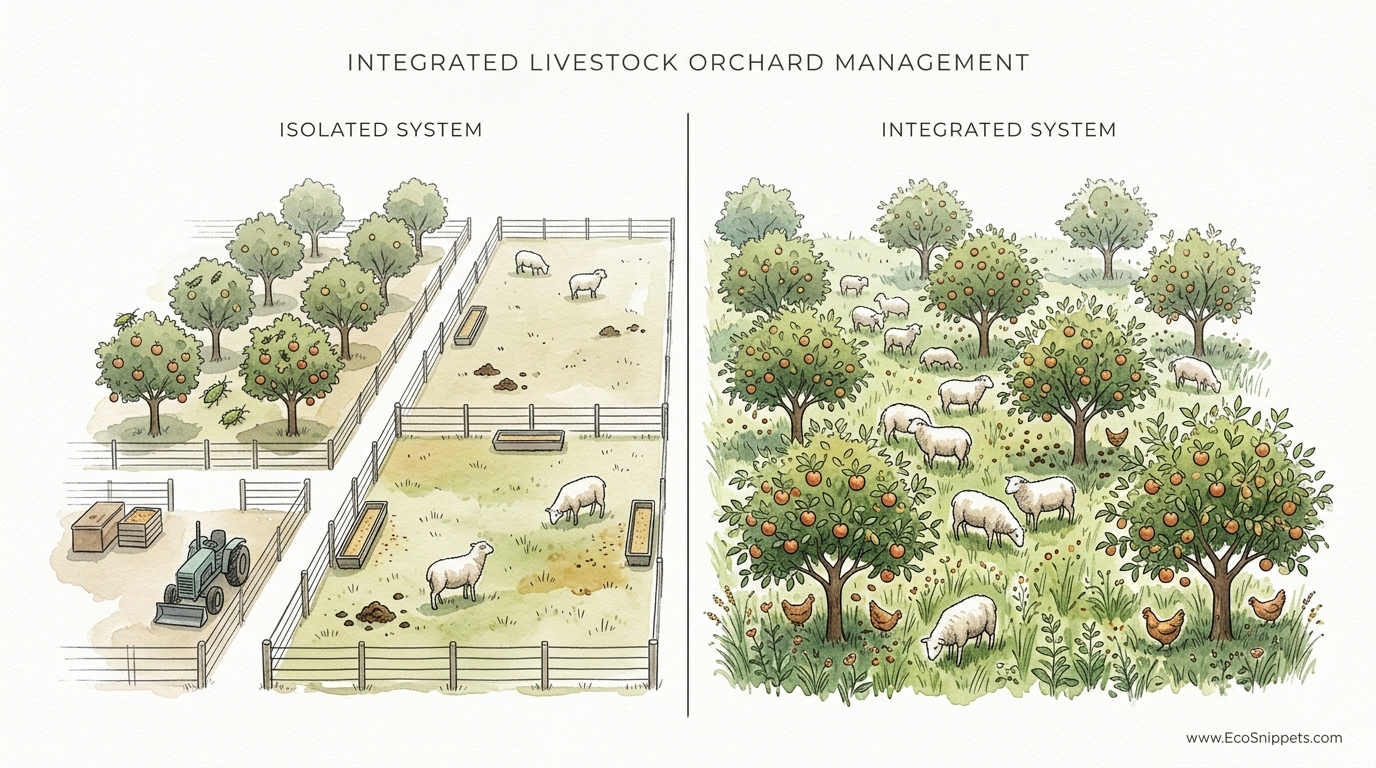
In a typical orchard, the “orchard floor” is often viewed as a maintenance liability. Farmers spend significant portions of their budget on herbicides to keep “weed-free” strips or on diesel to keep the alleys mowed. This keeps the orchard tidy, but it does nothing for the long-term health of the soil. In an integrated system, that same orchard floor becomes a high-value pasture. Sheep act as biological mowers, converting orchard grass, broadleaf weeds, and fallen fruit into nutrient-rich manure that is deposited directly at the base of the trees.
The real-world application of this system varies by crop. In apple and pear orchards, sheep are often used to manage the grass and clean up “windfall” fruit that would otherwise harbor pests like the codling moth. In nut orchards, such as pistachio or almond, sheep are increasingly used for “orchard sanitation,” eating the “mummy” nuts left on the ground after harvest which serve as overwintering sites for the navel orangeworm. Whether you are managing five heirloom trees in a backyard or fifty acres of commercial fruit, the principles remain the same: use the animal to do the work that the machine currently does.
How It Works: The Mechanics of Integration
The success of an integrated orchard depends on timing, movement, and animal behavior. You cannot simply turn a flock of sheep into an orchard and hope for the best; you must manage them with the same precision you use for your pruning shears.
Rotational Grazing and Movement
Sheep should never be left in one section of the orchard for too long. If they stay in one spot, they will graze the most palatable grasses down to the roots while ignoring the weeds, eventually leading to soil compaction and damage to the tree bark. The most effective method is a daily or frequent rotation using portable electric netting or polywire. By confining the flock to a small “cell” or “lane” between tree rows, you force them to graze evenly. Once they have taken the grass down to a height of about 3 to 4 inches (7.5 to 10 cm), you move them to the next section. This “graze and rest” cycle allows the pasture to recover and prevents the buildup of internal parasites, which is the primary health challenge for sheep in humid climates.
Pest Cycle Disruption
One of the most powerful functions of livestock in the orchard is biological pest control. Many of the most common fruit pests depend on fallen fruit to complete their life cycles. For example, the plum curculio and the codling moth often drop to the ground inside infested fruit. If that fruit sits on the ground, the larvae crawl into the soil to pupate and return the following year to infest more trees. Sheep are excellent “sanitation crews.” They will seek out and eat these fallen “drops,” effectively digesting the pests before they can reach the soil. In nut orchards, sheep have been shown to reduce “mummy” nut densities by up to 25%, significantly lowering the population of overwintering navel orangeworms.
The Bark Factor
The most common concern with sheep in orchards is “barking”—the stripping of bark from the tree trunks. Sheep generally prefer grass, but they will turn to bark if they are bored, hungry, or lacking in specific minerals. Choosing “tree-friendly” breeds is the first line of defense. Breeds like the Olde English Babydoll Southdown and the Shropshire are prized because they are shorter and less likely to stand on their hind legs to reach branches or rub excessively against trunks. However, even with these breeds, management is key. Moving the animals before the forage gets too short ensures they don’t look at the trees as a secondary food source.
Benefits of the Integrated Approach
Choosing to integrate livestock into your orchard provides measurable gains in fertility, labor efficiency, and farm resilience.
* Triple Soil Fertility: Sheep manure is a high-quality fertilizer that is better distributed than cattle manure. It is rich in nitrogen, phosphorus, and potassium. Research has shown that regular application of sheep manure can increase soil organic matter from 0.6% to over 3.6% in just a few seasons. This increase in organic matter improves the soil’s cation exchange capacity (CEC), meaning the soil can hold onto nutrients and water much more effectively.
* Elimination of Fuel Costs: Mowing an orchard can require multiple passes per month during the growing season. By using sheep, you replace diesel-burning mechanical mowers with biological ones that move themselves. For many small-scale producers, this can completely delete the fuel bill associated with orchard floor maintenance.
* Diversified Income: An integrated system allows you to harvest two crops from the same acre. You are not just selling apples; you are raising high-end, grass-fed lamb. This diversification provides a financial safety net. If a late frost ruins the fruit crop, you still have the livestock to provide income for the year.
* Reduced Chemical Dependency: Because sheep manage the weeds and disrupt the pest cycles, the need for herbicides and certain insecticides is greatly reduced. This is particularly beneficial for organic growers who have fewer chemical tools at their disposal.
* Enhanced Moisture Retention: As the sheep graze and the soil organic matter increases, the ground becomes more like a sponge. This reduces the need for irrigation and helps the trees withstand periods of drought.
Challenges and Common Mistakes
While the benefits are significant, the transition to an integrated system requires a learning curve. Most failures in this system come from a lack of observation or improper infrastructure.
Overgrazing and Soil Compaction: Leaving too many sheep in one area for too long is the fastest way to ruin an orchard. When the grass is gone, the sheep will start to eat the tree bark or low-hanging branches. Additionally, their hooves can compact the soil, especially in wet conditions, which can stress the tree roots. You must be prepared to move the animals based on the condition of the grass, not just a calendar.
Nutritional Imbalances and Bloat: Windfall fruit is a high-energy snack, but too much of it can be dangerous. If sheep gorge themselves on fallen apples or pears, they can suffer from rumen acidosis or bloat. This is most common in the late summer and fall. To prevent this, limit the flock’s access to the orchard during peak “drop” times or ensure they have a belly full of dry hay or grass before being moved into a row with lots of fallen fruit.
Infrastructure Failure: Using a single strand of electric wire is rarely enough for sheep, who are well-insulated by their wool. You need high-voltage fencing (at least 3,000 to 5,000 volts) and a reliable grounding system to ensure they respect the boundaries. Fencing is not a place to cut corners.
Limitations and Realistic Constraints
Integrated management is not a “set it and forget it” solution, and there are situations where it may not be the ideal choice.
Environmental and Topographical Constraints: On extremely steep or rocky slopes, managing portable fencing and providing water to a flock can be difficult and labor-intensive. If your orchard is on terrain that is difficult for you to walk daily, it will be even more difficult to manage livestock there.
The 120-Day Manure Rule: For those growing fruit for commercial sale, food safety regulations are a major constraint. In the United States, Good Agricultural Practices (GAP) and the Food Safety Modernization Act (FSMA) typically require a 90 to 120-day interval between the application of raw manure (including grazing) and the harvest of crops that touch the ground or are eaten fresh. This means you must pull the sheep out of the orchard about four months before you plan to pick the fruit. This creates a management gap in the late summer when the grass is often growing its fastest.
Young Trees: Young fruit trees with thin, tender bark are at the highest risk for damage. Until a tree is well-established (usually 3 to 5 years old), it should be protected by sturdy, physical tree guards or excluded from the grazing area entirely. Sheep can snap a young sapling just by leaning on it or scratching their backs.
Comparison: Isolated vs. Integrated Systems
To understand the value of integration, we must look at how it compares to the conventional “isolated” model of orchard management.
| Feature | Isolated System (Mowed) | Integrated System (Grazed) |
|---|---|---|
| Primary Input | Fossil fuels & synthetic fertilizers | Animal labor & solar energy |
| Pest Management | Chemical sprays & tillage | Biological consumption of windfall |
| Soil Health | Static or declining organic matter | Increasing organic matter & microbial life |
| Economic Yield | Single crop (Fruit/Nuts) | Dual crop (Fruit + Meat/Wool) |
| Complexity | Low (mechanical/chemical) | High (biological/management) |
Practical Tips and Best Practices
If you are ready to introduce sheep to your orchard, following these best practices will save you from common headaches and livestock losses.
* Start with Wethers: If you are new to sheep, start with wethers (castrated males) rather than a breeding flock. Wethers are generally hardier, have lower nutritional requirements, and won’t present the complications of lambing while you are still learning to manage the orchard floor.
* Invest in Quality Fencing: Use “electro-netting” for its ease of movement and visual barrier. Ensure your energizer is rated for the total length of the fence and that you have at least three 6-foot (1.8 m) ground rods driven into moist soil. Poor grounding is the number one cause of sheep “escaping” the system.
* The Two-Foot Rule for Guards: When building tree guards, use four sturdy wooden stakes or heavy-duty T-posts in a square about 2 feet (60 cm) away from the trunk. Wrap this square in heavy-gauge welded wire mesh. Avoid chicken wire; it is too flimsy and sheep will simply crush it to reach the bark.
* Monitor for Copper Toxicity: This is a critical safety point. Many orchard fungicides contain copper. Sheep are highly sensitive to copper and can die from chronic accumulation in their livers. If you use copper sprays, you must ensure the grass is thoroughly washed by rain before allowing sheep to graze, or better yet, avoid grazing during the spray season entirely.
* Provide Clean Water and Minerals: Even if the grass is lush, sheep need access to fresh, clean water and a “sheep-specific” mineral mix. Never use a general livestock mineral block, as these often contain copper levels that are toxic to sheep.
Advanced Considerations: Nutrient Cycling and Scaling
For the serious practitioner, moving beyond simple grazing into optimized nutrient cycling can yield even greater results.
The Mathematics of Manure
A single sheep will produce roughly 2 to 3 pounds (0.9 to 1.4 kg) of manure per day. In a well-managed rotational system, this translates to about 15 to 30 tons of organic matter per hectare (approx. 6 to 12 tons per acre) annually. This manure contains approximately 0.76% nitrogen and 0.45% potassium. By adjusting your stocking density and the speed of your rotation, you can effectively “target” fertilizer to specific rows of trees that may be underperforming. For example, if a specific block of trees shows signs of nitrogen deficiency, you can tighten the grazing cell in that area to increase the concentration of manure.
Multi-Species Integration
Some advanced growers use a “leader-follower” system. Sheep are moved through the orchard first to take the “top” of the grass and manage the fruit drops. They are followed 24 hours later by chickens in a mobile coop. The chickens scratch through the sheep manure, spreading it more evenly and eating the fly larvae and any pests the sheep missed. This stacking of enterprises increases the total protein produced per acre and provides a “sanitization” of the pasture, reducing the parasite load for the sheep’s next rotation.
Example Scenario: The 5-Acre Apple Orchard
Consider an established 5-acre (2-hectare) apple orchard with trees spaced 15 feet (4.5 m) apart in rows. The grass is a mix of orchard grass, clover, and dandelions.
The Setup: The owner introduces 15 Shropshire ewes. The orchard is divided into 10 grazing lanes using portable electric netting. Each lane is roughly half an acre.
The Cycle: The ewes are moved to a new lane every 3 to 4 days. In the spring, when the grass is growing rapidly, the rotation is fast to keep the grass from “bolting” and becoming stemmy. In the heat of summer, the rotation slows down to allow the pasture more time to recover.
The Outcome: By the end of the season, the farmer has conducted zero mowing passes, saving approximately 40 gallons (150 liters) of diesel and 20 hours of labor. The sheep are in prime condition and the farmer sells 20 finished lambs in the fall. Soil tests the following spring show a 0.5% increase in organic matter across the entire 5 acres. The presence of codling moth in the fruit is reduced by 15% compared to the previous year when no sheep were present.
Final Thoughts
Turning your orchard grass into a resource rather than a chore is one of the most rewarding steps toward a self-reliant homestead or farm. It requires a shift in mindset—from seeing the farm as a collection of parts to seeing it as a singular, living organism. When you let the sheep do the mowing, you aren’t just saving money on gasoline; you are feeding the earthworms, building the soil, and participating in a cycle of life that has sustained human civilization for millennia.
Success in this system is found in the daily walk. It is found in the moment you observe the height of the grass, the health of the tree bark, and the contentment of the flock. There is no machine that can replace the keen eye of a shepherd-orchardist.
As you move forward, start small. Protect your trees, secure your fences, and choose your animals wisely. The rewards of a more fertile soil and a quieter, more productive orchard are well worth the effort. Apply what you have learned here, experiment with your own timing and breeds, and watch as your land begins to thrive under the careful integration of trees and livestock.
