How To Become More Self-Sufficient Without Starting a Full-Blown Farm…
Want to start preserving your harvest, making your own soap, or building a backyard root cellar — but not sure where to begin? “Homesteading Advice” gives you instant lifetime access to 35+ practical homesteading books on food preservation, veggie gardening, DIY natural cleaning products (save over $250 per year with this skill alone), brewing, off-grid energy, and a whole lot more…
Click Here To Check It Out Now!
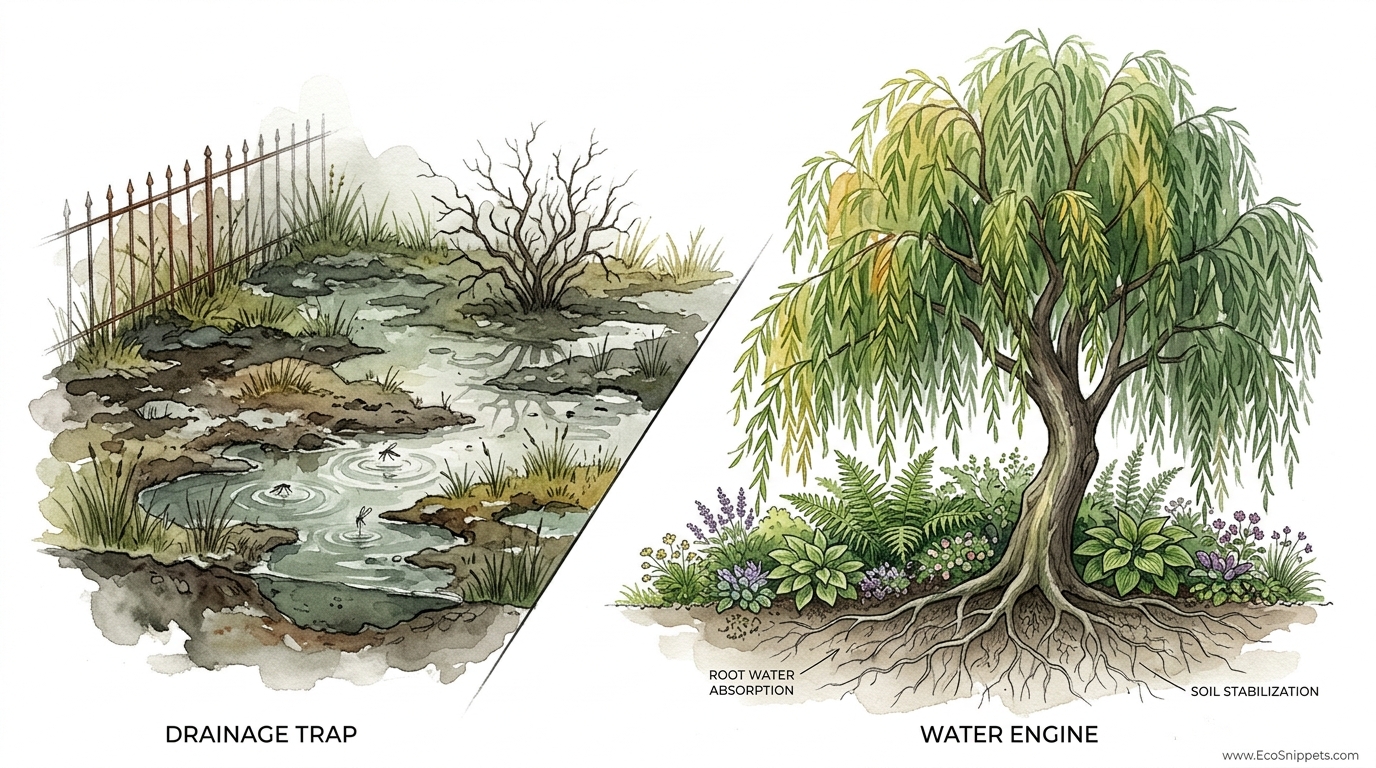
That ‘swamp’ in your backyard isn’t a problem; it’s a high-speed nutrient engine waiting to be planted. Don’t spend thousands on French drains and gravel pits. Nature’s biological pumps can turn a soggy nightmare into a lush, productive paradise. A single willow can move hundreds of gallons of water a day, drying your soil while creating a sanctuary for local wildlife.
Most homeowners look at standing water as a structural failure that requires plastic pipes and heavy machinery. Working with the land’s natural hydrology is often more effective and significantly cheaper. Willows are not just trees; they are specialized living tools designed by evolution to thrive where other plants drown.
Understanding how to deploy these trees requires a shift in perspective. Instead of trying to “get rid” of water, you are learning to manage it. This guide explores the ancestral wisdom of using willows for land reclamation, providing a blueprint for turning a mud hole into a thriving ecosystem.
Willows For Wet Ground Water Management
Willows, members of the genus Salix, are phreatophytes—plants that essentially “mine” the water table. These species have evolved to live in riparian zones, floodplains, and marshes where soil oxygen is low and moisture is high. While most trees suffer from “wet feet” and succumb to root rot, willows thrive by utilizing specialized structures called lenticels to facilitate gas exchange even in saturated conditions.
Water management with willows is the practice of biological drainage. A mature willow acts as a hydraulic pump, drawing moisture from the deep soil layers and releasing it into the atmosphere through transpiration. This process does more than just dry the ground; it stabilizes the soil structure through a dense, fibrous mat of roots that prevents erosion and compaction.
In real-world applications, willows are used for bank stabilization along rivers, as “vegetation filters” for agricultural runoff, and as primary tools in rain gardens. In a backyard setting, they serve as the ultimate solution for low spots where water collects after a storm. Rather than digging a trench to move the water somewhere else—often just making it a neighbor’s problem—you are using the willow to process the water on-site.
Imagine a wet field as a saturated sponge. A French drain is like poking a hole in the bottom of the sponge to let it drip. A willow is like a hand squeezing the sponge and throwing the water into the air. This biological “squeezing” is constant, silent, and powered entirely by the sun.
How the Biological Pump Works
The primary mechanism behind willow drainage is evapotranspiration. This is a two-part process: evaporation from the soil surface and transpiration through the plant’s leaves. Willows are masters of the latter. They possess a high leaf-area index, meaning they have a massive amount of surface area dedicated to releasing water vapor.
A single mature willow tree can move between 50 and 100 gallons (189 to 378 liters) of water on a hot summer day. Some larger species in optimal conditions have been recorded moving even more. This water travels through the xylem, the tree’s internal plumbing system, driven by a pressure gradient. As water evaporates from the leaf, it creates a “tug” that pulls more water up from the roots.
Root architecture is the second half of the equation. Willow roots are opportunistic and fast-growing. They don’t just sit in the water; they actively seek it out, creating a network of microscopic channels in the soil. These channels improve soil porosity, allowing air to penetrate deeper into the earth, which further aids in drying out the ground and supporting beneficial soil microbes.
Planting willows also initiates a process called phytoremediation. The roots act as a biological filter, capturing excess nutrients like nitrogen and phosphorus that often cause algae blooms in nearby ponds. They can even sequester heavy metals such as zinc and copper, locking them away in their biomass and cleaning the groundwater in the process.
Benefits of Biological Drainage
Choosing willows over mechanical drainage systems offers a range of practical advantages that go beyond simple water removal. For those looking for self-reliance and land health, the benefits are measurable.
First and foremost is the cost efficiency. A professional French drain installation can cost anywhere from $2,800 to over $15,000 (roughly €2,600 to €14,000), depending on the length and depth of the trench. In contrast, willow “live stakes”—cuttings taken from a parent tree—can be obtained for the price of a pair of loppers and a bit of labor.
Environmental resilience is another major factor. Plastic pipes can clog with silt, collapse under the weight of the soil, or become home to rodents. A willow system is self-repairing. If a root dies, new ones grow to take its place. The tree adapts to the changing water levels of the seasons, working harder during wet springs and slowing down during dry spells.
Beyond water management, willows provide valuable yields:
- Habitat Creation: Willows are among the first plants to bloom in the spring, providing vital nectar for pollinators when little else is available.
- Craft Materials: Species like Salix viminalis (Common Osier) provide long, flexible “withies” used for basket weaving, living fences (fedges), and garden structures.
- Biomass and Fuel: Willows grow incredibly fast, often 3 to 10 feet (0.9 to 3 meters) per year, making them an excellent source of sustainable firewood or mulch.
- Medicinal Value: Willow bark contains salicin, the ancestral precursor to modern aspirin, offering a natural source of pain relief for those who know how to prepare it.
Challenges and Common Mistakes
While willows are powerful tools, they are not a “plant it and forget it” solution. Their greatest strength—their aggressive thirst—is also their primary danger. The most common mistake is planting a willow too close to home infrastructure.
Willow roots are notoriously “water-seeking.” They can detect the humidity around a tiny crack in a sewer pipe or a septic line and will grow toward it with pinpoint accuracy. Once they reach the pipe, the roots will enter and expand, eventually causing a total blockage or a structural collapse.
Another frequent error is underestimating the tree’s eventual size. A Weeping Willow (Salix babylonica) can reach a spread of 50 feet (15 meters) or more. Planting such a massive tree in a small suburban lot often results in the tree having to be removed just as it reaches its peak water-moving capacity because it begins to interfere with power lines or neighboring properties.
Maintenance is also a factor. Willows are “messy” trees. They have relatively brittle wood and frequently drop small branches and leaves. In a managed landscape, this requires regular cleanup. If you are not prepared for the debris, the very tree you planted to solve a drainage problem might end up clogging your surface gutters or culverts with its own fallen limbs.
Limitations of the Willow Engine
Willows are not a universal fix for every wet spot. There are specific environmental and practical boundaries to their effectiveness.
Environmental constraints include:
- Sunlight Requirements: Most willow species are “pioneer species” that require full sun to grow vigorously. They will not function as effective water pumps in deep shade.
- Lifespan: Compared to oaks or maples, willows have short lives. A typical willow may only live 30 to 50 years. This means you must plan for their eventual decline and replacement.
- Soil pH: While adaptable, willows generally prefer slightly acidic to neutral soil. Extremely alkaline soils can lead to chlorosis (yellowing of the leaves) and reduced vigor.
Practical boundaries involve the “Water Engine vs. Drainage Trap” reality. Willows move water upward through their leaves. If it is a particularly humid or rainy week with no sun, transpiration slows down significantly. In these moments, a mechanical drain that relies on gravity will still be moving water, whereas a willow might be “idling.”
Additionally, willows do not work in the dead of winter in cold climates. When the leaves drop, the transpiration engine shuts off. While the roots still provide some soil stabilization, the massive water-moving capacity is lost until the spring buds break. If your primary drainage issue occurs during winter thaws, you may need to supplement your willows with a physical swale or a dry creek bed.
Comparison: Biological Pump vs. French Drain
Deciding between a natural solution and an engineered one requires looking at the long-term investment.
| Feature | Willow (Biological Pump) | French Drain (Mechanical) |
|---|---|---|
| Initial Cost | Very Low ($0 – $100) | High ($2,000 – $15,000) |
| Maintenance | Pruning, debris cleanup | Periodic flushing, clearing clogs |
| Longevity | 30 – 70 years (self-replacing) | 20 – 30 years (before replacement) |
| Secondary Benefits | Wildlife, fuel, aesthetics, soil health | None (purely functional) |
| Failure Mode | Disease, storm damage | Siltation, pipe collapse |
| Installation Impact | Low (simple planting) | High (trenching, heavy machinery) |
Practical Tips for Planting Willow Live Stakes
The most efficient way to establish a water management grove is through “live staking.” This is an ancient technique where dormant branches are driven directly into the mud.
1. Timing is Everything: Harvest and plant your stakes during the dormant season—late autumn through early spring, before the buds begin to swell. This allows the cutting to focus all its energy on root development before it has to support leaves.
2. Selection: Choose healthy, straight branches from a parent tree. The stakes should be between 0.5 and 1.5 inches (1.3 to 3.8 cm) in diameter and about 2 to 3 feet (60 to 90 cm) long.
3. Preparation: Cut the bottom of the stake at a 45-degree angle to create a point. Cut the top flat. This ensures you plant them right-side up (willows planted upside down will die) and makes them easier to drive into the ground.
4. The 48-Hour Soak: Before planting, place the bottom 6 inches (15 cm) of the stakes in a bucket of water for 48 hours. This hydrates the tissue and “wakes up” the root-forming cells (primordia) under the bark.
5. Installation: Use a piece of rebar or a planting bar to create a pilot hole in the wet ground. Insert the stake so that at least two-thirds of its length is underground. This is critical—the deeper the stake, the more access it has to consistent moisture and the more stable it will be.
6. Firming In: Tamp the soil firmly around the stake to eliminate air pockets. If the soil is loose, the roots will dry out and die before they can establish.
Advanced Considerations: Coppicing and Pollarding
For those who want to maximize the “engine” while minimizing the “mess,” ancestral pruning techniques like coppicing and pollarding are essential.
Coppicing is the practice of cutting a tree back to ground level every 1 to 3 years. This forces the willow to send up dozens of straight, vigorous shoots. From a water management perspective, this keeps the root system extremely active while keeping the top growth manageable. The resulting “whips” are the primary material for high-quality basketry and garden hurdles.
Pollarding is similar but involves cutting the tree back to a main trunk at a height of 6 to 10 feet (1.8 to 3 meters). This was traditionally done to keep the new growth out of the reach of grazing livestock. Pollarded willows develop a distinctive “knobby” head and can provide a lifetime of small-diameter firewood or mulch while maintaining a smaller footprint in the landscape.
Managing your willows this way also extends their lifespan. By regularly removing old wood, you reduce the weight on the trunk and decrease the risk of the tree splitting during a storm. It keeps the tree in a perpetual state of “juvenile” vigor, which is when its water-processing capabilities are often at their highest relative to its size.
Scenario: Reclaiming a Saturated Back Corner
Consider a typical 0.25-acre (0.1-hectare) lot with a back corner that stays underwater for three days after any significant rain. The soil is heavy clay, and the grass has been replaced by moss and sedges.
Instead of a $4,000 drainage project, the owner chooses a multi-tiered willow approach. They plant three Black Willows (Salix nigra) at the lowest point, spaced 15 feet (4.5 meters) apart. Along the edges of the wet zone, they plant a row of Dappled Willows (Hakuro Nishiki), a shrubby variety that adds ornamental color.
By the second year, the Black Willows have grown 6 feet (1.8 meters) tall. The standing water now disappears within 12 hours of a storm. By the fifth year, the ground is firm enough to walk on year-round. The owner now harvests the Dappled Willow branches every spring for indoor floral arrangements, and the “swamp” has become a “willow garden” that requires only an hour of pruning once a year.
Final Thoughts
The transition from viewing a wet yard as a problem to seeing it as a resource is the hallmark of a resilient land manager. Willows offer a bridge between the wild world and the domestic one, providing a functional solution that actually improves the health of the earth. They remind us that nature has already solved most of our engineering problems; we simply need to learn how to plant the solution.
Start small. Find a native willow near a local creek, take a few cuttings this winter, and place them in your problem area. Watch how they interact with the soil and the water. You will likely find that the “swamp” wasn’t a curse, but a place where the earth was asking for a specific kind of life to take root.
Embrace the willow as a living partner in your landscape. Whether you are seeking to dry out a pasture, protect a foundation, or simply create a beautiful, bird-filled sanctuary, these trees are ready to do the heavy lifting. Turn off the excavator, put down the plastic pipe, and let the biological pump begin its work.
