How To Become More Self-Sufficient Without Starting a Full-Blown Farm…
Want to start preserving your harvest, making your own soap, or building a backyard root cellar — but not sure where to begin? “Homesteading Advice” gives you instant lifetime access to 35+ practical homesteading books on food preservation, veggie gardening, DIY natural cleaning products (save over $250 per year with this skill alone), brewing, off-grid energy, and a whole lot more…
Click Here To Check It Out Now!
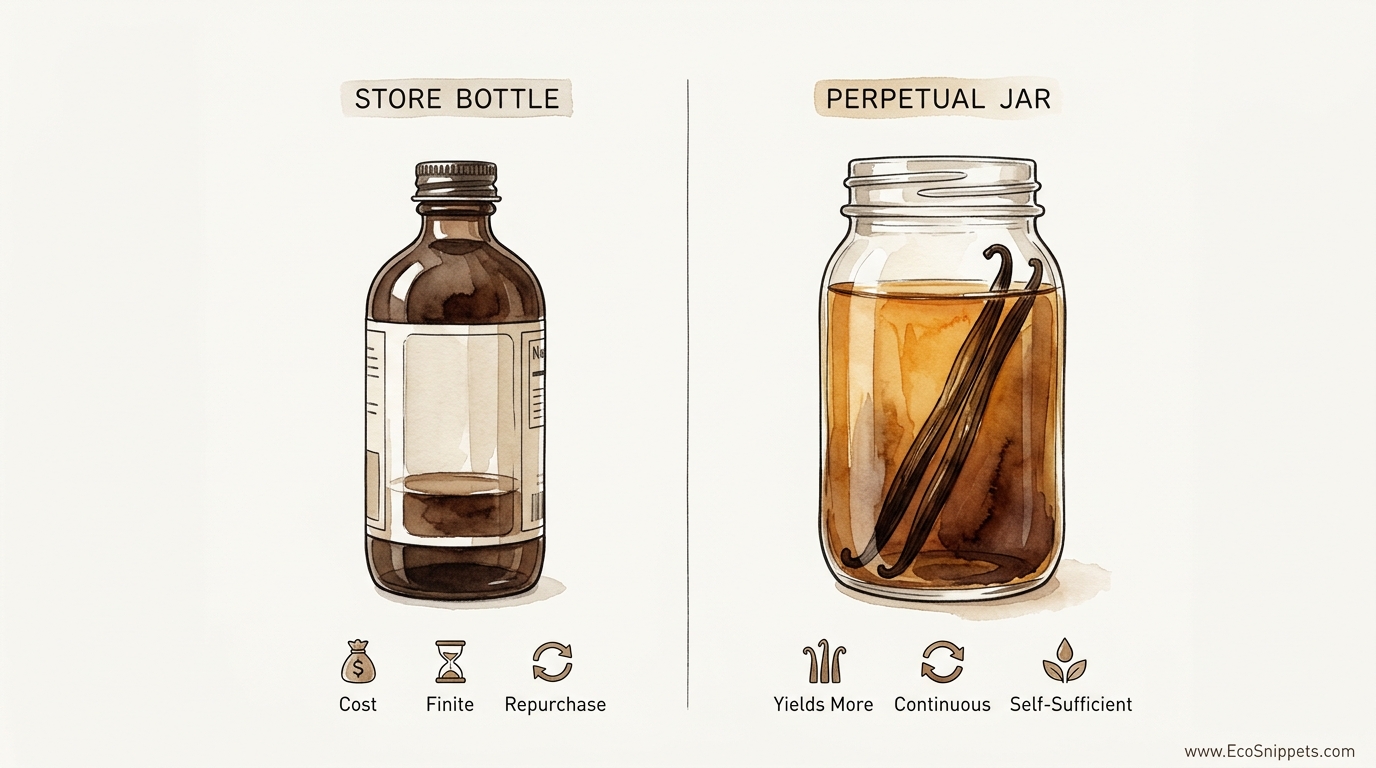
You are paying a 1,000% markup for a product that you can actually grow into an infinite supply in your own pantry. The grocery store wants you to buy 2 ounces at a time for a premium. The ‘Producer’ mindset uses a Solera-style jar. Add beans, add spirits, use some, and top it off. The flavor gets deeper every year, and your cost per ounce drops to nearly zero over a decade.
Step into any modern supermarket and look at the baking aisle. You will see small, 2-ounce (60 ml) amber bottles of “pure” vanilla extract priced as if they contained liquid gold. Often, these extracts are barely a year old and are mass-produced using industrial methods that prioritize speed over depth. For the consumer, this is a recurring tax on every batch of cookies or loaf of bread.
Switching to a “Producer” mindset changes the math entirely. Instead of viewing vanilla as a disposable commodity, you view it as a living system. A Solera-style mother jar is a legacy project for your pantry. It is an investment in flavor that pays dividends for the rest of your life. Once you establish this system, you never buy another bottle of extract again.
This guide will walk you through the transition from a consumer of expensive, diluted extracts to a producer of the world’s finest vanilla. We will cover the science of maceration, the history of the vanilla orchid, and the practical steps to ensure your “infinite” jar remains safe and potent for decades.
How To Make Infinite Vanilla Extract
Infinite vanilla extract is a continuous maceration system where vanilla beans are steeped in high-proof alcohol to extract their complex flavor compounds. Unlike the commercial “single-fold” extracts found in stores, a perpetual jar allows the beans to stay in the liquid indefinitely. This creates a “double-fold” or even “triple-fold” concentration that only improves with age.
In the world of fine spirits, this is often called the Solera method. It involves a “mother jar” that is never fully emptied. When you use 2 ounces (60 ml) of extract for your baking, you immediately replenish the jar with 2 ounces of fresh spirits and, occasionally, a fresh bean. The existing, aged extract “teaches” the new alcohol, while the old beans continue to release their remaining oils alongside the new ones.
This system exists because vanilla beans are incredibly resilient. A single bean can continue to release flavor for years if kept submerged in an appropriate solvent. By maintaining a perpetual jar, you take advantage of the 250 to 500 different flavor compounds found in natural vanilla—compounds that imitation vanillin simply cannot replicate.
In real-world terms, this means you always have a high-quality, professional-grade ingredient on hand. You are no longer at the mercy of supply chain fluctuations or the rising costs of Madagascar’s harvest. You have created a closed-loop system in your own kitchen that provides superior flavor for a fraction of the retail price.
The Mechanics of Extraction: How It Works
Making extract is a process of chemistry known as maceration. Alcohol acts as a solvent. It breaks down the cell walls of the vanilla bean and dissolves the vanillin, essential oils, and resins into the liquid. This is not a fast process. While you can get a “vanilla-flavored” spirit in a few weeks, a true extract requires months to develop its full spectrum of aroma and taste.
The first principle of a successful perpetual jar is the choice of solvent. The alcohol must be at least 80 proof (40% alcohol by volume). This concentration is high enough to extract the flavors effectively and, more importantly, high enough to act as a preservative. At 80 proof, no bacteria or mold can survive in the jar, making the extract shelf-stable for decades.
Surface area is the second principle. To speed up the initial extraction, most producers split the beans lengthwise. This exposes the “caviar”—the thousands of tiny seeds inside the pod—to the alcohol. Some choose to scrape the seeds into the jar, while others simply leave the split pod intact. Both methods work, but splitting the bean is essential for the solvent to reach the interior resins.
The third principle is patience. In the first three months, the extract will smell mostly of alcohol. Between six and twelve months, the harsh alcohol notes fade, replaced by a deep, woody, and sweet aroma. In a perpetual system, the “old” liquid provides a buffer, ensuring that even when you top off the jar with new spirits, the overall flavor remains mature and complex.
The Ingredients: Choosing Your Beans and Spirits
The quality of your infinite extract depends entirely on the raw materials you start with. Because you are only doing this once, it pays to select ingredients that align with your preferred flavor profiles.
Selecting the Right Vanilla Beans
Vanilla beans are generally categorized into two grades: Grade A and Grade B. For the purpose of making extract, Grade B is the superior choice.
Grade B (Extract Grade): These beans have a lower moisture content (usually 20-25%). They may look dry, brittle, or “ugly,” but they are more concentrated in flavor. Because you are not paying for water weight, you get more vanillin per ounce. They are also significantly cheaper than Grade A beans.
Grade A (Gourmet Grade): These beans are plump, moist, and oily. They are designed for chefs who want to scrape the seeds directly into a custard or sauce. While they can be used for extract, they are less efficient than Grade B because their high moisture content slightly dilutes the alcohol.
Beyond the grade, the origin of the bean (the terroir) dictates the flavor profile:
- Madagascar (Bourbon): The gold standard. Creamy, sweet, and classic. This is the flavor most people associate with “vanilla.”
- Tahitian: Floral and fruity. It often has notes of cherry or anise. Excellent for cold desserts like whipped cream or fruit tarts.
- Ugandan: Bold and chocolatey. These beans are high in vanillin and stand up well to heavy spices or dark chocolates.
- Mexican: Smooth and spicy. This is the ancestral home of vanilla, offering a woody, slightly smoky depth.
Selecting the Right Spirit
The alcohol is the canvas for your vanilla. Most practitioners use one of three spirits:
- Vodka: The neutral choice. Because it has no flavor of its own, it allows the pure profile of the vanilla bean to shine. Use a mid-shelf, 80-proof vodka.
- Bourbon: The “Bakery” choice. Bourbon already contains notes of caramel, oak, and vanillin from the aging barrels. It creates a rich, dark extract that is perfect for cookies and cakes.
- Dark Rum: The “Dessert” choice. Rum adds a molasses-like sweetness and warmth. It is particularly good when paired with Ugandan or Tahitian beans.
The Step-by-Step Setup
Setting up your perpetual jar takes about ten minutes of active work and several months of passive waiting.
1. Prepare the Jar: Use a glass jar with a tight-sealing lid. An amber-colored glass jar is ideal as it protects the extract from light, which can degrade the flavor compounds over time. If using clear glass, store it in a dark cupboard.
2. Measure the Ratio: The standard ratio for “single-fold” extract is 1 ounce (28 grams) of vanilla beans per 8 ounces (236 ml) of alcohol. For a more potent “double-fold” extract, use 2 ounces (56 grams) of beans.
3. Prep the Beans: Use a sharp knife or kitchen shears to split the beans lengthwise. Do not worry about being neat; the goal is to expose the interior. If your jar is short, you can cut the beans into 1-inch (2.5 cm) pieces.
4. Submerge: Place the beans in the jar and pour the alcohol over them. Ensure that the beans are completely submerged. Any part of the bean exposed to air for long periods can theoretically develop mold, though the high alcohol content makes this rare.
5. The First Wait: Seal the jar and store it in a cool, dark place. Shake the jar once a week for the first few months to help circulate the solvent. Do not open the jar for at least six months. Twelve months is the “sweet spot” for the first use.
6. Maintenance (The Perpetual Part): As you use the extract, top the jar back up with your chosen spirit. Every time you buy a vanilla bean for a specific recipe (to use the caviar), do not throw the pod away. Instead, drop the spent pod into your mother jar. This constantly refreshes the “bean-to-alcohol” ratio.
Benefits of the Perpetual Jar Method
The most immediate benefit is financial sovereignty. In 2024, the cost of high-quality vanilla beans purchased in bulk (such as 1/2 pound or 226 grams) often brings the cost of a homemade ounce of extract down to less than $1.00. Compared to the $5.00 to $8.00 per ounce charged for premium store brands, the system pays for itself within the first few batches of baking.
Beyond cost, there is the purity of ingredients. Commercial extracts often contain sugar, corn syrup, or caramel coloring to mask a lack of aging or poor bean quality. Your homemade extract contains exactly two ingredients: beans and alcohol. It is naturally gluten-free, sugar-free, and vegan.
The flavor depth of a perpetual jar is unmatched. Much like a sourdough starter or a well-seasoned cast-iron skillet, your vanilla jar becomes a “living” history of your kitchen. After five or ten years, the extract develops a syrupy, balsamic-like complexity that simply cannot be bought at a store. It becomes a signature ingredient that makes your food taste different—and better—than everyone else’s.
Finally, there is convenience. You will never again find yourself halfway through a recipe only to realize the tiny store-bought bottle is empty. Your mother jar provides a nearly limitless supply, provided you remember the simple rule: “use some, add some.”
Challenges and Common Mistakes
The most common mistake is impatience. Many beginners try to use their extract after only four weeks. At this stage, the liquid will taste like “vanilla-scented vodka” rather than vanilla extract. The chemical transformation takes time. If you use it too early, the alcohol will overpower the delicate notes of your baked goods.
Another frequent error is improper storage. Vanilla is sensitive to UV light and extreme temperature fluctuations. If you leave your jar on a sunny windowsill, the heat and light will “cook” the delicate oils, leading to a flat or even rancid flavor. Always store your jar in a dark, cool pantry or cupboard.
Using low-proof alcohol is a critical failure point. Some “light” spirits or liqueurs are only 40 or 60 proof. This is not enough alcohol to act as a proper solvent or preservative. Always ensure your spirit is at least 35% to 40% ABV (70 to 80 proof).
Finally, avoid flavored alcohols. Using a “vanilla-flavored” vodka might seem like a shortcut, but these products are usually filled with artificial flavorings and sweeteners that will clash with the natural oils of the beans. Stick to pure, unflavored spirits.
Limitations: When the System May Not Work
While the perpetual jar is a robust system, it is not ideal for those who need a high volume of extract immediately. If you are starting from scratch today, you cannot bake with it tomorrow. You must have an “overlap” period where you finish your last store-bought bottle while your mother jar matures.
Environmental constraints also play a role. If you live in an extremely hot, humid climate without climate control, you must be extra vigilant about ensuring the jar is tightly sealed to prevent the alcohol from evaporating. If the alcohol level drops significantly, the beans will be exposed to air and can rot.
There is also a diminishing return on beans. While a bean can last years, it is not “immortal.” Eventually, after several years of extraction, a pod will become spent and woody. In a perpetual system, the sediment at the bottom of the jar (the “sludge”) can eventually become too thick. Every 5 to 7 years, it is a good practice to strain the extract, remove the oldest, most decayed pods, and start the cycle over with the matured liquid as your base.
Comparison: Store Bottle vs. Perpetual Jar
To understand why the producer mindset wins, we must look at the measurable differences in a standard kitchen environment over a 5-year period.
| Feature | Store-Bought (Premium) | Perpetual “Solera” Jar |
|---|---|---|
| Cost per Ounce | $4.50 – $8.50 | $0.50 – $1.20 |
| Ingredients | Alcohol, Water, Vanilla, Sugars | Alcohol, Vanilla Beans (High Quality) |
| Flavor Depth | Consistent but “Thin” | Deepens and improves with age |
| Maintenance | Frequent purchase/waste | Annual top-off/bean addition |
| Supply Security | Subject to store stock | Infinite in-home supply |
Practical Tips and Best Practices
If you want to master the perpetual jar, apply these professional techniques to your home setup:
- The “Shake and Wake” Method: For the first 6 months, shake your jar every time you walk past it in the pantry. This movement increases the frequency of collisions between the alcohol molecules and the bean resins, accelerating the maceration process.
- Avoid Water: Ensure your jar is bone-dry before starting. Even a small amount of water can cloud the extract and potentially introduce bacteria that the alcohol cannot kill.
- Label Your Jar: Use a piece of masking tape or a hang-tag to record the date you started the jar and the types of beans used. This helps you track the maturity and identify which bean origins you prefer.
- Keep Beans Submerged: Use a “glass weight” or simply ensure you never pour out more than half of the liquid at once. If the beans are exposed to air, they can become a breeding ground for mold. If your beans are too long, coil them at the bottom of the jar.
- Vanilla Sugar Bonus: If you find you have too many old beans in your jar after a few years, take the “spent” beans out, let them dry, and bury them in a container of granulated sugar. In two weeks, you will have the world’s best vanilla sugar for your coffee or morning toast.
Advanced Considerations: The Science of Vanillin
For those who wish to go beyond the basics, understanding the chemical components of vanilla can help you fine-tune your extract. Vanilla contains over 200 identified flavor compounds, but the most prominent is vanillin. Interestingly, vanillin is not present in the green, harvested pods; it only develops during the curing process through enzymatic reactions.
When you make extract, you are not just pulling out vanillin. You are also extracting vanillic acid, p-hydroxybenzaldehyde, and esters that provide floral and fruity notes. These compounds extract at different speeds. The lighter, floral notes usually appear in the first 3 months, while the heavy, balsamic, and woody notes take 9 to 12 months to fully integrate.
Serious practitioners sometimes use a “Double-Fold” strategy. In the professional world, “fold” refers to the concentration. A single-fold extract (the legal minimum) uses 13.35 ounces of beans per gallon of alcohol. A double-fold uses twice that. By making a double-fold extract at home, you can use half as much in your recipes, making your mother jar last twice as long and providing a much more “punchy” vanilla flavor that doesn’t get lost in complex recipes.
Some also experiment with Sous Vide Extraction. By placing your jar in a water bath at 130°F (54°C) for 24 to 48 hours, you can significantly accelerate the initial extraction. However, most traditionalists argue that while heat speeds up the process, it lacks the “roundness” that only a slow, cold maceration at room temperature can provide. If you choose this method, ensure your jar is rated for heat to prevent breakage.
The Lifecycle of a 10-Year Jar
To help you visualize how this works in practice, here is a realistic scenario of a perpetual jar’s first decade:
Year 1: You start with 16 ounces (473 ml) of vodka and 2 ounces (56 grams) of Madagascar Grade B beans. By month 12, the liquid is dark brown. You use 4 ounces (118 ml) for holiday baking. You top it off with 4 ounces of fresh vodka and add one new bean.
Year 3: The jar is now a blend of 2-year-old extract and newer spirits. You decide to try something different and add a single Tahitian bean. The extract now has a subtle floral finish. You have saved approximately $120 compared to buying small store bottles over these three years.
Year 7: The jar is nearly 1/3 full of beans. The liquid is thick and opaque. The aroma is so potent that you only need half a teaspoon for most recipes. You strain the liquid into a fresh jar, discard the oldest, mushiest beans, and use the mid-aged beans to start a second “gift jar” for a family member.
Year 10: Your original mother jar is a pantry legend. It has provided the flavor for hundreds of birthday cakes, holiday pies, and morning lattes. Your total investment over a decade has been about $150 in beans and alcohol. Had you bought the same volume of premium extract at the grocery store, you would have spent over $1,500.
Final Thoughts
Building a perpetual vanilla jar is more than just a kitchen hack; it is a small act of rebellion against a consumer culture that prioritizes convenience over quality. By taking a few minutes to set up a Solera-style system, you reclaim control over one of the most essential flavors in the culinary world.
The transition from a consumer to a producer happens the moment you realize that the best ingredients aren’t found on a supermarket shelf—they are cultivated over time in your own home. Your jar will grow with you, maturing in complexity and depth with every passing season. It is a tangible reminder that patience and high-quality raw materials are the foundation of any great kitchen.
Start your jar today with a few good beans and a bottle of mid-shelf spirits. A year from now, when you open that lid to bake a batch of cookies, the aroma will tell you everything you need to know. You didn’t just make an extract; you created a legacy of flavor that will last a lifetime. Once you have tasted the difference, you will never look at those 2-ounce store bottles the same way again.
