How To Become More Self-Sufficient Without Starting a Full-Blown Farm…
Want to start preserving your harvest, making your own soap, or building a backyard root cellar — but not sure where to begin? “Homesteading Advice” gives you instant lifetime access to 35+ practical homesteading books on food preservation, veggie gardening, DIY natural cleaning products (save over $250 per year with this skill alone), brewing, off-grid energy, and a whole lot more…
Click Here To Check It Out Now!
The most effective pesticide for your honeybees has two legs, feathers, and a love for hive beetles. Small hive beetles and varroa larvae often drop to the soil to pupate—directly into the path of your most hungry garden workers. By placing your hives inside your chicken run, you create a 24/7 security detail that turns hive pests into high-protein eggs while keeping the ground around your bees clear and dry.
Working with nature rather than against it is the cornerstone of a resilient homestead. Modern beekeeping often relies on chemical strips and heavy interventions to keep colonies alive, yet many of our ancestors looked to the barnyard to find balance. When you bring your bees into the chicken run, you are not just saving space; you are re-establishing a biological partnership that has existed for as long as birds and bees have shared the same meadows. This approach requires a bit of planning and a shift in how you view “pest control,” but the rewards are measurable in both honey yields and flock health.
Integrating Chickens And Bees For Better Yields
Integrated homesteading is the practice of combining different livestock and plant systems so that the waste or natural behavior of one species serves as a resource for another. In the case of honeybees (Apis mellifera) and chickens (Gallus gallus domesticus), the synergy is centered on sanitation and pest suppression. This system exists to reduce the labor of the beekeeper while providing the flock with a steady stream of nutrient-dense forage that would otherwise remain hidden in the soil.
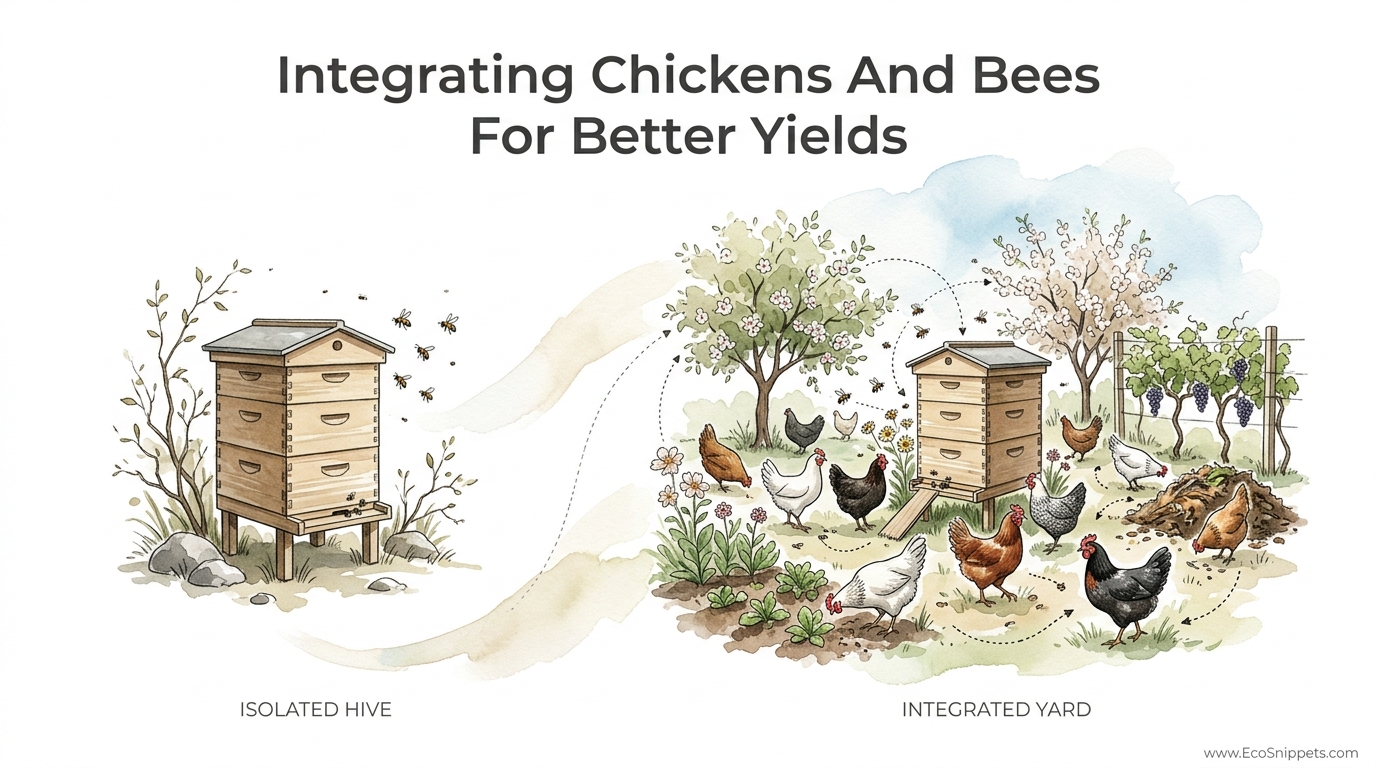
Farmers and orchardists use this integrated yard model in various climates to maximize the productivity of small acreage. A hive tucked into the corner of a well-managed chicken run benefits from the constant scratching of the birds, which prevents the soil from becoming a damp harbor for pathogens. The chickens, in turn, find an endless supply of high-protein snacks in the form of “trash” larvae and beetles that the bees discard from the hive. This partnership creates a closed-loop system where the presence of the birds directly contributes to the survival of the pollinators.
The Biological Synergy Of The Hive And The Run
Understanding how this partnership works requires a look at the life cycle of common hive pests. Small hive beetles (Aethina tumida) are perhaps the most persistent threat in many regions. These beetles enter the hive to lay eggs in the crevices of the wax. When the beetle larvae hatch, they tunnel through the comb, eating honey and pollen and leaving behind a slime that causes the honey to ferment. Eventually, these larvae must leave the hive to complete their transformation into adults.
Larvae typically crawl out of the hive entrance at night and drop into the soil within a few feet (about 1 meter) of the hive. They burrow 1 to 4 inches (2.5 to 10 cm) into the ground to pupate. Soil that is undisturbed and moist is the ideal nursery for these pests. Chickens disrupt this entire process. Their natural instinct to scratch and peck ensures that any larva attempting to enter the soil is immediately discovered and eaten. The birds effectively act as a biological filter, catching the pests at the most vulnerable stage of their development.
Varroa mites (Varroa destructor) also play a role in this synergy, though more indirectly. Beekeepers often use “drone culling” as a natural way to reduce mite populations. Mites prefer the larger cells of drone (male) larvae because the longer capping period allows for more mite reproduction. When a beekeeper removes a frame of drone brood to kill the mites, those frames can be offered to the chickens. The birds will pick every single larva out of the cells, consuming the mites along with them and leaving the wax frames clean for the bees to reuse.
How To Set Up Your Integrated Apiary
Setting up a hive within a chicken run is not as simple as dropping a box in the dirt. Success requires careful attention to the flight path of the bees and the physical reach of the chickens. You must ensure that the bees can enter and exit the hive without being hindered, while also protecting the birds from accidental stings during times of hive agitation.
Choosing The Right Location
The hive should be placed in a corner or along a fence line of the run where foot traffic is lower. Orient the entrance of the hive so it faces away from the main door of the coop or the area where you scatter grain for the chickens. Bees generally fly in a “V” shape as they leave the hive, rising gradually. Placing the entrance 3 to 5 feet (1 to 1.5 meters) away from a fence ensures the bees fly up and over the heads of the chickens, rather than through them.
Hive Stand Construction And Elevation
Elevating the hive is the single most important step in preventing chickens from eating live foragers. A standard hive stand of 12 inches (30 cm) is often too low, as a curious hen can stand on her tiptoes and pluck bees right off the landing board. Construction of a sturdy stand at a height of 18 to 24 inches (45 to 60 cm) is recommended. This height puts the entrance above the “peck zone” of most standard chicken breeds while keeping the hive at a comfortable height for the beekeeper to work.
Use rot-resistant timber such as cedar or pressure-treated 4×4 posts (10×10 cm) for the legs. A full hive during a heavy honey flow can weigh well over 200 pounds (90 kg), so the stand must be level and firmly anchored in the ground. If your chickens are particularly flighty or curious, you can add a simple “skirt” of 1-inch (2.5 cm) chicken wire around the base of the stand to prevent them from roosting directly under the hive, though many keepers find that letting the birds under the hive provides the best pest control.
Benefits Of The Feathered Security Detail
The primary advantage of this arrangement is the near-total suppression of ground-pupating pests. Beyond the small hive beetle, chickens will also target wax moth larvae (Galleria mellonella). Wax moths usually target weak hives or stored comb, but if a larva falls from the hive, it becomes instant poultry feed. This constant “patrolling” by the flock reduces the need for chemical soil drenches or oil traps that can sometimes be messy or harmful to the bees themselves.
Vegetation control is another quiet benefit of the chicken-and-bee partnership. Tall grass and weeds around a hive entrance can obstruct the bees’ flight path and trap moisture, which leads to mold inside the hive and rot in the wooden bottom boards. Chickens are masters of “biological mowing.” They will keep the ground around the hive completely bare and well-scratched, ensuring maximum airflow and a dry environment. This improved ventilation is critical during hot summer months when bees must work hard to cool the hive.
Challenges And Common Mistakes
Misunderstanding the temperament of your livestock can lead to conflict in the integrated yard. While bees and chickens generally ignore each other, certain situations can trigger aggression. One common mistake is placing the hive too close to the chicken’s water source. Bees are opportunistic foragers and will often choose the chicken’s waterer because it is reliable and contains minerals. If hundreds of bees are floating in the water, the chickens may become hesitant to drink, or they may start snapping at the bees and get stung in the process.
Another pitfall is failing to secure the hive against the physical strength of the birds. A large rooster or a heavy breed of hen can easily knock over a poorly balanced hive while trying to roost on top. Always ensure the hive covers are heavy or strapped down with ratcheting straps. Additionally, avoid using “hot” or aggressive bee colonies in a chicken run. If a hive is prone to “following” or bumping intruders, the chickens will eventually be targeted, leading to a stressed flock and potentially lost birds.
Limitations Of The Integrated Model
The integrated yard is not a universal solution for every beekeeper. Environmental constraints, such as extremely small urban lots, may make it difficult to provide enough space for the flight path and the chickens’ territory. If the run is too small, the high concentration of nitrogen from chicken manure can lead to ammonia buildup, which might irritate the bees’ sensitive respiratory systems. Maintaining a clean, well-carboned floor (using wood chips or straw) in the run is essential to balance this.
Climate also dictates the success of this method. In regions with very long, cold winters, chickens spend more time inside the coop and less time scratching the soil. During these periods, the pest-control benefits are essentially paused. Furthermore, if you must treat your bees with certain harsh chemicals or miticides, you must ensure that the chickens are not consuming larvae that have been exposed to these treatments. Always read the labels of your bee medications to ensure they are “poultry-safe” if the birds are expected to forage the debris.
Practical Tips For Success
* Separate Water Sources: Provide a dedicated bee waterer—a shallow pan filled with pebbles and water—placed at least 20 feet (6 meters) away from the chicken coop. This prevents the bees from crowding the chickens’ water.
* Entrance Guards: Use a mouse guard or a reduced entrance during the winter. This prevents chickens from poking their heads into the hive if they get bored or hungry.
* Monitor Behavior: Spend time watching the interaction during a heavy nectar flow. If you see chickens actively “hunting” live bees at the entrance, it is time to raise the hive stand another 6 inches (15 cm).
* Scent Management: Avoid using strong-smelling cleaners in the coop that might agitate the bees. Stick to natural products like white vinegar or simple water.
* Shade Balance: In hot climates, ensure the hive has some afternoon shade. Chickens also appreciate this shade, creating a shared cooling zone.
Advanced Considerations For The Homesteader
For those looking to scale this system, consider the “Permaculture Guild” approach. Planting bee-friendly forage like borage, clover, or comfrey along the outside of the chicken run fence creates a buffer zone. The bees forage on the flowers, and the chickens eat the leaves that poke through the wire. This adds another layer of productivity to the space.
Experienced practitioners also look at the “Isolated Hive vs Integrated Yard” comparison. An isolated hive in a distant field is often out of sight and out of mind, making it easier for pests like skunks or beetles to establish a foothold. In an integrated yard, the frequent presence of the beekeeper (to feed the chickens) and the 24-hour presence of the birds makes for much higher “situational awareness.” You will notice a problem with your bees much sooner when you are visiting the area twice a day to collect eggs.
Example Scenario: The Beetle-Free Yard
Consider a homesteader in a humid, temperate region who struggles with Small Hive Beetles every July. In a standard yard, they might lose two out of five hives to “sliming” because the beetle larvae pupate successfully in the soft garden soil. After moving the hives into a 200-square-foot (18.5-square-meter) chicken run with six hens, the dynamic changes.
As the beetle larvae emerge from the hive at 2:00 AM, they seek the soil. However, the chickens have spent the previous day scratching the ground into a fine, dry dust and removing all cover. The few larvae that manage to hide are quickly unearthed at dawn when the chickens begin their morning forage. By the following year, the beetle population in the apiary drops by an estimated 80%, not because of a chemical spray, but because the “nursery” for the next generation has been eliminated by the flock.
Final Thoughts
The most effective tools on a homestead are often the ones that have been there all along. By inviting your chickens into the apiary, you are leveraging thousands of years of evolutionary instinct to solve modern beekeeping problems. This system reduces the chemical load on your honey, improves the protein intake of your flock, and creates a cleaner, drier environment for your bees to thrive.
Success in this endeavor comes from observation and stewardship. Take the time to build sturdy stands, manage your water sources, and respect the flight paths of your workers. When you align the needs of the bird with the needs of the bee, the result is a more resilient and productive landscape. Experiment with your setup, watch your animals closely, and enjoy the unique harmony of a yard that works for itself.
