How To Become More Self-Sufficient Without Starting a Full-Blown Farm…
Want to start preserving your harvest, making your own soap, or building a backyard root cellar — but not sure where to begin? “Homesteading Advice” gives you instant lifetime access to 35+ practical homesteading books on food preservation, veggie gardening, DIY natural cleaning products (save over $250 per year with this skill alone), brewing, off-grid energy, and a whole lot more…
Click Here To Check It Out Now!
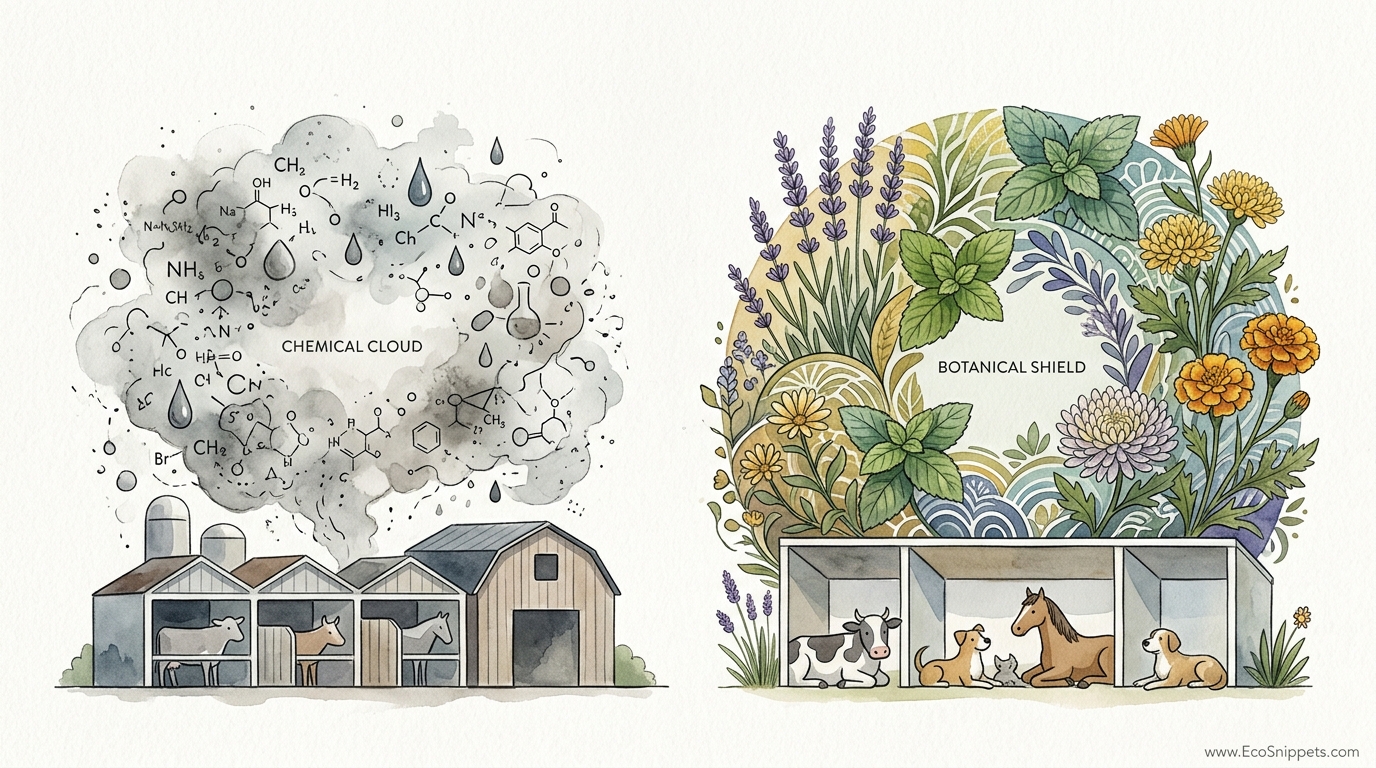
You can spend a fortune on toxic sprays, or you can plant a living fortress that hunts the pests for you. Every time you spray a chemical cloud, you’re resetting the clock on a toxic cycle. Smart homesteaders are moving away from ‘dead’ solutions and toward living biology. Planting specific repellent buffers like Tansy and Elderberry around barn openings creates a permanent, self-growing shield that keeps the flies out and the ecosystem in balance.
Fly control is often treated as a seasonal war, but it should be viewed as a landscape design problem. A barn that relies on constant chemical intervention is a fragile system. A shelter protected by botanical shields and biological allies is a resilient one. This guide will show you how to stop the buzz before it starts by using the wisdom of the past and the biology of the present.
Natural Fly Control For Animal Shelters
Natural fly control is the practice of using living plants, beneficial insects, and strategic management to reduce pest populations without synthetic pesticides. This method focuses on the entire lifecycle of the fly rather than just the adult stage. In a typical livestock environment, house flies, stable flies, and horn flies can reduce weight gain in cattle by 10% to 25% and spread over 65 known diseases.
A natural system works by making the barn unattractive to flies and hospitable to their enemies. For instance, house flies thrive in moist manure, while stable flies prefer rotting organic matter like wet hay. A botanical shield uses the aromatic power of plants to mask the scents of the animals. Meanwhile, biological controls like predatory wasps actively hunt the fly larvae in the bedding.
This approach is used anywhere animals are kept, from small backyard chicken coops to large-scale dairy operations. It is particularly vital for those pursuing organic certification or anyone concerned about the long-term health of their soil and groundwater. Instead of a temporary fix that requires constant re-application, natural systems grow stronger and more effective as the plants mature and the beneficial insect populations stabilize.
How It Works: The Botanical Shield and Biological Warfare
The primary mechanism of a botanical shield involves the release of volatile organic compounds (VOCs). Plants like Tansy (Tanacetum vulgare) and Elderberry (Sambucus nigra) produce strong scents that are pleasant to humans but overwhelming to a fly’s sensitive sensory organs. These plants act as a “masking agent,” hiding the smell of livestock and manure from searching pests.
To make this work, you must plant these buffers at the primary “entry ports” of your shelter. This includes the windward side of the barn and around all doors and windows. When the wind blows through the leaves of Tansy or Elderberry, it carries a concentrated stream of repellent molecules into the barn. This creates a zone of confusion that discourages flies from entering the airspace.
Beyond the plants, biological control agents like Fly Predators (parasitic wasps of the Muscidifurax and Spalangia genera) offer a second line of defense. These tiny, gnat-sized wasps do not sting humans or animals. They work by finding fly pupae in the manure and laying their own eggs inside them. The developing wasp consumes the fly before it ever hatches. This stops the next generation of flies before they can even take flight.
The Benefits of a Living Fortress
Choosing a biological approach over a chemical one offers measurable advantages for both the animal and the homesteader. One of the most immediate benefits is the reduction in respiratory stress. Many synthetic pyrethroids and organophosphates used in barn sprays can irritate the sensitive lungs of horses, goats, and calves. A natural buffer allows for cleaner air and a more relaxed environment for the herd.
Economic savings are another major factor. While a gallon (3.78 liters) of high-grade livestock spray can be expensive and last only a month, a perennial hedge of Tansy and Elderberry is a one-time investment that pays dividends for decades. Over a five-year period, the cost of natural control is often 70% lower than the cost of a continuous chemical regimen.
Furthermore, these systems promote biodiversity. A botanical shield provides a habitat for other beneficial insects like ladybugs and lacewings, which keep garden pests in check. It also protects the dung beetles in your pasture. These beetles are critical for soil health, but they are often killed by the residues of chemical fly-control products found in the manure.
Challenges and Common Mistakes
The most frequent error in natural fly control is starting too late in the season. You cannot wait until the barn is swarming to release your predatory wasps. These biological allies must be established when the first few flies appear in the spring. If the fly population explodes before the wasps are settled, the predators will never catch up to the exponential growth of the pests.
Another common pitfall is poor placement of the repellent plants. Planting a buffer on the leeward side of the barn will do nothing to protect the interior. The scent must be carried *into* the structure by the prevailing winds. If your barn is in a valley where air remains stagnant, you may need to supplement the plants with fans to ensure the repellent VOCs are circulated effectively.
Finally, homesteaders often overlook moisture management. No amount of Tansy will stop a fly infestation if there is standing water or a leaking trough inside the barn. Flies need moisture to breed. A single square foot (0.09 square meters) of wet, manure-caked bedding can produce thousands of flies in a single week. Keeping the floor dry is the non-negotiable foundation of any successful plan.
Limitations: When the Shield Isn’t Enough
Natural methods are highly effective but they are not a “magic button.” In environments with extreme fly pressure—such as a property located directly downwind of a poorly managed commercial feedlot—botanical buffers may be overwhelmed. In these cases, you will need to double your efforts with physical barriers like fine-mesh screening and heavy-duty industrial fans.
Environmental constraints also play a role. Elderberry is a hardy plant, but it requires consistent moisture to thrive. If you are in a high-desert climate with restricted water access, maintaining a thick green buffer may be difficult. In such regions, drought-tolerant alternatives like Rosemary or Lavender may be more appropriate, though their repellent range is generally smaller than that of a large Elderberry shrub.
It is also important to note the specific toxicities of certain plants. While Tansy and Elderberry are excellent fly repellents, they can be toxic if ingested in large quantities by certain livestock. Elderberry leaves and stems are known to be fatal to poultry, turkeys, and peacocks. You must ensure that your buffers are planted behind a fence or in a location where the animals cannot graze on them.
Comparing the Approaches: Chemical Cloud vs. Botanical Shield
| Feature | Chemical Sprays (Chemical Cloud) | Natural Buffers (Botanical Shield) |
|---|---|---|
| Initial Setup Cost | Low ($20 – $50) | Moderate ($100 – $300) |
| Long-term Maintenance | High (Repetitive purchases) | Low (Pruning and watering) |
| Health Impact | Possible respiratory irritation | Improves air quality/biodiversity |
| Pest Resistance | High risk (Flies adapt quickly) | Low risk (Flies rarely adapt to VOCs) |
| Labor Frequency | Daily or weekly application | Occasional seasonal care |
Practical Tips and Best Practices
Establish your buffer at least one season before you expect full protection. Perennials like Elderberry take time to develop the biomass needed to produce a significant “scent wall.” During the first year, supplement your plants with a homemade botanical spray made by steeping Elderberry leaves and Tansy flowers in hot water. Once cooled, spray this liquid on window sills and door frames.
Space your Tansy plants about 18 to 24 inches (45 to 60 centimeters) apart to create a dense, hedge-like structure. For Elderberry, leave about 6 to 10 feet (1.8 to 3 meters) of space between shrubs, as they can grow quite large—up to 12 feet (3.6 meters) in height and width. This height is actually an advantage, as it creates a vertical barrier that intercepts flies flying at different altitudes.
Utilize “scent-triggering” techniques to maximize the plants’ effectiveness. Walking past or brushing against Tansy releases a burst of its aromatic oils. Planting these along the paths where you lead your animals will provide a temporary spike in protection right when they need it most. You can also crush a few leaves and rub them on the outside of the barn door during peak fly hours.
Advanced Considerations: Scaling and Soil Health
For those with larger shelters or multiple outbuildings, consider the role of “decoy zones.” This involves setting up a highly attractive manure pile or “stinky trap” several hundred feet (roughly 100 meters) away from the barn. When combined with a botanical shield, this creates a “push-pull” system. The plants push the flies away from the barn, while the decoy zone pulls them toward a location where they can be managed or trapped.
Advanced practitioners also look at the mineral balance of the livestock themselves. There is strong evidence that animals with adequate sulfur levels in their blood are less attractive to biting flies. Supplementing with high-sulfur minerals or organic apple cider vinegar in the water can make the animals less “tasty” to pests. This internal defense works in perfect harmony with the external botanical shield.
Consider the role of the dung beetle in your wider pasture management. Chemical fly treatments often pass through the animal and kill these beetles, leading to manure piles that sit for months. In a natural system, the absence of toxic residues allows dung beetles to flourish. These beetles can bury a manure pat in 48 hours, effectively removing the breeding ground for hundreds of flies before they even hatch.
Example Scenario: The 10-Horse Stable
Imagine a stable that houses 10 horses. In a typical summer, the owner might spend $400 on fly sprays and masks. Despite this, the horses are constantly stomping and swishing. The owner decides to transition to a biological system. They start by planting a row of Elderberry along the west side of the barn where the wind enters. They also plant Tansy beneath each window.
In April, as soon as the temperature stays above 50°F (10°C) at night, they begin releasing 15,000 predatory wasps every two weeks. These wasps are sprinkled in the corners of the stalls and near the manure pile. By June, the fly population is 80% lower than the previous year. The horses are calm, and the only cost for the rest of the summer is a few minutes of watering the plants.
By the second year, the Elderberries have reached 6 feet (1.8 meters) in height. The botanical shield is now so strong that even on the hottest days, the flies stay away from the barn openings. The owner no longer needs to use masks on the horses while they are in their stalls. The soil around the barn is also healthier, as the deep roots of the Elderberry have improved drainage and reduced mud.
Final Thoughts
Building a living fortress for your animals is an act of stewardship that pays off in every season. You are not just killing pests; you are fostering a balanced ecosystem where biology does the heavy lifting. By trading the chemical cloud for a botanical shield, you create a sanctuary that is safer for your livestock, your family, and the soil beneath your boots.
The transition from a ‘dead’ solution to a living one requires a shift in mindset. It asks you to observe the wind, understand the lifecycle of your enemies, and nurture your botanical allies. This is the way of the self-reliant homesteader. It is a path that values ancestral wisdom and modern biological insights in equal measure.
Experiment with different plant varieties and observe which ones thrive in your specific microclimate. Start small if you must, but start now. Every Tansy plant you put in the ground and every predatory wasp you release is a step away from chemical dependence and a step toward a truly resilient homestead. Your animals will thank you with their health and their quiet, stompless days.
