How To Become More Self-Sufficient Without Starting a Full-Blown Farm…
Want to start preserving your harvest, making your own soap, or building a backyard root cellar — but not sure where to begin? “Homesteading Advice” gives you instant lifetime access to 35+ practical homesteading books on food preservation, veggie gardening, DIY natural cleaning products (save over $250 per year with this skill alone), brewing, off-grid energy, and a whole lot more…
Click Here To Check It Out Now!
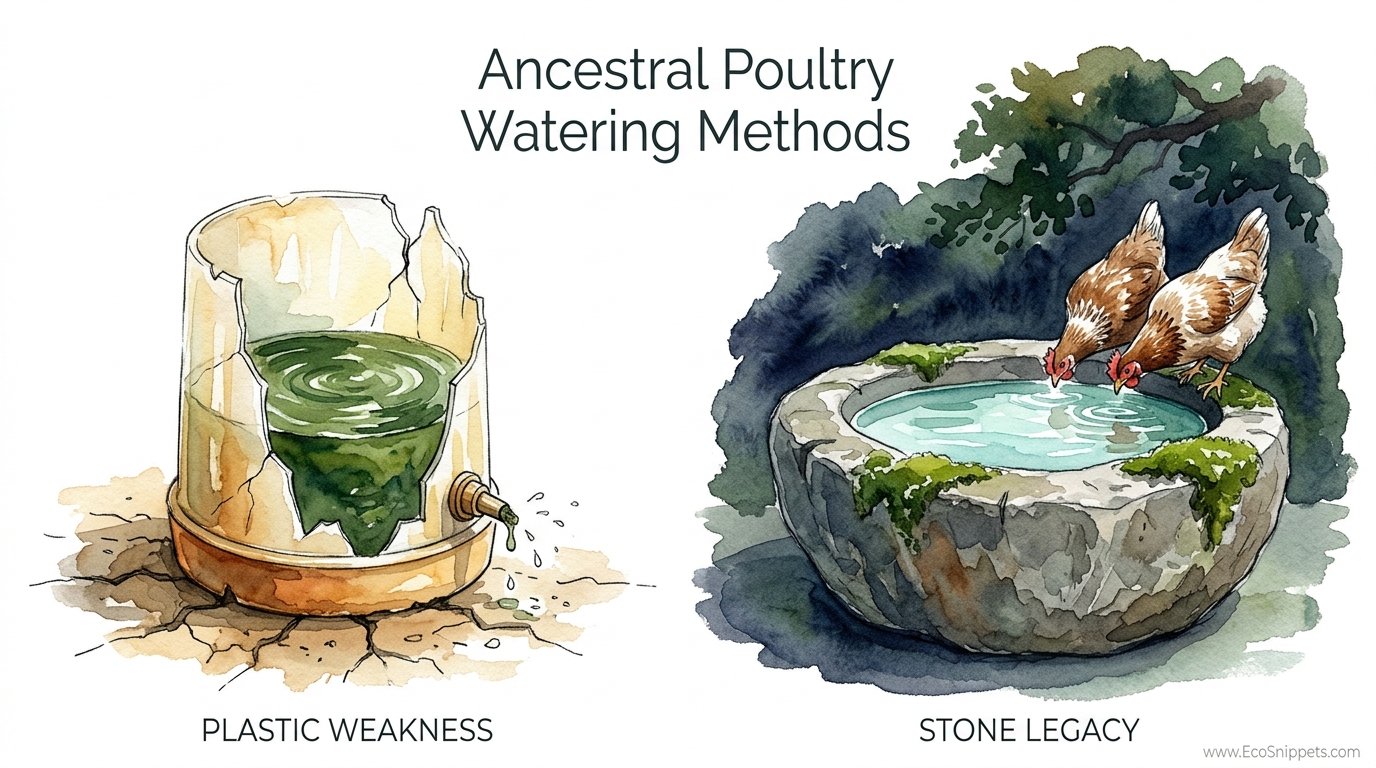
Modern plastic is convenient until the first freeze or the peak of summer heat—then the stone legacy wins every time. We’ve traded the thermal mass and durability of stone for cheap, brittle plastic that leaches chemicals and clogs constantly. Ancestral stone basins keep water cool through the heat of July and resist freezing long after the plastic founts have shattered. It’s time to return to a watering system that lasts for centuries, not seasons.
The move toward stone is more than just a nostalgic whim. It represents a commitment to self-reliance and the health of your flock. When you place a heavy stone basin in your coop or run, you are installing a piece of infrastructure that will likely outlive you. It does not require electricity, it does not crack under UV rays, and it provides a stable, chemical-free environment for the most essential nutrient in a bird’s diet.
Understanding why our ancestors chose stone requires us to look past the “tedious cutting and chipping” that eventually saw stone replaced by cast iron in the 1800s. While modern manufacturing prioritizes speed, the old ways prioritized the physiological needs of the animals. A stone trough is a living piece of the landscape that interacts with the water it holds, cooling it through evaporation and insulating it against the biting wind of winter.
Ancestral Poultry Watering Methods
Ancestral poultry watering methods centered on the use of natural, locally sourced materials that could withstand the rigors of an outdoor environment. For thousands of years, farmers across Europe, Asia, and the Americas utilized hand-carved stone troughs and basins to provide hydration for their livestock. These vessels were typically carved from solid blocks of granite, limestone, or sandstone, depending on what was available in the local geography.
In Britain and Europe, these troughs were often multi-functional. Large agricultural troughs served horses and cattle, while smaller, shallower basins were carved specifically for “short-legged animals” like sheep, pigs, and poultry. Many of these antique basins were carved from a single block of stone, ensuring there were no seams or joints to leak over time. This solid construction made them virtually indestructible, with many 150-year-old examples still in use today as garden ornaments or functional farm tools.
The design of these ancestral waterers often accounted for the specific behavior of birds. Stone basins for poultry were frequently shallow to prevent drowning and wide enough to allow multiple birds to drink at once without aggression. In some regions, farmers would place a sandstone divider or bars across a trough set into a field wall, allowing animals in two separate areas to access the same water source. This level of integrated design shows a deep understanding of farm layout and animal management that we often overlook in the age of “plug-and-play” plastic equipment.
Beyond just holding water, these stone methods were deeply tied to the seasons. Because stone is a poor conductor of heat but an excellent thermal battery, it acted as a regulator. In ancient Roman agriculture, stone basins were often placed in shaded areas or partially submerged in the earth to take advantage of the ground’s natural cooling properties. This ensured that even during the peak of summer, the flock had access to water that was refreshing rather than tepid and bacteria-laden.
How It Works: The Engineering of a Stone Basin
The effectiveness of a stone watering system relies on the principle of thermal mass. Thermal mass is the ability of a material to absorb, store, and later release thermal energy. High-density materials like granite or limestone have a high capacity for heat storage, meaning they change temperature very slowly. When a stone basin is filled with 5 gallons (19 liters) of water, the combined mass of the stone and the liquid creates a thermal buffer that resists the rapid fluctuations of the outside air.
To create or source a functional stone waterer, you must understand the porosity of the material. Limestone and sandstone are more porous than granite. While this means they may “weat” or leak slightly if not sealed, this minor evaporation actually helps keep the water cool during the summer through evaporative cooling. Granite, being much harder and less porous, is the gold standard for durability and water retention.
Sourcing and Carving Your Own Basin
Finding a suitable stone is the first step for anyone looking to implement this system. You don’t always need to carve a trough from a raw boulder. Many people find success by searching for “leaverites”—stones that are naturally concave—or by repurposing old stone sinks and architectural salvage. If you choose to carve your own, you will need a set of traditional stonemasonry tools, including a point chisel for roughing out the center, a claw chisel for smoothing the interior walls, and a bush hammer for creating a textured finish that helps birds maintain their grip.
The process begins by selecting a stone with at least one flat side to serve as the base. You should mark out the interior dimensions of the basin, leaving at least 3 inches (7.6 cm) of wall thickness for structural integrity. Begin by “pointing” the center, removing small chips of stone at a time. This is a slow process, but it ensures you do not crack the main block. Once the desired depth is reached—typically 3 to 5 inches (7.6 to 12.7 cm) for poultry—you can smooth the interior to make cleaning easier.
Placement and Gravity
Traditional placement of stone waterers often involved semi-permanent installation. Because a granite trough can weigh upwards of 200 pounds (90 kg), it is not a tool you will move daily. Ancestral systems often placed these basins under the eaves of a barn to catch rainwater or near a well-head. To prevent the area around the stone from becoming a muddy mess, it was common practice to place smaller stones or “cobbles” around the base of the trough. This provided drainage and kept the birds’ feet clean as they approached to drink.
The Practical Benefits of Stone Over Plastic
The most immediate benefit of a stone waterer is its lifespan. While a plastic fount may last three to five years before the sun makes it brittle enough to crack, a stone basin is a “buy once, use forever” investment. This longevity is especially valuable for those seeking to build a resilient, self-sufficient homestead where the constant replacement of cheap goods is seen as a liability.
In addition to durability, stone offers significant health advantages for your poultry. Plastic waterers, especially those made from lower-grade materials, can leach Bisphenol A (BPA) and other endocrine-disrupting chemicals into the water, particularly when heated by the sun. Stone is a natural, inert material that does not off-gas or leach toxins. In fact, certain stones like limestone can leach trace amounts of calcium into the water, which is a vital mineral for egg-laying hens.
* Temperature Stability: Stone waterers keep liquid significantly cooler in summer. Research into livestock welfare shows that animals prefer water between 50°F and 70°F (10°C to 21°C). Stone’s thermal mass keeps the water within this range far better than thin plastic or metal.
* Wind Resistance: High winds can easily tip over empty plastic waterers, leaving your birds without hydration. A stone basin stays exactly where you put it, regardless of the weather.
* Natural Algae Suppression: While algae can grow on any surface, the cooler water temperatures in stone basins slow its growth. Furthermore, the lack of UV penetration through thick stone walls prevents algae from thriving in the deeper sections of the water.
* Stability and Safety: Larger birds like turkeys or heavy heritage-breed chickens can easily tip over standard founts. A stone basin provides a solid platform that will not budge, even if a bird perches on the edge.
Challenges and Common Mistakes
One of the most frequent errors when transitioning to stone is failing to account for the weight and the difficulty of cleaning. Because you cannot simply pick up a large stone trough and dump it out as easily as a plastic jug, you must have a plan for maintenance. Choosing a basin that is too deep can lead to stagnant water at the bottom, which becomes a breeding ground for bacteria if not cycled regularly.
Another challenge is the porosity of certain stones. If you use a very porous sandstone without a proper seal, you may find that the water level drops faster than the birds can drink. Some practitioners solve this by “seasoning” the stone with a natural, food-safe sealant like beeswax or by allowing a natural biofilm of beneficial minerals to build up over time. However, the most effective solution is simply choosing a denser stone like granite from the start.
Hygiene is another area where mistakes happen. You cannot ignore a stone waterer just because it is “ancestral.” Debris like feathers, feed, and droppings will still find their way in. The mistake is often using harsh chemicals like bleach to clean the stone. Because stone is porous, it can absorb these chemicals and slowly release them back into the birds’ water. Instead, use a stiff-bristled brush and a solution of white vinegar or apple cider vinegar to scrub the surfaces every few days.
Limitations: When Stone May Not Be Ideal
Despite its many advantages, a stone system is not a universal solution. The primary limitation is portability. If you utilize a “chicken tractor” or a mobile pasturing system where you move your flock every few days, a 300-pound (136 kg) stone trough is a logistical nightmare. In these scenarios, lightweight, UV-resistant plastic or stainless steel is often the more practical choice.
Environmental factors also play a role. In regions where temperatures stay well below freezing for months at a time, even the thermal mass of stone will eventually succumb. While the stone itself won’t shatter like plastic, the water will freeze solid. Because you cannot easily bring a heavy stone basin inside to thaw, you must either use a submersible heater (which requires electricity) or rely on a secondary, more portable watering system during the depth of winter.
Furthermore, the initial cost or labor involved in acquiring a stone waterer can be a barrier. If you are not lucky enough to find one on your property or at a local salvage yard, purchasing an antique or hand-carved stone trough can cost hundreds of dollars. For a beginner on a tight budget, this may not be the most logical place to start when simple DIY plastic waterers can be made for under $10.
Comparison: Stone vs. Plastic vs. Metal
Choosing the right material requires a balance of cost, durability, and health considerations. The following table highlights the differences between the three most common watering materials.
| Feature | Stone (Granite/Limestone) | Plastic (HDPE) | Galvanized Metal |
|---|---|---|---|
| Lifespan | 100+ Years | 2–5 Years | 5–10 Years |
| Thermal Mass | Excellent (Stabilizes Temp) | Poor (Heats/Freezes Fast) | Very Poor (Conductive) |
| Chemical Safety | Inert/Natural | Leaches BPA/Microplastics | Can Rust/Leach Zinc |
| Maintenance | Heavy (Scrub in place) | Easy (Lightweight) | Moderate (Avoid Rust) |
| Initial Cost | High (or Labor Intensive) | Low | Moderate |
Practical Tips and Best Practices
If you decide to commit to a stone watering system, start by selecting a location that will be its permanent home. Look for a spot that is naturally shaded during the hottest part of the day, as this will maximize the cooling properties of the stone. If the ground is uneven, dig a shallow pit and fill it with 2 to 3 inches (5 to 7.6 cm) of leveling sand or pea gravel. This prevents the heavy stone from shifting or sinking over time and provides a drainage area for spills.
To keep the water as clean as possible, elevate the basin. While a heavy trough is hard to move, you can place it on a base of sturdy cinder blocks or a stack of flat fieldstones. Elevating the waterer to the level of the birds’ backs prevents them from kicking bedding, dirt, and manure into the water. This one simple adjustment can reduce your cleaning frequency from once a day to once every three or four days.
When it comes to cleaning, use a dedicated stiff-bristled scrub brush. Keep this brush near the waterer so the chore is easy to complete. For a deep clean, empty the water and sprinkle a handful of coarse salt onto the damp stone surface. Use the brush to scrub the salt into the stone; the grit acts as a natural abrasive to remove algae and biofilm without the need for toxic soaps. Rinse thoroughly with fresh water before refilling.
Advanced Considerations for the Serious Practitioner
For those looking to optimize their system, consider integrating a “slow-drip” replenishment method. Our ancestors often placed stone troughs near natural springs or piped water from a higher elevation. You can mimic this by setting up a rain barrel with a small, adjustable valve that slowly drips into the stone basin. This ensures the water is constantly being refreshed, which further stabilizes the temperature and oxygenates the liquid, making it more palatable for the birds.
Another advanced technique is the use of “bio-management” for algae. In very large stone troughs, some farmers keep one or two small goldfish. The fish eat the algae and mosquito larvae, keeping the water clear. While this is more common for larger livestock troughs, it can work for deep poultry basins if the water is kept clean and the birds are prevented from “fishing.” However, for most backyard poultry setups, regular scrubbing is a safer and more hygienic approach.
Finally, consider the mineral profile of your stone. If you are in an area with very soft, acidic water, using a limestone basin can naturally buffer the pH of the drinking water. This not only benefits the chickens’ skeletal health and eggshell quality but also makes the water less corrosive to any metal components (like valves or pipes) you might have in your overall watering system.
Example Scenario: The 100-Year Trough
Consider a homestead in a temperate climate that experiences hot summers and freezing winters. The owner replaces three plastic founts in five years because they cracked during a “polar vortex” or became brittle under the summer sun. Each plastic fount costs $40, totaling $120, not including the time spent driving to the store or the waste sent to a landfill.
Instead, the homesteader sources an old granite “butler’s sink” from a local demolition site for $100. They spend one afternoon leveling a spot in the orchard and setting the sink on four sturdy stones. They fill it with a hose once every three days and spend two minutes scrubbing it with a brush once a week. Ten years later, the stone sink looks exactly the same as the day it was installed. It has survived record-breaking freezes and heatwaves without a single crack. The birds are healthier because they aren’t drinking “plastic tea” on 90°F (32°C) days, and the homesteader has one less recurring expense to worry about.
This scenario illustrates the difference between “efficient” modern tools and “effective” ancestral tools. While the plastic was easier to carry home from the store, the stone was the more effective long-term solution for both the farmer’s wallet and the animals’ welfare.
Final Thoughts
Returning to ancestral watering methods is a powerful way to reclaim the resilience of your farm. By choosing stone, you are stepping away from a cycle of planned obsolescence and moving toward a system that honors the natural needs of your flock. The thermal mass, chemical purity, and sheer durability of a stone basin provide a level of security that plastic can never match.
While the initial effort of sourcing, moving, or carving a stone trough is significant, the rewards span decades. You will find that your birds are more hydrated during the summer and that your morning chores are less dictated by the fragility of your equipment. It is a transition that requires a change in mindset—prioritizing the permanent over the portable and the natural over the synthetic.
Whether you find an antique relic or carve a new legacy from a local boulder, a stone watering system is a testament to the wisdom of those who came before us. It is a practical, beautiful, and deeply satisfying way to care for your poultry, ensuring they have access to cool, clean, and life-sustaining water for as long as you keep a flock. Strong, steady, and silent, the stone remains while the plastic fades away.
