How To Become More Self-Sufficient Without Starting a Full-Blown Farm…
Want to start preserving your harvest, making your own soap, or building a backyard root cellar — but not sure where to begin? “Homesteading Advice” gives you instant lifetime access to 35+ practical homesteading books on food preservation, veggie gardening, DIY natural cleaning products (save over $250 per year with this skill alone), brewing, off-grid energy, and a whole lot more…
Click Here To Check It Out Now!
Are you just a customer of the poultry industry, or have you mastered the art of hatching your own permanent food security?
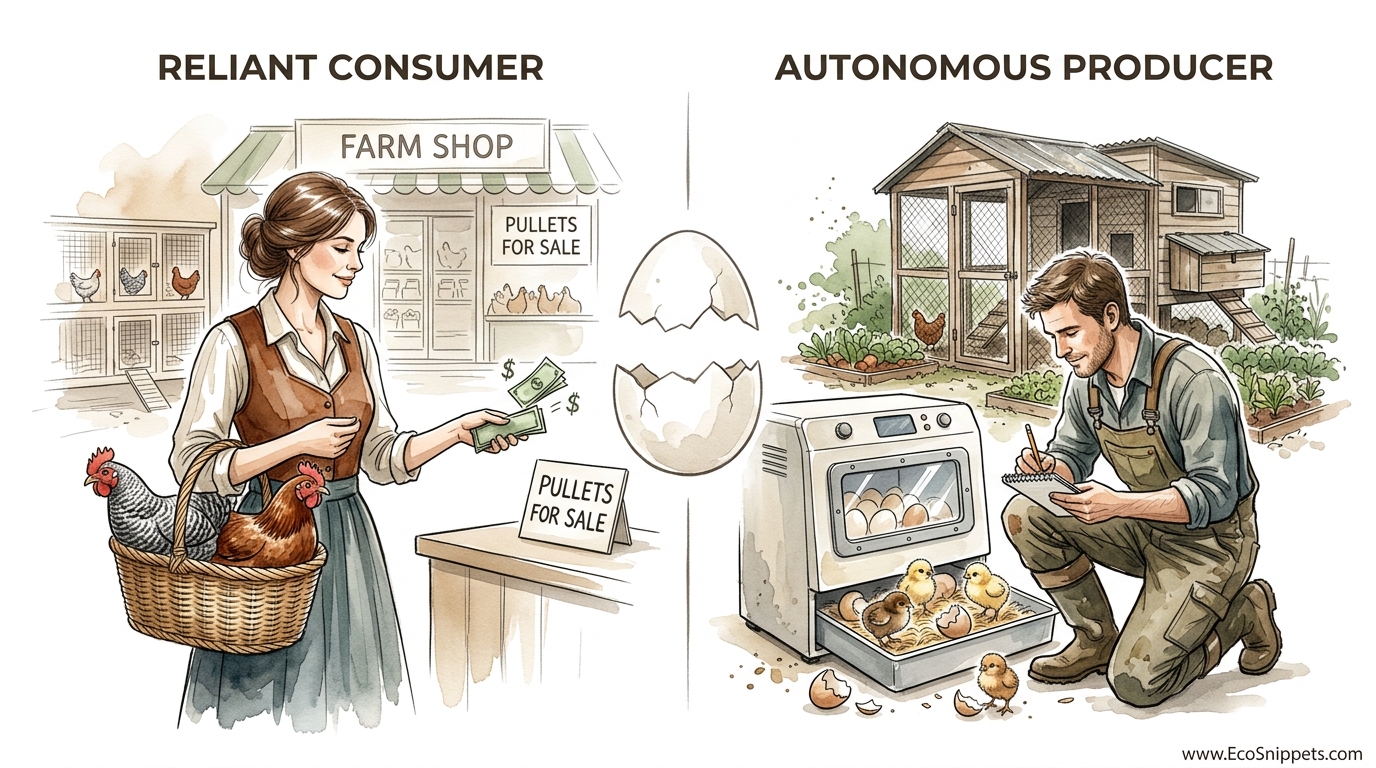
If you have to buy new birds every two years, you aren’t a producer—you’re just a customer. Here is how to break the cycle and hatch a resilient, multi-generational flock. The modern food system relies on a fragile chain of hatcheries, shipping logistics, and industrial breeding programs. When you rely on a postman to deliver your future egg layers, you are a RELIANT CONSUMER. To become an AUTONOMOUS PRODUCER, you must hold the power of life and death in your own hands, beginning with the humble egg.
Hatching your own chicks is not merely a hobby or a school science project. It is the fundamental pillar of ancestral wisdom that ensures your family eats regardless of what happens at the local feed store. It requires grit, patience, and a deep understanding of the biological rhythms of the avian world. This guide will take you from the basics of incubation to the advanced genetic strategies required to maintain a closed flock for decades.
Buying Pullets Vs Hatching Your Own Chicks
Most beginners start their journey by ordering “started pullets” or day-old chicks from a catalog. This is a logical entry point, but it is a trap if you never move beyond it. When you buy pullets, you are purchasing a finished product. You have no control over their early nutrition, their exposure to industrial pathogens, or the genetic selection that went into their creation. Often, these birds are high-production hybrids designed to “burn out” after eighteen months of intense laying.
Hatching your own chicks is the transition from consumerism to stewardship. Instead of buying a bird that was bred for a cage in a massive facility, you are breeding a bird for your specific backyard, your specific climate, and your specific predators. In the real world, this means your flock becomes more resilient over time. If you live in a high-altitude region with freezing winters, the chicks that survive your first few years of home-hatching are genetically superior to any generic bird shipped from a temperate hatchery.
Think of it as the difference between buying a loaf of bread and owning the wheat field, the mill, and the oven. One provides a meal; the other provides a future. While buying pullets gives you immediate gratification, hatching your own provides the long-term security of a self-sustaining system. You are no longer vulnerable to “out of stock” notices or shipping delays that can cripple your food supply.
The Mechanics of Incubation: Mastering the Environment
To hatch an egg, you must replicate the conditions of a mother hen’s breast. This requires precise control over temperature, humidity, and movement. Whether you use a high-end digital cabinet or a simple still-air styrofoam box, the biological requirements of the embryo remain the same. The standard incubation period for a chicken is 21 days, though this can vary slightly based on breed and environment.
Temperature: The Breath of Life
Temperature is the most critical variable. For a forced-air incubator (one with a fan), the “sweet spot” is a constant 37.5°C (99.5°F). If you are using a still-air incubator, you must aim slightly higher—around 38.3°C to 38.9°C (101°F to 102°F)—because the air layers inside the machine, and the top of the egg needs more heat to compensate for the cooler air at the bottom.
Fluctuations are the enemy. A temperature that remains too high will lead to “bloody navels” or chicks that hatch too early and are too weak to survive. Conversely, a temperature that runs consistently low will delay the hatch, often resulting in “sticky” chicks that are smeared with unabsorbed egg contents. In the late stages of incubation (days 18-21), the embryos themselves begin to generate metabolic heat. A serious practitioner will often lower the incubator temperature by half a degree during the final three days to prevent overheating as the chicks prepare to emerge.
Humidity and the Air Cell
Humidity manages the rate of evaporation within the egg. As the chick grows, it must lose a specific amount of moisture so that an air cell can form at the blunt end of the egg. This air cell is what the chick will “pip” into for its first breath of oxygen before it breaks the shell. For the first 18 days, maintain a relative humidity of 45% to 55%. During the “lockdown” phase—the final three days—increase this to 65% or 70%.
If humidity is too high, the chick will grow too large and drown in the excess fluid before it can hatch. If it is too low, the membrane inside the shell will dry out and “shrink-wrap” the chick, pinning its wings to its sides and preventing it from turning to zip the shell open. Always use a calibrated hygrometer; do not trust the built-in sensors on cheap machines.
The Ancestral Way: Using Broody Hens
Before the invention of electricity, every farmer relied on the “broody” instinct. A broody hen is a female whose hormones have shifted, causing her to stop laying eggs and instead sit on a clutch to hatch them. She is the ultimate autonomous tool. She requires no power, she turns the eggs hundreds of times a day with her beak, and she provides the exact humidity needed through her own skin contact.
Traditional breeds like the Buff Orpington, Black Australorp, and Silkie are renowned for their mothering instincts. When you find a hen that “goes broody,” she will become fierce, puffing her feathers and growling at anyone who approaches. This is a valuable asset on a self-sufficient homestead. The main limitation is that you cannot force a hen to go broody; you must work with her schedule. However, once she hatches the chicks, she will also act as their brooder, protecting them from predators and teaching them how to forage, which saves you the labor of raising them in a box in your house.
Genetic Sovereignty: Spiral Breeding and Selection
If you want a flock that lasts 50 years without buying new birds, you must manage genetics. Simple “flock mating” (letting everyone breed with everyone) eventually leads to inbreeding depression—reduced fertility, crooked beaks, and weakened immune systems. To avoid this, serious producers use a Spiral Breeding or Clan Mating system.
How to Set Up a Clan System
Divide your flock into three “clans” (Clan A, Clan B, and Clan C). Mark the hens of each clan with colored leg bands. In the first year, you mate a Rooster from Clan A with Hens from Clan A. The resulting chicks stay in Clan A for their entire lives. In the second year, you rotate the roosters: take the best Rooster from Clan A and move him to the Clan B hens. Take the Clan B Rooster and move him to Clan C. Take the Clan C Rooster and move him to Clan A.
By rotating the males “one clan over” each year, you ensure that a daughter is never mated to her father and a sister is never mated to her brother. This system allows a closed flock to remain genetically vibrant for decades. It requires record-keeping and discipline, but it is the hallmark of the AUTONOMOUS PRODUCER. You are no longer just raising chickens; you are managing a bloodline.
Benefits of Hatching Your Own
The practical advantages of home-hatching far outweigh the convenience of buying pullets once you master the skill.
- Biosecurity: Every time you bring a bird from a hatchery or another farm, you risk introducing Marek’s disease, respiratory infections, or mites. A closed, home-hatched flock is a fortress against external pathogens.
- Local Adaptation: Over several generations, your birds will adapt to your specific environment. If you have high predator pressure, you will naturally select for birds that are more alert and flighty. If you have hot summers, you will select for birds that don’t suffer from heat stroke.
- Financial Independence: At $4.00 to $6.00 per chick (plus shipping), a large flock is expensive to replace. With your own incubator or broody hens, your only cost is the feed for the parent stock.
- Resourcefulness: You can hatch “dual-purpose” breeds. The females become your layers, and the “extra” roosters (which always make up about 50% of a hatch) become high-quality meat for your freezer.
Challenges and Common Mistakes
The path to self-reliance is paved with failed hatches. The most common pitfall is impatience during lockdown. Many beginners see a “pip”—a small hole in the shell—and after a few hours of no progress, they try to “help” the chick out. This is often a death sentence. When a chick pips, it is still absorbing the yolk sac and the blood from the membranes. If you peel the shell too early, the chick can bleed to death or be left with an unabsorbed yolk that leads to infection. Unless the chick has been stuck for more than 24 hours without progress, keep the incubator lid closed.
Another mistake is poor egg storage. Fertilized eggs should be stored at 12.7°C to 15.5°C (55°F to 60°F) and never in a standard refrigerator, which is too cold and will kill the embryo. Eggs should be “set” in the incubator within 7 to 10 days of being laid. Every day past day ten, the hatch rate drops significantly. During storage, eggs should be kept small-end down and tilted from side to side once a day to prevent the yolk from sticking to the shell.
Limitations and Realistic Constraints
Hatching is not ideal for everyone. If you live in an urban environment with strict “no rooster” laws, maintaining a self-sustaining flock is nearly impossible. You need at least one rooster for every 10 hens to ensure fertility. Without a rooster, your eggs are just breakfast.
Additionally, hatching requires a “culling mindset.” Not every chick will be born perfect. You will encounter “spraddle leg” (where the legs slide out to the sides) or weaklings that simply fail to thrive. In a self-sufficient system, you cannot spend $200 at a vet for a $5 chicken. You must be prepared to humanely end the life of a bird that will only weaken the genetics of the flock. This is the “grit” part of the equation that most modern consumers find difficult.
Comparison: Incubation Methods
| Feature | Broody Hen | Electronic Incubator |
|---|---|---|
| Cost | Zero (Natural) | $50 – $500+ |
| Capacity | 8 – 12 eggs | 7 – 1000+ eggs |
| Labor | Minimal | High (Daily Monitoring) |
| Reliability | Subject to hen’s mood | Subject to power outages |
| Post-Hatch | Hen raises chicks | You provide brooder/heat |
Practical Tips for Success
Before you set your first clutch, ensure your equipment is ready.
- The 48-Hour Test: Run your incubator for at least two full days before putting eggs inside. This ensures the temperature has stabilized and you can make adjustments without risking live embryos.
- Ventilation: Embryos breathe through the pores in the shell. Ensure the air vents on your incubator are at least partially open. As the chicks grow, they need more oxygen. Never seal an incubator airtight.
Advanced Considerations: Heritage vs. Hybrid
If you are serious about becoming an AUTONOMOUS PRODUCER, you must choose Heritage Breeds. Modern commercial hybrids, like the Cornish Cross or the ISA Brown, do not “breed true.” If you hatch an egg from an ISA Brown, the offspring will not have the same incredible laying capabilities as the parent. They are genetic “dead ends” designed to keep you buying more from the hatchery.
Heritage breeds—such as the Rhode Island Red (Non-Industrial), Delaware, or Plymouth Rock—are stable. Their offspring will look and perform like their parents. Furthermore, these birds are foragers. They have the instinct to look for bugs and seeds, reducing your reliance on expensive commercial grain. A self-sustaining flock must be able to offset its own costs by gathering its own food from the land.
Example Scenario: The Five-Year Transition
Imagine you have a flock of 20 hybrid hens. In Year 1, you buy a high-quality Heritage rooster and two Heritage hens. You keep them separate and hatch 20 of their eggs. By Year 2, you have 10 new Heritage pullets. You cull the oldest 10 hybrids. In Year 3, you hatch another 20 eggs from your now-adapted Heritage birds and replace the remaining hybrids. By Year 5, you have a 100% home-bred flock that has never seen the inside of a shipping box. You have effectively exited the system.
During this transition, you will learn the nuances of your local predators. You might notice that your solid black hens survive better against hawks than the white ones. You then choose to only hatch eggs from the black hens. This is active stewardship. You are the architect of a mini-ecosystem that is specifically tuned to your acre of earth.
Final Thoughts
Mastering the hatch is the ultimate act of defiance against a fragile and centralized food system. It requires you to step away from the convenience of the “Add to Cart” button and step into the role of a creator. It is a journey of 21-day cycles, punctuated by the thrill of the first peep and the hard lessons of the failed shell.
True food security isn’t found in a full pantry; it’s found in the skills that allow you to refill that pantry indefinitely. When you can take a clutch of eggs and turn them into a thriving, reproducing flock, you have achieved a level of autonomy that few in the modern world can claim. Start small, keep your records clean, and trust the ancient instincts of the bird. Experiment with both the technology of the incubator and the biology of the broody hen. Your future flock is waiting inside those shells.
