How To Become More Self-Sufficient Without Starting a Full-Blown Farm…
Want to start preserving your harvest, making your own soap, or building a backyard root cellar — but not sure where to begin? “Homesteading Advice” gives you instant lifetime access to 35+ practical homesteading books on food preservation, veggie gardening, DIY natural cleaning products (save over $250 per year with this skill alone), brewing, off-grid energy, and a whole lot more…
Click Here To Check It Out Now!
They called it ‘lazy’ not because it was easy, but because the design was so smart it did the drainage and fertilizing for you. Before the plow ruined our topsoil, the Celts used ‘Lazy Beds’ to conquer the dampest landscapes in Europe. By flipping sod into precision-engineered ridges, they created self-draining, thermal-efficient mounds that outproduced flat fields by double. It is the ultimate ancient hack for heavy clay or boggy backyard soil that refuses to dry out.
As you look at your own plot of land—perhaps a patch of stubborn, waterlogged grass or a section of heavy clay that turns to concrete in summer—it is easy to feel defeated. Traditional advice often suggests expensive tilling or importing tons of store-bought topsoil. These ancient cultivators knew a better way. They worked with the land’s natural biology to create a growing system that survives where modern methods fail.
This guide will walk you through the mechanics of the Celtic lazy bed, from the history of its Gaelic roots to the modern science of its soil biology. You will learn how to build your own using nothing but a spade and the materials already beneath your feet.
Celtic Lazy Bed Gardening Technique
The Celtic lazy bed is an ancient agricultural system primarily associated with Ireland and the Scottish Highlands, though its influence reached as far as Newfoundland and the Faroe Islands. In Gaelic, these structures are known as feannagan. They were born out of necessity in landscapes where the soil was either too shallow, too wet, or too rocky for a traditional plow to penetrate.
Unlike modern gardens that fight against the existing sod, the lazy bed uses the turf as a biological engine. The technique involves marking out long, narrow strips of ground and flipping the grass sod upside down onto the planting area. This creates a raised ridge that sits between two deep furrows. These furrows serve a dual purpose: they provide the soil needed to build the ridge and act as permanent drainage channels.
Historically, this method allowed subsistence farmers to grow a staggering amount of food on land that was considered “marginal” by the ruling classes. While the British often used the term ‘lazy’ as a derogatory slur against Irish and Highland farmers, the reality was a sophisticated, labor-intensive system of land reclamation. It transformed rocky hillsides and peat bogs into fertile, productive gardens that could support large families on just a few acres (0.4 to 2 hectares).
Today, the lazy bed is resurfacing as a powerful tool for self-reliant gardeners. It offers a way to bypass the costs of lumber for raised beds and the soil destruction caused by rototilling. It is, in essence, the original no-dig method, perfected over thousands of years in some of the harshest growing conditions in the northern hemisphere.
How It Works: The Anatomy of a Ridge
To build a lazy bed, you must first understand the relationship between the ridge and the furrow. The ridge is where your plants live, while the furrow is where the water and cold air go to die.
Begin by marking out your plot. A traditional bed is typically 3 to 4 feet wide (90 to 120 centimeters). This width is crucial because it allows you to reach the center from either side without ever stepping on the growing surface. Compaction is the enemy of soil health; the lazy bed solves this by making the furrows your permanent walking paths.
Once you have marked your lines, mow the grass as short as possible. If you are working on a slope, always run your beds vertically—up and down the hill. This may seem counterintuitive to modern contour plowing, but vertical ridges allow water to exit the furrows quickly during heavy rain, preventing the bottom of the beds from becoming a swamp.
The next step is the application of fertility. Before the sod is flipped, lay down your amendments directly onto the short grass. Historically, coastal farmers used seaweed, which provided essential iodine and minerals. Inward farmers used well-rotted manure or composted straw. This “fertility sandwich” is then covered by the inverted sod.
Using a sharp spade, cut the turf along the edges of your marked bed. You are looking to flip a strip of sod about 12 inches wide (30 centimeters) from the furrow area onto the bed. The goal is to keep the sod in one piece, flipping it over so the grass side faces down and the soil side faces up. This smothers the existing vegetation and creates a layer of decomposing organic matter that feeds your crops from below.
The Benefits of the Raised Ridge
One of the most practical advantages of this system is its thermal efficiency. Because the mounds are elevated, they catch the sun’s rays at an angle, warming the soil much faster in the spring than flat ground. In cold, temperate climates, this can extend the growing season by several weeks.
Drainage is the secondary, yet equally vital, benefit. In areas with high rainfall or heavy clay, water tends to sit on the surface, drowning plant roots. The furrows of a lazy bed act like a network of mini-canals, pulling excess moisture away from the root zone. This allows you to grow root crops like potatoes and carrots in ground that would otherwise be far too wet.
Cold air drainage is a lesser-known but brilliant feature of the design. Cold air is denser than warm air and flows like water. During a light frost, the cold air rolls off the ridges and settles into the deep furrows, often protecting tender young shoots on the mounds while plants in flat fields nearby are bitten by the frost.
Furthermore, this method is incredibly cost-effective. You do not need to buy timber, screws, or plastic liners. You do not need to import “triple mix” soil from a landscape center. You are simply rearranging the resources that are already present on your land. The “first earth” taken from the bottom of the furrows and piled on top of the inverted sod provides a clean, weed-free seedbed for your first season.
Challenges and Common Mistakes
While the lazy bed is a superior system for many environments, it is not without its pitfalls. The most frequent error is failing to create a tight “hinge” when flipping the sod. If there are gaps between the inverted pieces of turf, the grass will find its way back to the light. You must ensure the sods are laid tightly together, like tiles on a roof, to effectively smother the weeds.
Another challenge is the initial labor. While called ‘lazy,’ the first year of construction is a serious workout. You are manually moving hundreds of pounds of earth and turf. Using a traditional long-handled Irish shovel or a heavy-duty garden spade is essential to save your back. If the soil is particularly dry, the sods can crumble; it is best to build your beds when the soil is moist but not saturated.
Pests can also find refuge in the new structure. Slugs and snails love the damp furrows and the protection offered by the decomposing sod. In the first year, you may need to be more vigilant with organic slug controls. However, as the bed matures and the soil biology balances out, these issues typically diminish.
Finally, do not underestimate the amount of fertilizer needed. The inverted sod provides a boost, but the “first earth” from the subsoil in the furrows is often nutrient-poor. You must be generous with your initial layer of manure or seaweed to ensure the first crop has what it needs to thrive.
Limitations and Environmental Constraints
The lazy bed is not a universal solution for every climate. In semi-arid or desert regions, the increased surface area of the ridges and the deep furrows will cause the soil to dry out too quickly. This system was designed for the damp, cool fringes of the Atlantic—not for the sun-scorched plains. If you live in a drought-prone area, a sunken bed system or traditional flat mulching may serve you better.
Extremely sandy soil also presents a structural challenge. Without the binding power of clay or the root mass of heavy sod, the ridges will simply slump back into the furrows after the first heavy rain. The lazy bed relies on the structural integrity of the turf to hold its shape.
There is also the consideration of scale. While a single person can maintain a large homestead garden using this method, it does not easily translate to modern tractor-scale farming. It is a system built for the human hand and the spade. If your goal is to farm hundreds of acres mechanically, the precision ridging of the Celts will feel like an obstacle rather than an asset.
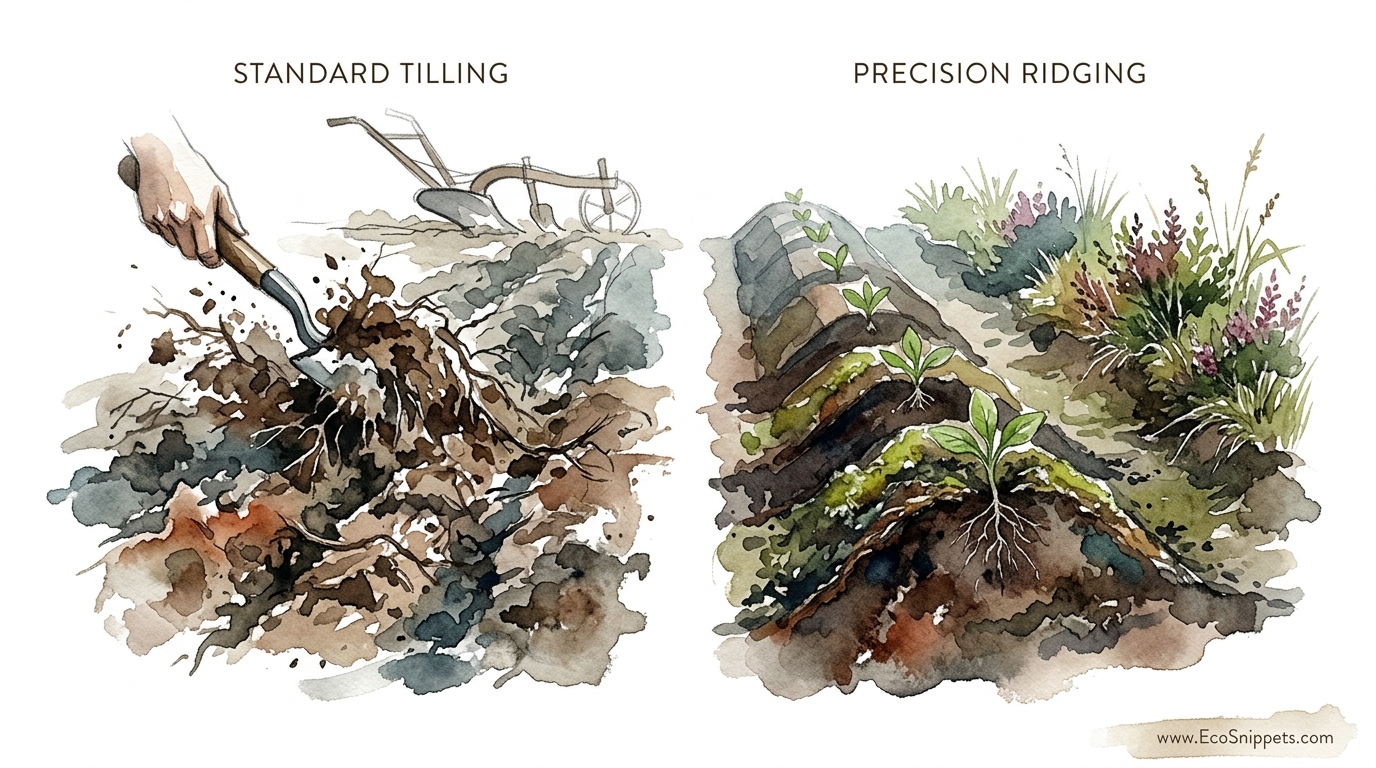
Comparing Traditional Tilling vs. Precision Ridging
To understand why a practitioner would choose this over a standard garden plot, a direct comparison is helpful. Modern tillage focuses on pulverizing the soil to create a flat surface, while precision ridging focuses on building a permanent, living structure.
| Feature | Standard Tilling | Celtic Lazy Beds |
|---|---|---|
| Initial Cost | High (Fuel, machine rental) | Low (Hand tools only) |
| Soil Structure | Destroyed by blades | Preserved and stacked |
| Drainage | Poor in clay; soil “puddles” | Excellent (Integrated furrows) |
| Thermal Performance | Soil remains cold longer | Heats up 2–4 weeks earlier |
| Weed Pressure | High (Brings seeds to surface) | Low (Smothers existing weeds) |
Practical Tips for Success
When you begin your first bed, start small. A single ridge 10 feet (3 meters) long is enough to teach you the mechanics. Use a string line to keep your edges straight; a crooked bed makes for uneven drainage and difficult walking paths.
If you cannot source seaweed, use a combination of aged cow or horse manure and a handful of wood ash. The ash provides the potassium that root crops crave, mimicking the mineral profile of the ocean plants used by the ancients. Avoid using fresh manure directly against your seeds or tubers, as the “heat” of the decomposition can burn them.
Choose your “pioneer crop” wisely. Potatoes are the traditional choice for a reason. Their vigorous root systems and expansive foliage help break down the inverted sod and smother any grass that attempts to poke through. Once the potatoes are harvested at the end of the first season, you will find the sod has transformed into a rich, crumbly loam.
Maintenance in subsequent years becomes much easier. Instead of rebuilding the bed, you simply add a fresh layer of compost or mulch to the top and “trench” the furrows. Trenching involves taking any soil that has washed into the furrow and throwing it back onto the ridge. This keeps the drainage clear and the growing area fertile.
Advanced Considerations: The Microbial Sandwich
For the serious practitioner, the lazy bed is more than just a pile of dirt; it is a complex biological reactor. When you flip the sod onto a layer of manure, you are creating what soil scientists call a “microbial sandwich.” The anaerobic environment beneath the sod accelerates the breakdown of the grass, while the aerobic environment on the surface supports nitrogen-fixing bacteria.
This inversion creates a massive surge in Proteobacteria and fungal biomass. These organisms work to convert the raw organic matter of the grass roots into plant-available nutrients. Over time, this builds a soil structure that is remarkably resilient. Because you never step on the bed, the delicate fungal networks (mycelium) remain intact, acting as a transport system for water and nutrients.
Scaling this up for a larger homestead can be done by using a “broadfork” in the second or third year. Instead of turning the soil, the broadfork allows you to aerate the deep layers of the ridge without disturbing the established microbial communities. This “no-till evolution” is how a temporary survival garden becomes a permanent, high-yield food forest.
Example Scenario: Reclaiming a Clay Backyard
Imagine a gardener in the Pacific Northwest or the UK with a backyard that is 70% heavy clay. Every spring, the yard is a mud pit until June. A traditional garden would require a rototiller, which would only create a “hardpan” layer 6 inches (15 centimeters) down, making the drainage even worse.
Instead, this gardener marks out three lazy beds, each 4 feet (120 centimeters) wide with 2-foot (60-centimeter) furrows. They lay down 2 inches (5 centimeters) of composted manure and flip the sod. By April, while the neighbor’s flat garden is still underwater, the ridges are dry and warm.
They plant “Kerr’s Pink” or “Sarpo Mira” potatoes. By July, the potato vines have completely shaded the ridges, preventing any weed growth. When they harvest in September, they pull up clean, large tubers from soil that was previously impenetrable. The following spring, the “lazy” gardener has three perfectly formed, fertile raised beds ready for winter brassicas or spring onions, without ever having bought a single piece of lumber.
Final Thoughts
The Celtic lazy bed is a testament to the wisdom of working with, rather than against, the natural world. It proves that wealth is not found in the tools you buy, but in the intelligence of the systems you employ. By understanding the simple physics of the ridge and furrow, any gardener can transform a difficult plot into a thriving sanctuary of food.
This technique bridges the gap between ancient survival and modern sustainability. It requires grit to establish, but it pays dividends in soil health, water management, and sheer productivity. It is a reminder that our ancestors were not “lazy”—they were simply efficient enough to let the earth do the heavy lifting for them.
Whether you are looking to increase your self-reliance or simply solve a drainage problem in your backyard, the lazy bed offers a time-tested path forward. Experiment with different mulches, observe how the water moves through your furrows, and trust in the biology of the inverted sod. The land is ready to produce; you only need to give it the right shape.
