How To Become More Self-Sufficient Without Starting a Full-Blown Farm…
Want to start preserving your harvest, making your own soap, or building a backyard root cellar — but not sure where to begin? “Homesteading Advice” gives you instant lifetime access to 35+ practical homesteading books on food preservation, veggie gardening, DIY natural cleaning products (save over $250 per year with this skill alone), brewing, off-grid energy, and a whole lot more…
Click Here To Check It Out Now!
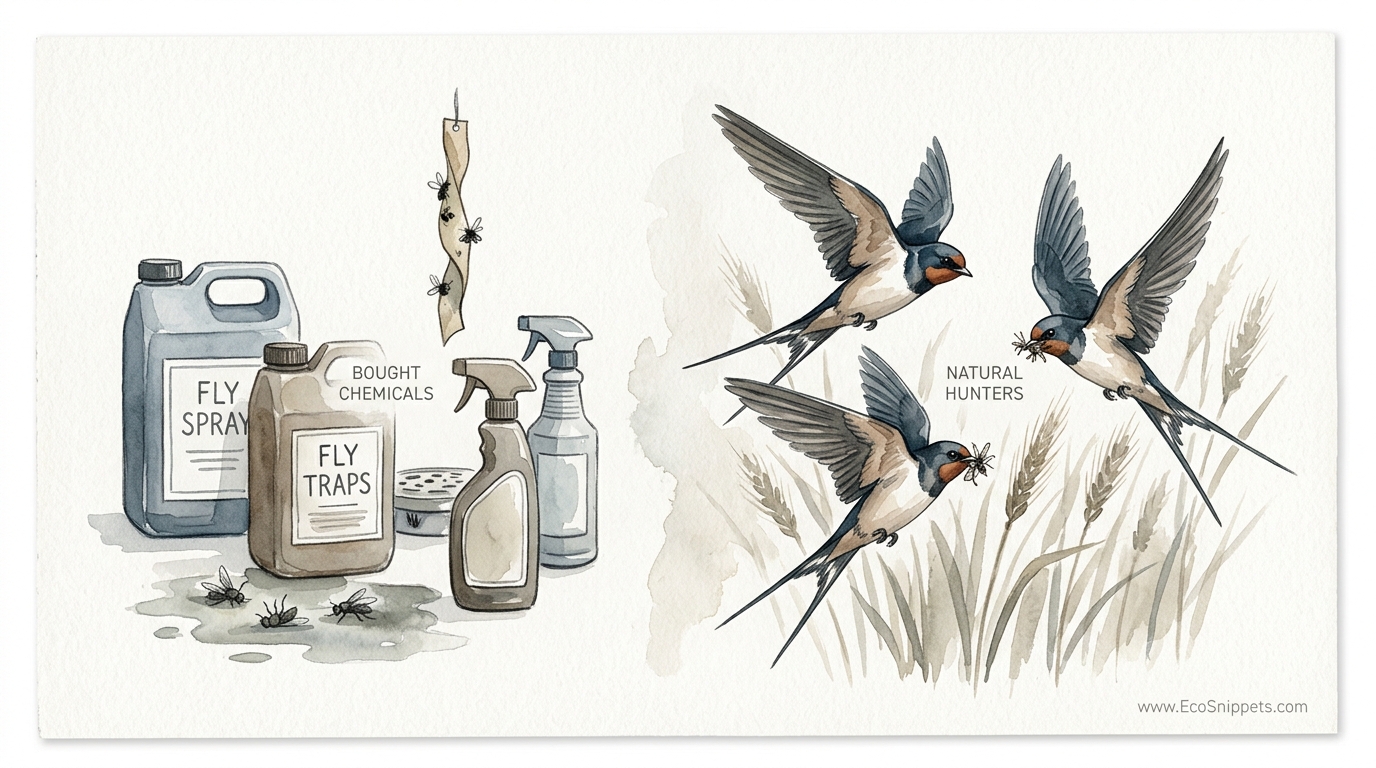
Stop paying a monthly subscription for fly control when nature wants to do it for free. Are you a consumer of toxic fly sprays or a producer of bird habitat? A single pair of Barn Swallows can consume thousands of flies, mosquitoes, and gnats every single day. Simply installing mud-shelf rafters turns your barn into a high-output pest control factory that never needs a refill and never poisons your livestock.
Working alongside nature often yields better results than fighting against it with expensive canisters. These agile, cobalt-blue hunters have spent millennia refining their craft, evolving specifically to thrive in the presence of humans and their animals. For generations, farmers understood that a “swallow barn” was a healthy barn, yet modern shortcuts have led many to trade this ancestral wisdom for chemical reliance.
Restoring this balance requires very little in terms of materials but demands a shift in perspective. Instead of seeing a bird as a nuisance that leaves a mess, you begin to see a professional-grade aerial technician. This guide will walk you through the precise steps of transforming your outbuildings into a sanctuary for these insectivorous allies.
How To Attract Barn Swallows For Pest Management
Barn swallows (Hirundo rustica) are highly specialized aerial insectivores that have shifted almost entirely from nesting on cliffs and in caves to nesting on human-made structures. This unique evolution makes them the perfect partner for any homestead, ranch, or stable owner. Attracting them is less about “calling” them and more about providing the specific architectural features they require for safety and success.
These birds hunt on the wing, catching 99% of their food while performing incredible acrobatic maneuvers in mid-air. Because livestock naturally attract flies, beetles, and winged ants, your barn is essentially a five-star restaurant for a swallow. However, modern construction—with its smooth surfaces and sealed entry points—often prevents these birds from finding a secure place to set up shop.
To successfully attract a colony, you must provide three non-negotiable elements: easy interior access, a reliable source of mud, and stable horizontal surfaces for nest attachment. When these three conditions are met, swallows will often return to the same rafters year after year, often arriving in the same week each spring as they follow the warming weather and emerging insect populations.
The Biology of the Hunt
Understanding the value of these birds starts with the numbers. A single adult swallow can consume up to 60 insects per hour, totaling roughly 850 to 1,000 insects per day. During the peak of the breeding season, when a pair is feeding a brood of four or five hungry chicks, that number sky-rockets. A single swallow family can easily clear 6,000 insects from your property every single day.
This hunting pressure creates what researchers call a “landscape of fear” for pests. Even if the birds don’t catch every single fly, their constant patrolling disrupts the feeding and breeding cycles of filth flies. Studies have shown that the mere presence of barn swallows can reduce fly activity inside a barn by as much as 60%.
How the Mud-Shelf Rafter System Works
Barn swallows build their nests using mud pellets mixed with grass stems, essentially creating a form of avian cob or adobe. Each nest requires approximately 1,000 individual beak-loads of mud. On a smooth, vertical wooden beam, this heavy mud structure is prone to falling, especially as the chicks grow and add weight. Mud-shelf rafters provide a structural foundation that eliminates this risk.
Designing the Perfect Mud-Shelf
The ideal nesting shelf is not a complex birdhouse but a simple, rugged ledge. Standard dimensions should be approximately 4 inches by 4 inches (10 cm by 10 cm) or up to 6 inches square (15 cm). Use rough-cut, untreated lumber such as cedar or hemlock. Rough wood provides the “tooth” the mud needs to grip the surface effectively.
Placement is the most critical factor in your success. Swallows prefer to nest tucked high up near a ceiling or roofline to avoid predators like cats and owls. Install your shelves approximately 5.5 inches (14 cm) below the ceiling. This gap is narrow enough to make the birds feel secure from overhead threats but wide enough for them to stand on the rim of the nest and feed their young.
Step-by-Step Installation
- Select the Site: Choose a location inside a barn, shed, or under a deep porch eave. The site must be protected from direct rain and excessive wind.
- Verify Clearance: Ensure the shelf is at least 7 to 12 feet (2.1 to 3.6 meters) above the ground. This height keeps the nest out of reach of most ground-based predators.
- Apply the Shelf: Screw the shelf directly into the side of a rafter or joist. Using a small “L” bracket or a simple wooden cleat underneath the shelf adds the necessary support for a heavy mud nest.
- Provide Spacing: While swallows are social, they can be territorial. Space your shelves at least 4 to 5 feet (1.2 to 1.5 meters) apart. If you want to put them closer, ensure there is a physical barrier, like a rafter, between them so the birds cannot see each other from the nest.
The “Mud Puddle” Factor
If your land is well-drained or you are experiencing a dry spring, swallows may bypass your barn simply because they cannot find building materials. You can solve this by creating a dedicated “mud station.” Find a patch of bare earth near the barn and keep it saturated with a hose during the nesting weeks of May and June. Adding a little bit of natural clay to the soil can make the mud even stickier and more attractive to the birds.
Benefits of Natural Pest Management
Transitioning to biological fly control offers several measurable advantages over traditional chemical methods. The most immediate benefit is the reduction of “chemical drift” on your property. Toxic sprays do not just kill flies; they often impact beneficial insects, contaminate water troughs, and can cause respiratory irritation in sensitive livestock like horses or show cattle.
Economic savings are another major driver. Once the rafters are installed, your “pest control technicians” work for free. You no longer have to worry about the recurring costs of automatic misting systems, pyrethrin refills, or the labor required to apply pour-on treatments to every animal in the herd. Over a five-year period, a single colony of swallows can save a small farm thousands of dollars in supply costs.
Furthermore, swallows provide a service that chemicals cannot: mobility. While a spray only works where it is applied, swallows follow the insects. They will hunt in the barn, over the manure pile, and out in the pastures, providing a wide-reaching umbrella of protection. This holistic approach helps prevent conditions like fly strike in sheep or painful summer sores in horses by reducing the overall insect load across the entire acreage.
Challenges and Common Mistakes
The most frequent complaint regarding barn swallows is the accumulation of droppings. Because the birds are so efficient at eating, they are also quite efficient at producing waste. If you place a nesting shelf directly above a pristine tractor or a feed bin, you are setting yourself up for frustration. This is a mistake of placement, not a flaw in the bird.
Another common error is closing the barn doors at night. Barn swallows are active from dawn until dusk. If you lock up the barn to keep out small predators but forget to leave a window or a “swallow hole” open, the parents may be trapped inside (unable to hunt) or locked out (unable to feed the young). This leads to nest failure and ensures the birds will not return the following year.
Failing to manage competition is also a pitfall. Non-native House Sparrows often try to take over swallow nests or shelves. These sparrows are aggressive and will even kill swallow chicks to claim a nesting site. You must stay vigilant during the early spring and discourage sparrows from moving in before the swallows arrive from their long migration.
Limitations and Environmental Constraints
Nature is not a machine, and swallows have their own requirements that may not fit every environment. If your barn is located in a heavily forested area with very little open airspace, you may struggle to attract a colony. Barn swallows are “open-country” birds; they need wide fields and meadows to perform the high-speed maneuvers required for hunting.
Temperature can also be a limiting factor. In modern barns with metal roofs and poor ventilation, the area near the peak can become dangerously hot during mid-summer. If the temperature at the nest site exceeds 100°F (38°C), the chicks can become dehydrated or fledge prematurely. Ensuring your barn has ridge vents or open gable ends is essential for the health of your avian partners.
Finally, there is the legal limitation. In many regions, including North America and Europe, barn swallows are protected by law, such as the Migratory Bird Treaty Act. It is illegal to remove or destroy an active nest containing eggs or young. This means once they have moved in, you must be prepared to host them until the end of the season. Planning your “poop management” strategy ahead of time is the best way to ensure a peaceful co-existence.
Comparison: BOUGHT CHEMICALS vs NATAL HUNTERS
When deciding how to manage your fly population, it helps to look at the cold, hard facts of efficiency and cost. The following table compares the two most common approaches used on modern homesteads.
| Feature | Chemical Sprays/Mists | Barn Swallow Colony |
|---|---|---|
| Initial Cost | $200 – $1,500 (System setup) | $20 (Scrap wood and screws) |
| Monthly Cost | $50 – $150 (Refills) | $0 |
| Labor | High (Applying/Maintaining) | Very Low (Annual cleaning) |
| Environmental Impact | Toxic; kills pollinators | Positive; boosts biodiversity |
| Duration | Temporary (minutes to hours) | Continuous (sunrise to sunset) |
| Target Reach | Inside barn only | Barn, pasture, and pond |
Practical Tips for Success
Success with swallows comes down to the details. If you want to jump-start your colony, consider installing a “poop board” or dropping board. This is a simple piece of plywood or plastic installed about 2 feet (60 cm) below the nest. It catches all the debris, protecting your floor and equipment. You can then simply scrape the board into your compost pile once a week, turning a nuisance into high-quality fertilizer.
Another tip is to avoid using high-gloss paint on your rafters. Swallows need a surface they can grip. If your barn interior is painted with a slick, oil-based enamel, the mud will have a hard time sticking. You can solve this by tacking a small piece of hardware cloth (wire mesh) or a strip of rough wood to the rafter where you want them to build.
- Keep it Dark: Swallows prefer the darker corners of the barn where they are less visible to hawks.
- Water is Life: If you have a pond nearby, ensure it has a clear flight path. Swallows drink by skimming the surface of the water while flying.
- Avoid Deterrents: Remove any “bird spikes” or shiny holographic tape from the areas where you want the swallows to nest. These tools do not distinguish between “good” birds and “bad” birds.
Advanced Considerations for Large Colonies
Once you have a single pair nesting successfully, the colony will naturally grow. Barn swallows are semi-colonial, meaning they like to be near others but still require their own personal space. For those looking to manage large-scale fly problems on commercial dairies or large horse boarding facilities, you should think in terms of “zones.”
Create nesting zones in different parts of the barn to maximize coverage. Each pair will defend a “hunting territory” around the barn, and by distributing the nests, you ensure that every square inch of your property is being patrolled. If you find that the birds are becoming too numerous for one building, you can install specialized nesting kiosks—essentially a roofed frame with rafters—out in the middle of a pasture.
Scaling up also means you must pay closer attention to hygiene. While swallows are generally clean, a colony of twenty nests can produce a significant amount of dust and dander. Annual maintenance is key. Once the birds have migrated south for the winter, use a long-handled brush to remove old, mite-infested nests. This encourages the birds to build fresh, healthy nests when they return in the spring and prevents the buildup of avian parasites.
The Result: A Thriving Ecosystem
Imagine walking into your barn on a humid July afternoon. Normally, this is the time when flies are thick, landing on your face and causing your horses to stamp their feet in frustration. But instead of the smell of chemicals and the sound of buzzing, you hear the cheerful twittering of swallows. You watch as a blue streak flashes past your head, snatching a horsefly out of the air before it can land.
This isn’t a fairy tale; it is the reality for thousands of farmers who have embraced the mud-shelf rafter system. In this scenario, the birds are well-fed, the livestock are calm, and the farmer has more money in his pocket. By providing a few simple wooden ledges and a patch of wet mud, you have successfully outsourced one of the most annoying chores on the farm to a group of professionals who love their job.
Final Thoughts
Nature provides everything we need to manage the land, provided we are willing to build the right habitat. Choosing swallows over sprays is more than just a pest control strategy; it is a commitment to a cleaner, more resilient way of living. It honors the old ways of the farm while utilizing modern observations to maximize efficiency.
Start small this season. Install two or three shelves in the quietest corners of your barn and keep a mud puddle ready for the spring arrival. You will soon find that the sight of a swallow’s forked tail is the most welcome sign of summer. Experiment with placement, watch their behavior, and enjoy the peace of a barn that works with the wild instead of against it.
Once you see the results, you will never want to go back to the aerosol can. For more information on creating a self-sustaining homestead, look into internal linking opportunities regarding soil health and natural water management. Those systems, combined with your new aerial patrol, will create a farm that thrives on its own terms.
