How To Become More Self-Sufficient Without Starting a Full-Blown Farm…
Want to start preserving your harvest, making your own soap, or building a backyard root cellar — but not sure where to begin? “Homesteading Advice” gives you instant lifetime access to 35+ practical homesteading books on food preservation, veggie gardening, DIY natural cleaning products (save over $250 per year with this skill alone), brewing, off-grid energy, and a whole lot more…
Click Here To Check It Out Now!
Your roof is a massive collection plate – are you throwing away the chance to filter your water and grow food at the same time? Every rainstorm, your house is throwing away a massive opportunity for biological filtration. By turning standard gutters into a multi-use bio-filter, you’re not just moving water; you’re cleaning it and growing a year’s supply of aquatic greens at the same time. Here is how to stack functions on your roofline.
This isn’t about mere drainage. It is about transforming a dead, industrial surface into a living, breathing kidney for your homestead. Most modern homes treat rainwater like a liability, rushing it into the sewers as quickly as possible. You are going to treat it like the resource it is.
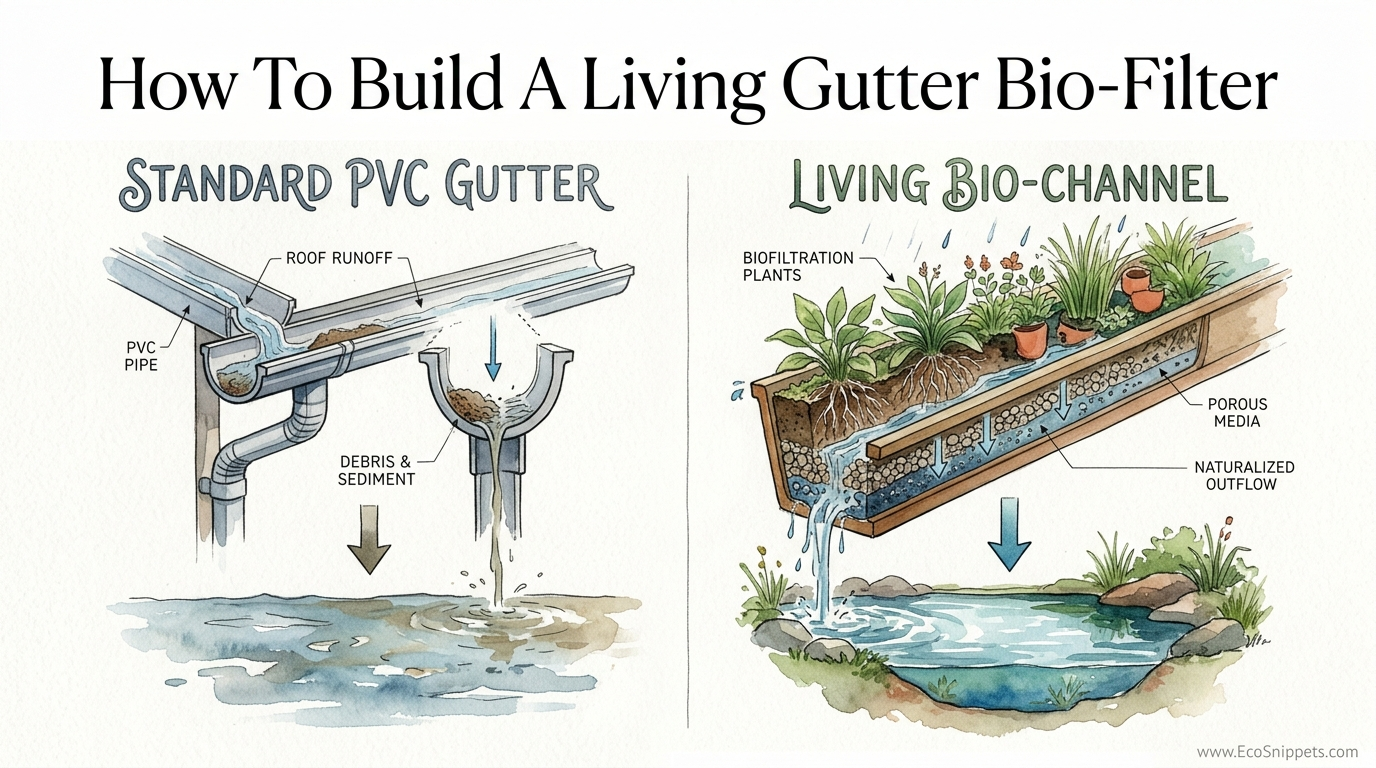
The concept is simple but profound. We are taking the standard eaves of a house and replacing the hollow, sterile run of STANDARD PVC with what we call a LIVING BIO-CHANNEL. This system uses the same principles as ancient floating gardens and modern wastewater treatment to strip out pollutants and turn them into edible biomass.
How To Build A Living Gutter Bio-Filter
A living gutter bio-filter is a horizontal hydroponic system that uses the natural flow of rainwater to sustain a community of beneficial microbes and edible aquatic plants. It exists at the intersection of structural engineering and biology. In the real world, these systems act as a “first-tier” treatment for roof runoff, intercepting organic debris, bird droppings, and atmospheric dust before they ever reach your storage tanks.
Think of it like a mountain stream pinned to your fascia board. In a natural stream, water doesn’t just fall; it rolls over rocks and through the roots of water-loving plants. These plants and the “slime” on the rocks—a complex community of bacteria called a biofilm—do the heavy lifting of purification. We are simply recreating that ancient process on the side of your house.
These systems are used by urban homesteaders with limited ground space and off-grid pioneers who need the cleanest water possible for their cisterns. Instead of a bare metal channel that gets hot and grows nothing but algae, you build a lush, green ribbon that cools your home and provides fresh salads even when the ground is too hard to dig.
The Mechanics of Biological Interception
Rainwater is rarely pure H2O. As it falls through the sky, it picks up atmospheric nitrogen, making it a powerful fertilizer. As it hits your roof, it collects everything from pollen to bird guano. In a standard gutter, this “roof juice” sits and rots. In a bio-filter, this organic matter becomes the fuel for a thriving ecosystem.
The core of the system is the substrate. We fill the gutter with porous media like expanded clay (LECA) or washed pea gravel. These materials provide a massive amount of surface area for nitrifying bacteria—specifically Nitrosomonas and Nitrobacter—to colonize. These microbes perform the “nitrogen cycle” in real-time. They convert ammonia from animal waste into nitrites, and then into nitrates, which the plants then suck up as food.
This process is known as nutrient starvation. Because the plants and beneficial bacteria are so efficient at grabbing these nutrients, there is nothing left for “bad” bacteria or mosquitoes to live on. The water that leaves the end of the bio-channel is significantly cleaner, oxygenated, and stripped of the excess nutrients that cause storage tanks to go anaerobic and stink.
Step-By-Step Construction of the Bio-Channel
Building this system requires a shift in how you think about roof weight. A standard gutter is meant to carry a moving sheet of water. A bio-filter carries a saturated bed of stone and roots. You cannot simply use the flimsy plastic clips found at big-box hardware stores.
Start by selecting your channel. While vinyl is easy to work with, heavy-duty 6-inch (15cm) aluminum or food-grade K-style gutters are better for the long haul. The slope is critical. You need a fall of exactly 1/8 inch for every foot of length (about 1cm per meter). If the water moves too fast, the microbes can’t “eat” the pollutants. If it moves too slow, the system will overflow during heavy storms.
Reinforcement is the next stage. Standard gutter hangers are often spaced every 36 inches (90cm). For a living bio-filter, you must install heavy-duty hidden hangers or wrap-around brackets every 18 inches (45cm). These must be screwed directly into the rafter tails, not just the thin fascia board. A 10-foot (3m) section of gutter filled with wet gravel and plants can weigh upwards of 150 pounds (68kg). Ensure your structure can handle the load.
Once the channel is hung and tested for leaks, install a First Flush Diverter at the beginning of the run. This is a simple vertical pipe that catches the very first, dirtiest few gallons of water from a storm. Once that pipe is full, the cleaner water “overflows” into your bio-gutter. This prevents the media from becoming clogged with heavy silt or excessive leaf litter.
Choosing Your Bio-Filter Media
The “dirt” in your gutter isn’t dirt at all. Soil is too heavy and will clog the system almost immediately. You need a media that allows water to flow through it while providing “lung space” for the roots.
Leca (Lightweight Expanded Clay Aggregate) is the gold standard. These are baked clay balls that are incredibly light—roughly 3.18 lbs per gallon (0.38kg per liter). They are porous, meaning they hold moisture like a sponge but allow air to reach the roots. This prevents root rot and provides a perfect home for your microbial army.
Pea Gravel is the old-school choice. It is cheap and will never break down. However, it is heavy, weighing about 12.83 lbs per gallon (1.54kg per liter). If you choose gravel, your bracket system must be industrial grade. The advantage of gravel is its thermal mass; it stays cool in the summer and holds onto the sun’s warmth in the winter, extending your growing season.
Plants: The Living Machinery
The plants are the “pump” of the system. They don’t just sit there; they actively pull water up and transpire it into the air, which can actually help cool the fascia and eaves of your home.
Watercress (Nasturtium officinale) is the undisputed king of the bio-gutter. It loves moving water, thrives in the shallow depth of a 5-inch or 6-inch gutter, and is one of the most nutrient-dense greens on the planet. It is a perennial that can survive surprisingly cold temperatures. In many regions, you can harvest watercress all year round.
Aquatic Mint is another heavy hitter. It has a massive root system that acts like a fine mechanical filter, trapping sediment. Be warned: mint is aggressive. It will take over the entire gutter if not pruned regularly. Other excellent choices include leaf lettuce, chives, and even small varieties of strawberries if you have enough sunlight.
Benefits of a Living Gutter System
The most immediate benefit is water security. By cleaning the water at the point of collection, you reduce the maintenance on your downstream filters and tanks. You aren’t just catching rain; you are processing it.
Practical homesteaders will appreciate the calorie production. A 20-foot (6m) run of watercress and mint can provide enough greens for a daily salad for a family of four. This is “free” food grown in space that was previously wasted.
Thermal regulation is a hidden advantage. A thick mat of green plants on your roofline acts as a buffer against the sun. In the peak of summer, the evaporating water from the plants creates a micro-climate of cool air that can lower the temperature of the air entering your attic vents.
Biodiversity is the final win. These gutters become a highway for beneficial insects and pollinators. While standard gutters are a breeding ground for pests, a well-managed bio-filter is a balanced ecosystem that supports life rather than inviting decay.
Challenges and Common Mistakes
The biggest mistake people make is underestimating the weight. Many DIYers build a beautiful gutter garden only to see it rip off the side of the house after the first heavy rain. You must calculate the weight of the media plus the weight of a full channel of water. If you aren’t sure, go with Leca balls—they are much more forgiving on your rafters.
Clogging is the second most common failure. If you don’t use a first-flush diverter or a leaf screen, the gaps between your rocks will fill with “muck.” Once the system goes anaerobic (lacks oxygen), it will start to smell like a swamp and the plants will die. You must ensure the water is always moving.
Neglecting the roof material can also be dangerous. If you have a brand-new asphalt shingle roof, the water will contain petroleum-based oils and anti-fungal chemicals for the first year or two. Do not grow food in these gutters until the roof has “weathered” for at least two seasons. If you have a metal, slate, or tile roof, you are good to go from day one.
Limitations: When This May Not Work
Environmental constraints play a big role. If your roof is heavily shaded by large oak or maple trees, you will spend more time cleaning out leaves than harvesting food. This system needs at least 4-6 hours of sunlight to keep the plants healthy enough to perform their filtration duties.
Extreme cold is another boundary. In regions where the temperature stays below freezing for months, the water in the gutters will turn into a solid block of ice. This can create ice dams that damage your shingles. If you live in a deep-winter climate, you must have a plan to “drain and dormant” the system in late autumn.
Structural integrity is a non-negotiable limit. Some older homes with rotted fascia boards or rafter tails cannot support the weight of a bio-filter. Always inspect the wood behind your gutters before you begin. If the wood is soft, you are building on a foundation of sand.
Comparison: Standard PVC vs Living Bio-Channel
| Feature | Standard PVC Gutter | Living Bio-Channel |
|---|---|---|
| Primary Function | Water Diversion | Filtration & Production |
| Maintenance | High (Debris Removal) | Moderate (Pruning/Harvest) |
| Water Quality | Raw/Contaminated | Biologically Filtered |
| Weight Load | Low | High |
| Lifespan | 10-15 Years | 25+ Years (Alloy/Metal) |
Practical Tips for Success
Start small. Don’t try to convert your entire roofline in one weekend. Choose a single 10-foot (3m) section on a garage or shed first. This will give you a feel for the weight and the water flow before you commit your main residence to the project.
Washing your media is non-negotiable. Whether you use gravel or Leca, it is covered in dust from the quarry or factory. If you put it in the gutter dry, that dust will turn into a thick sludge that will cement your downspouts shut. Rinse your media in a bucket until the water runs clear.
Use Stainless Steel hardware. Because this system is always wet and exposed to the elements, standard galvanized screws will rust through in a few years. Spending the extra five dollars on high-grade screws is the difference between a system that lasts and one that collapses.
Keep a “wet-dry” balance. In times of drought, your plants will need water. You can easily integrate a small solar-powered pump that recirculates water from your rain barrel back up to the top of the gutter. This keeps the bio-film alive during dry spells and ensures your watercress doesn’t wilt.
Advanced Considerations: The Closed Loop
For the serious practitioner, the gutter bio-filter is just one piece of a larger closed-loop system. You can design your downspouts to feed into a pond or a large aquaponic tank. The water leaves the roof, gets filtered by the plants, feeds the fish, and is then pumped back up to the roof.
This constant recirculation maximizes nutrient uptake. If you have fish, their waste provides the ammonia that the roof microbes turn into plant food. This “upstairs-downstairs” relationship creates a massive amount of food in a very small footprint.
Consider the pH of your rain. Rainwater is naturally slightly acidic (usually around 5.6 pH). Most aquatic plants prefer a range of 6.5 to 7.5. Adding a few handfuls of crushed oyster shells or limestone to your gutter media can act as a natural buffer, keeping the water chemistry stable for both your plants and your microbes.
Scenario: The 10-Foot Harvest
Imagine a standard 10-foot (3m) section of gutter on a backyard shed. You have reinforced it with five brackets and filled it with 8 gallons (30 liters) of washed Leca. You’ve planted ten watercress starts and a small clump of peppermint.
In a single growing season, this small section can produce over 5 pounds (2.2kg) of fresh watercress. Simultaneously, it is stripping out the atmospheric nitrogen from every rainstorm, preventing that nitrogen from fueling algae growth in your 500-gallon (1900-liter) cistern. The water entering your tank is clear, smells like fresh earth, and requires minimal mechanical filtration for garden use.
The cooling effect of this 10-foot green ribbon can reduce the surface temperature of the fascia by up to 15 degrees Fahrenheit (8 degrees Celsius) on a hot afternoon. This is the power of stacking functions. You are solving the problem of “waste water” while creating a vertical farm.
Final Thoughts
The transition from a sterile gutter to a living bio-filter is a return to a more resilient way of living. It acknowledges that every part of our built environment can be an asset rather than a liability. When we stop seeing rain as something to be managed and start seeing it as something to be harvested, our relationship with the land changes.
Building a bio-filter requires grit and a willingness to understand the microscopic world. It is not a “set it and forget it” system. It requires the hands of a steward to prune the plants and clear the diverters. But for those willing to do the work, the rewards are measured in clean water, fresh food, and the satisfaction of a house that finally pays for its own keep.
Apply these principles to your own roofline. Start with a small section, watch the microbes take hold, and taste the difference of watercress grown from the sky. This is how we rebuild our world, one gutter at a time.
