How To Become More Self-Sufficient Without Starting a Full-Blown Farm…
Want to start preserving your harvest, making your own soap, or building a backyard root cellar — but not sure where to begin? “Homesteading Advice” gives you instant lifetime access to 35+ practical homesteading books on food preservation, veggie gardening, DIY natural cleaning products (save over $250 per year with this skill alone), brewing, off-grid energy, and a whole lot more…
Click Here To Check It Out Now!
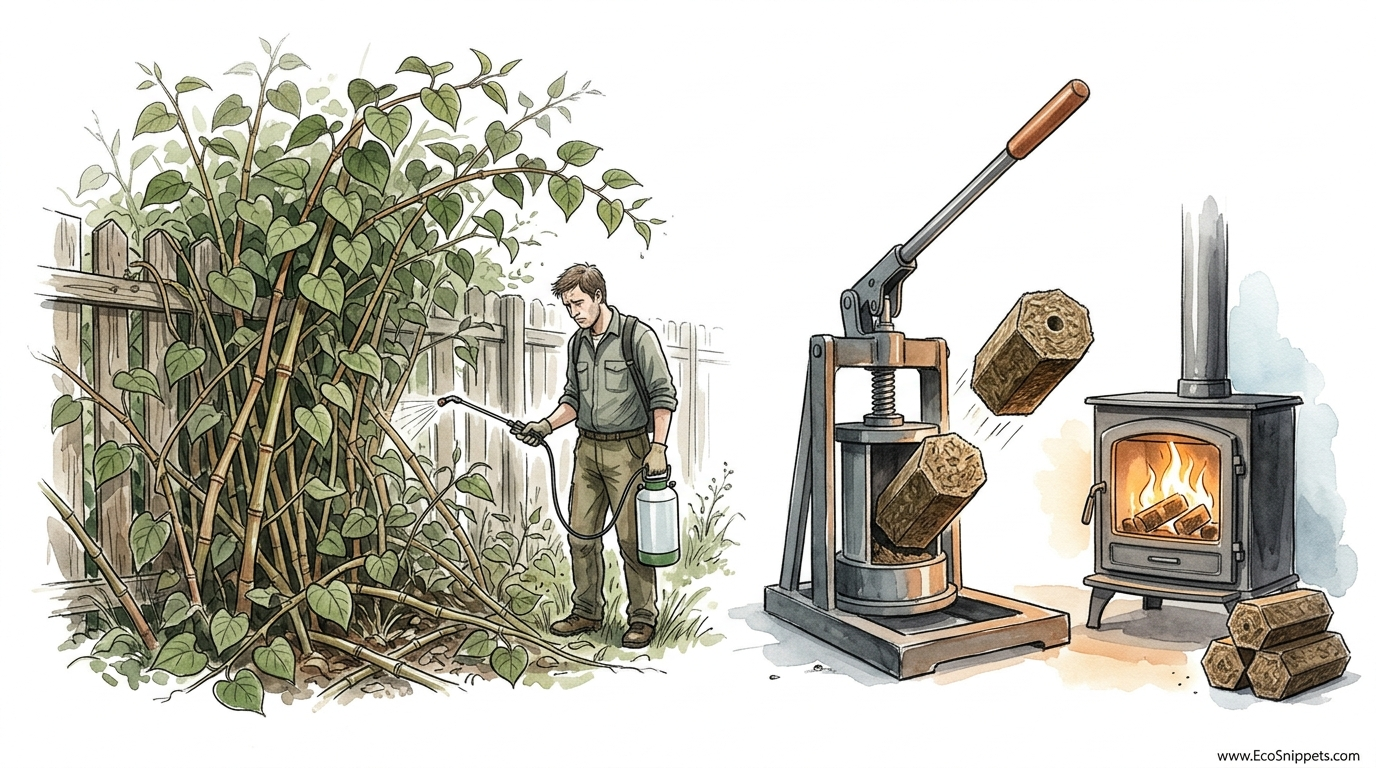
You’re spending a fortune trying to kill the very thing that could be heating your home for free all winter. Japanese Knotweed is a nightmare for most, but for the DIY energy enthusiast, it’s a high-growth biomass factory. Stop spraying poison and start pressing bricks. We show you how to harvest, dry, and compress this invasive ‘nuisance’ into fuel that burns hotter and longer than seasoned oak.
For decades, homeowners and land managers have waged an expensive, often losing war against Fallopia japonica. This plant is known for its ability to crack concrete and devalue property, but its aggressive growth hides a secret: it is one of the most efficient carbon-capture machines in the temperate world. By shifting your perspective from eradication to utilization, you can turn a biological liability into a sustainable energy asset.
This guide isn’t about making a backyard bonfire. It’s about understanding the science of biomass, the mechanics of lignin-binding, and the legal frameworks required to handle this plant responsibly. We are looking at a fuel source that replenishes itself every single season, requiring zero fertilizer, zero irrigation, and zero mercy during the harvest.
Turning Invasive Japanese Knotweed Into Fuel
Japanese Knotweed is often compared to bamboo because of its hollow, segmented stalks and rapid vertical growth. In its peak season, it can grow up to 10 centimeters (4 inches) per day, reaching heights of 3 to 4 meters (10 to 13 feet). While this growth is what makes it a “choking weed,” it also results in a massive accumulation of lignocellulosic biomass in a very short window of time.
When we talk about fuel, we are essentially talking about stored solar energy. Japanese Knotweed captures this energy and stores it in its cellulose and lignin structures. Once dried, these stalks have a gross calorific value (GCV) of approximately 18.4 to 19.43 megajoules per kilogram (MJ/kg). To put that into perspective, seasoned oak typically ranges between 18 and 19 MJ/kg. You are essentially dealing with a fuel that has the energy density of hardwood but grows at the speed of a weed.
The hollow nature of the stems is a significant advantage for the home burner. Unlike dense logs that can take two years to season properly, knotweed stems have a high surface-area-to-volume ratio. This allows them to shed moisture at an accelerated rate. However, because the raw stems are light and airy, they burn too quickly in a standard wood stove. The secret to unlocking their potential is compression—turning loose stalks into high-density “energy bricks.”
How It Works: From Stalk to Energy Brick
Transforming knotweed into fuel requires a systematic approach to ensure you aren’t accidentally spreading the plant while you’re trying to burn it. The process relies on three pillars: timed harvesting, thorough drying, and mechanical compression.
1. The Strategic Harvest
Timing is everything. If you harvest in the spring or early summer, the plant is full of water and sap, making it difficult to dry. The best time to harvest for fuel is late autumn or early winter, after the first few hard frosts. By this time, the plant has naturally pulled its nutrients back down into the rhizomes, and the standing stalks have begun to senesce (die back) and dry out on the root.
Use sharp loppers or a brush cutter to take the stalks down as close to the ground as possible. At this stage, the stalks are brittle and often brown. Wear gloves and eye protection; although the plant isn’t toxic like Giant Hogweed, the dry shards can be sharp and irritating to the skin.
2. Chipping and Shredding
Raw stalks are bulky and inefficient to store. To create a brick, you must first reduce the material to a uniform “grist.” A standard garden shredder or wood chipper works perfectly for this. You want to aim for a particle size between 5mm and 20mm (0.2 to 0.8 inches). This increased surface area is critical for the next stage: the final dry-down.
3. Achieving Critical Moisture Content
Freshly cut green knotweed can have a moisture content as high as 60%, which yields a measly 7.8 MJ/kg of energy. For a high-quality burn, you need to get that moisture level down to between 10% and 15%. Because the material is now shredded, you can spread it out on a tarp in a greenhouse, polytunnel, or even a well-ventilated shed. In dry conditions, this material can reach target moisture levels in just a few weeks.
4. The Compression Process
This is where the magic of “lignin binding” happens. Lignin is the natural “glue” that holds plant cells together. When you subject shredded knotweed to high pressure—and ideally a bit of heat—the lignin softens and then resets, binding the particles into a solid, dense mass without the need for artificial glues. For the DIY enthusiast, this can be done using a manual lever press or a hydraulic jack press. If the material is dry enough, the resulting bricks will be as hard as coal and burn with a steady, intense flame.
Benefits of Knotweed Biomass
Why go through the trouble of pressing bricks when you could just buy a cord of wood? The benefits go beyond simple cost savings.
- Zero-Cost Feedstock: If you have an infestation on your land, your fuel is free. If your neighbor has one, they will likely pay you to take it away.
- High Energy Output: As established, the calorific value of 19.43 MJ/kg is higher than many traditional softwoods and rivals the best hardwoods.
- Reduced Creosote: When properly dried and compressed, knotweed burns very cleanly. Its chemical composition often leads to less creosote buildup in your chimney compared to unseasoned or “wet” wood.
- Ecological Service: By harvesting the above-ground biomass, you are removing the photosynthetic engine of the plant. While this won’t kill the deep rhizomes overnight, repeated harvesting weakens the plant over several years, helping to manage the infestation without heavy chemical use.
- Rapid Renewability: Trees take 20 to 50 years to mature. Japanese Knotweed matures in 5 months. It is the ultimate “short-rotation” energy crop.
Challenges and Common Mistakes
Working with an invasive species is not without risks. The most common mistake is accidental propagation. A fragment of knotweed rhizome as small as 1 centimeter (0.4 inches) can grow into a new colony. If you are sloppy during the harvest and drop fragments in your lawn or near a watercourse, you are creating a bigger problem for yourself.
Another pitfall is insufficient pressure. If your energy bricks are too “fluffy,” they will expand and fall apart as soon as they hit the heat of the stove, resulting in a flash-burn that could overheat your appliance. You need enough mechanical force to crush the cellular structure of the plant. A simple hand-squeeze won’t cut it; you need a dedicated press capable of several tons of force.
Lastly, ash management can be a surprise. Knotweed has an ash content between 1.14% and 4.6%, which is higher than high-grade wood pellets. You will need to clean your stove’s ash pan more frequently when burning knotweed bricks. However, this ash is rich in potash and can be a valuable addition to your compost heap—provided you are 100% certain no live plant fragments survived the fire.
Limitations and Environmental Constraints
While Japanese Knotweed is a powerhouse of energy, it is not a “magic bullet” for every situation. There are realistic boundaries to its use that you must respect.
Legal Restrictions: In many jurisdictions, such as the UK under the Wildlife and Countryside Act 1981, Japanese Knotweed is classified as “controlled waste.” It is often illegal to transport knotweed off-site without a specialized license. This means your energy-brick factory must be located on the same property where the plant is harvested. You cannot simply go to a local riverbank, fill a truck, and drive home without risking massive fines or even criminal charges.
Storage Space: Because the raw stalks are so voluminous before they are pressed, you need a significant amount of dry, airy storage space. A winter’s supply of knotweed stalks can take up three to four times the space of an equivalent amount of cordwood before processing.
Scale: This is primarily a solution for the individual homesteader or small-scale DIYer. The logistics of industrial-scale knotweed pelletizing are complicated by the legalities of transporting the material and the “patchy” nature of its growth.
Comparison: Choking Weed vs. Traditional Fuel
To understand the practical value of these energy bricks, it helps to see how they stack up against the “gold standards” of home heating.
| Fuel Source | Calorific Value (MJ/kg) | Renew Rate | Ash Content (%) | Difficulty to Process |
|---|---|---|---|---|
| Knotweed Bricks | 18.4 – 19.4 | 1 Year | 1.1 – 4.6% | High (Needs Press) |
| Seasoned Oak | 18.0 – 19.0 | 30+ Years | < 1% | Low (Split & Dry) |
| White Pine | 19.0 – 20.0 | 20+ Years | < 1% | Medium (Resinous) |
| Wheat Straw | 17.0 – 17.5 | 1 Year | 5.0 – 8.0% | High (Low Density) |
Practical Tips and Best Practices
If you’re ready to start pressing your own energy bricks, keep these best practices in mind to maximize efficiency and safety.
- Use a “Bait” Shredder: Don’t use your expensive, brand-new wood chipper for the first pass on knotweed. The stalks often grow in sandy or rocky soil, and the base of the plant can carry grit that dulls blades quickly. Use an older, dedicated machine for knotweed.
- The 15% Rule: Invest in a cheap digital moisture meter. Never press material that is above 20% moisture; the steam generated during combustion will rot your stove from the inside out and the bricks will likely mold in storage.
- Leverage Paper as a Binder: If you find your bricks are crumbly, mix in 10-20% shredded wet paper or cardboard. The cellulose fibers in the paper act as a secondary binder, creating a much tougher brick.
- Air-Flow Storage: Store your finished bricks in “onion bags” or crates with plenty of air gaps. Even a “dry” brick can sweat slightly if the temperature fluctuates, and you want to prevent any surface mold from forming.
- Clean Your Chimney: Because knotweed has a different mineral profile than wood, keep a close eye on your flue for the first month of burning. Any new fuel source requires a period of “tuning” your stove’s air intake.
Advanced Considerations: Torrefaction and Biochar
For the serious practitioner, simply pressing bricks is the beginning. Torrefaction—a process of heating the biomass to 200-300°C (390-570°F) in the absence of oxygen—can turn knotweed into a “bio-coal.” This process removes even more volatiles and moisture, leaving behind a hydrophobic, energy-dense material that can be stored outside without absorbing water.
Alternatively, if you have more knotweed than you can burn, consider Biochar production. By pyrolyzing the stalks, you create a stable form of carbon that can be buried in your garden soil. This not only sequesters the carbon permanently but the porous structure of the charred knotweed provides an incredible habitat for beneficial soil microbes, effectively turning your “curse” into a “fertility engine.”
Example Scenario: A Winter’s Supply
Let’s look at a practical example. Suppose you have a 100 square meter (1,076 square foot) patch of Japanese Knotweed on your property. Research shows that knotweed can yield up to 30 tonnes of dry matter per hectare. For your 100 square meter patch, that’s about 300 kilograms (660 pounds) of dry fuel per year.
If an average energy brick weighs 500 grams (1.1 lbs), your patch produces roughly 600 bricks per season. If you burn 5 bricks an evening for supplementary heat during the 120 coldest days of the year, you’ve used 600 bricks. You have effectively heated your living room for the entire winter using nothing but a plant that you were previously paying a contractor to spray with poison.
Final Thoughts
The transition from viewing Japanese Knotweed as an invincible enemy to a valuable resource is a hallmark of the self-reliant mindset. It requires us to stop looking at “nuisances” and start looking at “surpluses.” Nature is giving you a massive amount of free energy; the only cost is the labor required to harvest and shape it.
By using the energy-brick method, you solve two problems at once: you manage an invasive species without relying on industrial chemicals, and you reduce your dependence on the centralized energy grid. It is a slow, methodical process that rewards those who are willing to work with the seasons rather than against them.
Experiment with your press designs, find the moisture “sweet spot” for your local climate, and take pride in the fact that your hearth is being warmed by the very resilience that makes this plant so famous. In the world of DIY energy, there is no such thing as a weed—only an untapped resource waiting for the right tool.
