How To Become More Self-Sufficient Without Starting a Full-Blown Farm…
Want to start preserving your harvest, making your own soap, or building a backyard root cellar — but not sure where to begin? “Homesteading Advice” gives you instant lifetime access to 35+ practical homesteading books on food preservation, veggie gardening, DIY natural cleaning products (save over $250 per year with this skill alone), brewing, off-grid energy, and a whole lot more…
Click Here To Check It Out Now!
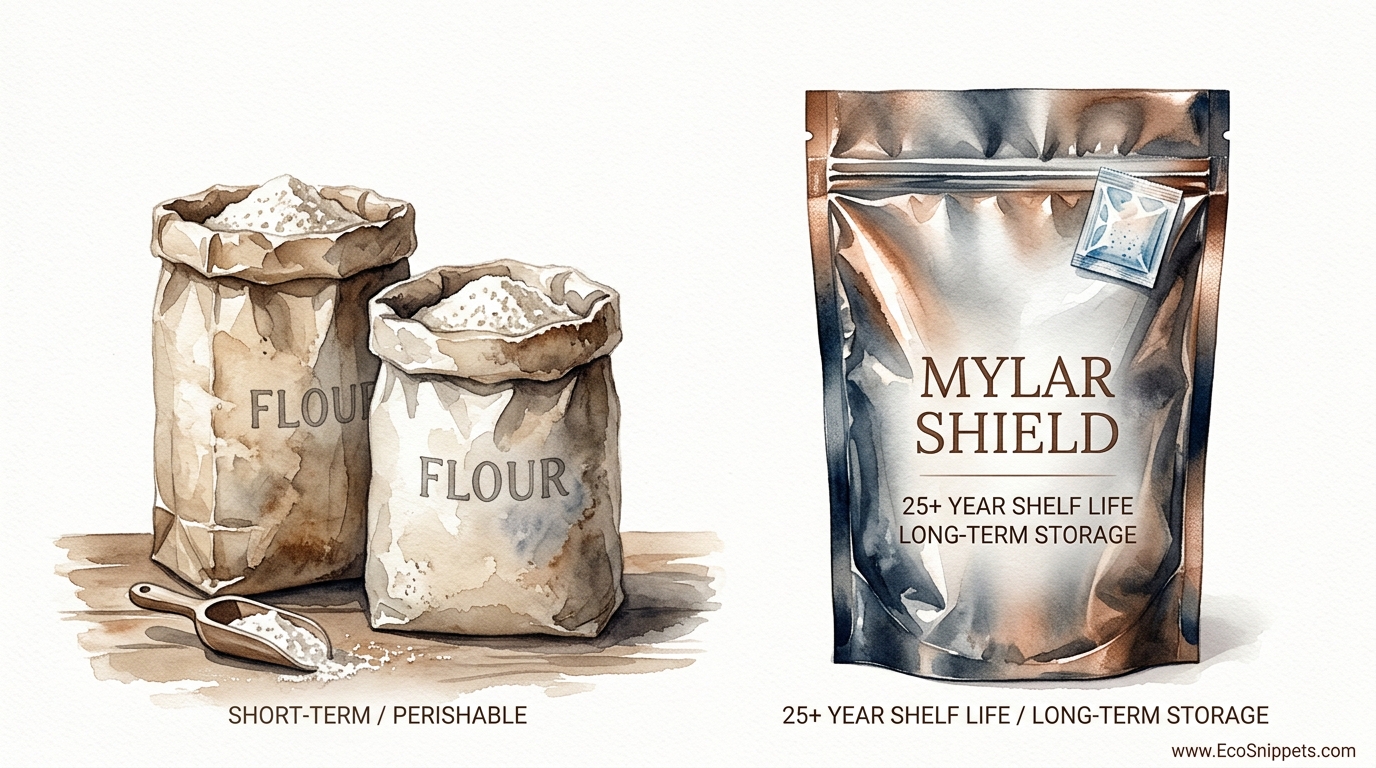
Is your food storage a ticking time bomb? A single paper bag stands between your family and a total loss of your grain supply. Relying on original store packaging is the most common mistake in food preservation. Paper bags are a ‘fragile’ system – they invite moisture and pests. To build a ‘resilient’ larder that can last for 25 years, you need the Mylar shield. Removing oxygen and blocking light means you aren’t just storing food; you’re creating a vault for your family’s future.
How To Store Flour For 25 Years
Long-term storage of flour requires a fundamental shift in how we view food packaging. Standard grocery store bags are designed for rapid turnover and breathability, which is the exact opposite of what you need for a 25-year shelf life. White flour can effectively be preserved for a quarter-century when isolated from its primary enemies: oxygen, light, moisture, and pests.
Storing flour for decades is a practice used by self-reliance enthusiasts and those building emergency reserves. It provides a stable source of carbohydrates and calories that remains “table-ready” without the need for milling equipment. While whole wheat berries are often cited as the ultimate long-term grain, white flour is a viable alternative for those who want immediate usability in a crisis.
Successful long-term storage relies on the “Mylar shield” method. This involves transferring refined white flour into high-barrier Mylar bags, adding oxygen absorbers to create an anaerobic environment, and sealing the bags with heat. This process halts the oxidation of the small amount of fat left in white flour and prevents any microscopic insect eggs from hatching.
The Mechanics of Modern Preservation
The science behind a 25-year shelf life rests on the material properties of Mylar, technically known as BoPET (Biaxially-oriented polyethylene terephthalate). Unlike standard plastic bags, Mylar is a multi-layered laminate that includes a core of aluminum foil. This foil layer provides an near-total barrier against oxygen and light.
Oxygen absorbers, typically small packets filled with iron powder, work through a chemical reaction. Once sealed inside the bag, the iron reacts with the trapped oxygen to create iron oxide. This process reduces the oxygen level to less than 0.01%, which is far more effective than vacuum sealing alone.
The removal of oxygen serves two purposes. First, it prevents oxidative rancidity, where the lipids in the flour break down and create “off” flavors often described as smelling like old crayons. Second, it creates an environment where life cannot be sustained. Most flour contains tiny weevil eggs that are harmless but will hatch in the presence of oxygen and warmth. Removing the oxygen ensures these eggs remain dormant or are neutralized.
Step-by-Step Guide to the Mylar Shield
Creating a 25-year flour vault requires precision and the right supplies. You will need 5-mil or 7-mil Mylar bags, 2,000cc to 2,500cc oxygen absorbers (for 5-gallon bags), and food-grade 5-gallon (18.9-liter) buckets for physical protection.
- Clean Your Workspace: Ensure your area is dry and free of dust. Flour is hygroscopic, meaning it absorbs moisture from the air, so avoid doing this on a humid day.
- Prepare the Buckets: Place a 5-gallon Mylar bag inside a clean, food-grade bucket. This provides structural support and makes the filling process easier.
- Fill with Flour: Pour the flour into the Mylar bag. Use a clean scoop and leave approximately 4 to 6 inches (10 to 15 cm) of headspace at the top for sealing.
- Add Oxygen Absorbers: Drop the required amount of oxygen absorbers on top of the flour. For a 5-gallon bag, 2,000cc to 2,500cc is the standard. If using 1-gallon bags, 300cc to 500cc is sufficient.
- Heat Seal: Squeeze as much air out of the bag as possible. Use an impulse sealer, a flat iron, or a clothing iron set to the “wool” or “cotton” setting to seal the top 2 inches (5 cm) of the bag. A double seal is often recommended for extra security.
- Label and Store: Write the date and the type of flour on the bag or the bucket. Store in a cool, dark place, ideally between 40°F and 60°F (4°C to 15°C).
The Primary Benefits of Long-Term Flour Storage
Building a deep pantry with a 25-year horizon offers more than just emergency calories. It acts as a financial hedge against food inflation. Purchasing flour in bulk today locks in current prices, protecting your family from future market volatility.
Resilience is the second major advantage. In a scenario where supply chains are disrupted, having a ready-to-use staple like flour allows for the production of bread, pasta, and thickeners without needing a grain mill or electricity. It is a “plug-and-play” resource for the household.
Furthermore, Mylar storage provides peace of mind. Knowing that your investment is protected from rodents and insects inside a sealed bucket system removes the constant worry of pantry infestations that plague traditional storage methods.
Challenges and Common Pitfalls
The most frequent mistake in long-term storage is attempting to store the wrong type of flour. Whole wheat flour contains the germ and the bran, which are rich in oils. These oils go rancid even in an oxygen-free environment over a long enough timeline. For a true 25-year target, only refined white flour (All-Purpose or Bread Flour) should be used.
Punctures are another significant risk. Flour can be “dusty,” and if flour particles get into the heat-seal area, it can create a microscopic leak. Always wipe the inside of the bag’s rim with a clean cloth before sealing to ensure a perfect bond.
Some users worry when their bags do not “shrink-wrap” like a vacuum-sealed steak. Oxygen absorbers only remove the 21% of air that is oxygen; the remaining 79% is nitrogen, which will not be absorbed. A bag that isn’t tight may still be perfectly preserved as long as the oxygen is gone.
Limitations of Stored Flour
While white flour can last 25 years, it is not an immortal substance. Over decades, the protein structure (gluten) can slowly degrade. While the flour will still be safe to eat and provide calories, it may not rise as vigorously in bread making. Adding a dough enhancer or vital wheat gluten can help revitalize older flour.
Nutritional degradation is a reality. While the macronutrients (carbohydrates and proteins) remain stable, certain vitamins like Thiamin (B1) and Vitamin E may decrease over time. This is why flour should be viewed as a caloric foundation rather than a total nutritional solution.
Temperature remains the ultimate limiting factor. If stored in a hot attic or a garage with 100°F (38°C) summers, the shelf life will be cut by more than half. High heat accelerates every chemical degradation process, regardless of the packaging.
Comparison: Flour vs. Wheat Berries
Deciding between storing flour and wheat berries depends on your equipment and your timeline. Wheat berries are the “gold standard” for 30-year storage because the protective bran is still intact, but they require a mill to be useful.
| Feature | White Flour | Wheat Berries |
|---|---|---|
| Shelf Life | 15–25 Years | 25–30+ Years |
| Preparation | Ready to use immediately | Must be milled into flour |
| Nutritional Value | Low (Stripped of germ/bran) | High (Full spectrum) |
| Resilience | Moderate (Sensitive to heat) | High (Very hardy) |
| Storage Complexity | Low (Seal and store) | Low (Seal and store) |
Practical Tips for Success
Implementing a few advanced techniques can further secure your food supply. Consider these best practices before you start your next sealing session.
- The Freezer Trick: Put your flour in the freezer for 48 hours before packing it. This kills any existing larvae or adult pests. Ensure the flour returns to room temperature before sealing to prevent condensation.
- Bucket Lids: Use Gamma Seal lids for buckets you plan to rotate frequently. For 25-year storage, a standard snap-on lid with a rubber gasket is often more airtight over the long run.
- Diatomaceous Earth (DE): Mixing a small amount of food-grade DE into the flour is an old-school method to prevent insects. It is harmless to humans but lethal to bugs.
- Bay Leaves: Placing a few dried bay leaves inside the bucket (outside the Mylar bag) can act as a secondary deterrent for weevils and moths.
Advanced Considerations for the Serious Practitioner
Scaling your storage requires a rotation plan. Even though the flour can last 25 years, a “First In, First Out” (FIFO) system is still the best approach. Every five years, consider opening one bucket to test the quality and replace it with fresh stock.
Think about the environment of your storage room. Basements are often ideal for temperature but can be prone to high humidity. If you store your buckets on concrete floors, use pallets or 2x4s to lift them. Concrete can “wick” moisture and cause the bottom of the buckets to rust or degrade over several years.
Serious practitioners also consider the “headspace” math. The less air you leave in the bag, the less work the oxygen absorber has to do. Use a vacuum hose to pull out the bulk of the air before the final seal, but be careful not to suck up the flour itself.
Example Scenario: The One-Year Buffer
A family of four decides to store a one-year supply of flour as a safety net. Statistics suggest the average person consumes about 130 lbs (59 kg) of wheat products annually. For a family of four, this equals roughly 520 lbs (236 kg).
In this scenario, the family would need about 16 to 17 five-gallon buckets, as each bucket holds approximately 30 to 35 lbs (13.6 to 15.8 kg) of flour. By using the Mylar shield method, they can store these buckets in a cool basement and forget about them for two decades, knowing they have a reliable bread-making foundation ready at any moment.
Final Thoughts
The transition from a fragile paper-bag pantry to a resilient Mylar-sealed vault is a hallmark of true self-reliance. Storing flour for 25 years is not about paranoia; it is about recognizing the vulnerability of modern systems and taking practical steps to mitigate those risks. By following the scientific principles of oxygen exclusion and light blocking, you ensure that your investment remains a valuable asset for years to period.
Experiment with small batches first. Buy a few bags of Mylar and a pack of absorbers to get a feel for the heat-sealing process. Once you master the technique, you can expand your larder to include other dry staples like rice, beans, and oats.
Taking control of your food security today provides a sense of calm that no grocery store shelf can offer. Your future self will thank you for the foresight to protect the simple, essential grain that has sustained families for generations.
