How To Become More Self-Sufficient Without Starting a Full-Blown Farm…
Want to start preserving your harvest, making your own soap, or building a backyard root cellar — but not sure where to begin? “Homesteading Advice” gives you instant lifetime access to 35+ practical homesteading books on food preservation, veggie gardening, DIY natural cleaning products (save over $250 per year with this skill alone), brewing, off-grid energy, and a whole lot more…
Click Here To Check It Out Now!
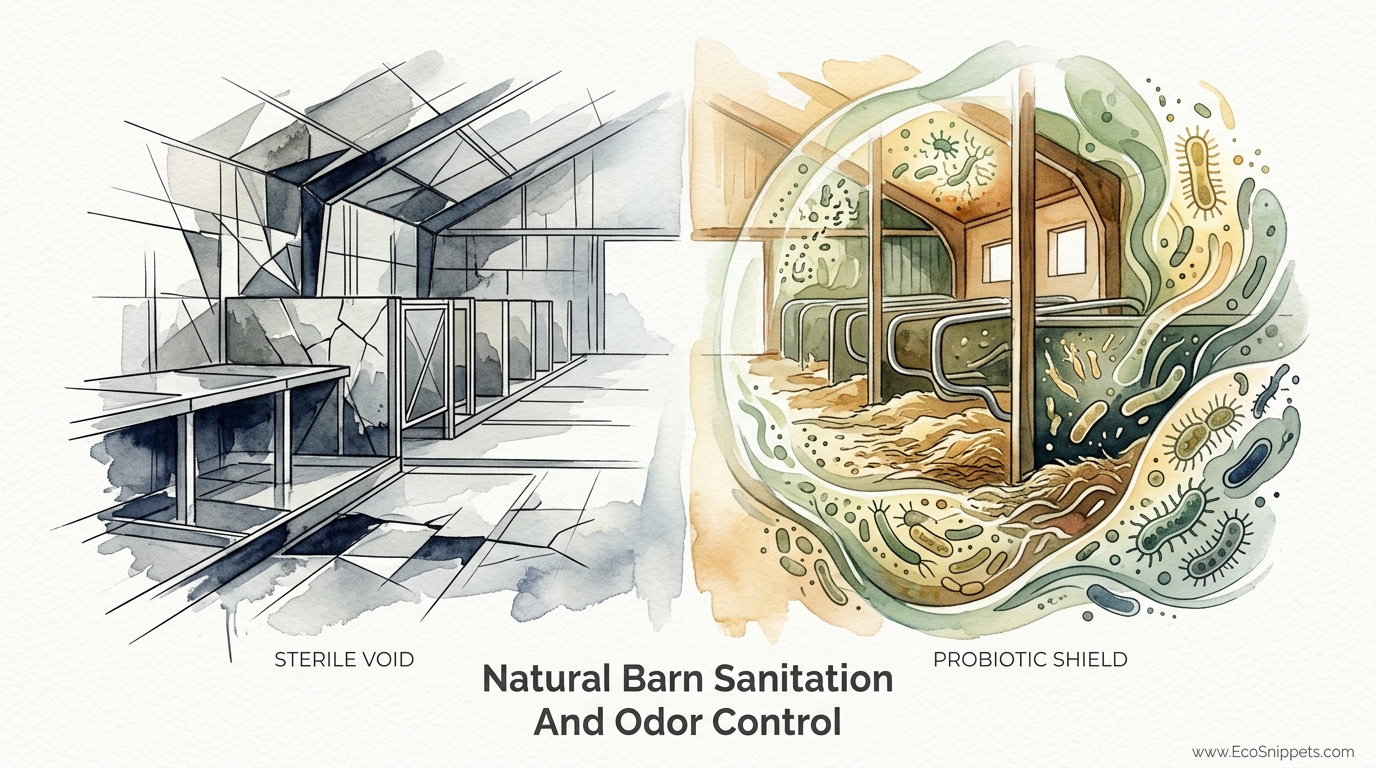
If your barn smells like a hospital, you’ve killed the beneficial bacteria that actually prevent disease. Harsh chemicals create a biological vacuum that is quickly filled by the most aggressive, resistant pathogens. Using ‘Living’ Effective Microorganisms (EM) creates a probiotic shield in your barn, out-competing bad bacteria and naturally digesting ammonia odors before they irritate your animals’ lungs.
This approach to animal husbandry is not just a modern trend; it is a return to a more balanced way of living alongside our livestock. For generations, farmers understood that health came from a clean environment, but they didn’t equate “clean” with “dead.” A healthy barn is a living ecosystem where the right kind of life keeps the wrong kind of life in check.
When you walk into a stable or a coop, your nose tells you the story of the microbiology at work. A sharp, stinging scent of ammonia indicates that proteins are rotting and off-gassing, while a sweet, earthy, or fermented scent indicates that beneficial microbes are winning the battle. This guide will show you how to tip the scales in favor of health.
Natural Barn Sanitation And Odor Control
Natural barn sanitation is the practice of managing the microbial life within an animal enclosure to prevent the buildup of pathogens and noxious gases. Instead of using corrosive disinfectants like bleach or ammonia-based cleaners, we introduce a massive population of beneficial “Effective Microorganisms” (EM). These microbes occupy the physical space and consume the resources that would otherwise support the growth of disease-causing bacteria.
This method exists because the traditional “slash and burn” approach to sanitation—sterilizing everything with chemicals—often backfires. When you use a heavy-duty disinfectant, you kill 99.9% of everything, but that remaining 0.1% is often the most resistant and aggressive. Without any competition from “good” bacteria, these “bad” actors multiply rapidly in the sterile void.
You can visualize this like a garden. If you clear-cut a piece of land and leave the soil bare and sterile, the first things to grow back are the toughest, most invasive weeds. However, if you intentionally plant a thick, healthy cover crop, the weeds cannot find the space or nutrients to take hold. A probiotic shield works the exact same way on the floor of your horse stall or chicken coop.
In real-world terms, this means your barn stops smelling like a laboratory and starts smelling like a forest floor. It means your animals stop coughing from caustic fumes, and their skin and hooves stay healthier because they aren’t standing in a swamp of putrefactive bacteria.
How It Works: The Microbiology of the Probiotic Shield
Effective Microorganisms, often referred to as EM-1, are a liquid consortium of three primary groups of microbes: Lactic Acid Bacteria, Yeast, and Phototrophic Bacteria. These microbes work in a synergistic loop to transform waste into stable, non-toxic matter.
Lactic Acid Bacteria are the “workhorses” of the group. They produce lactic acid, which lowers the pH of the environment. Most pathogenic bacteria, such as Salmonella and E. coli, cannot thrive in an acidic environment. These bacteria are also experts at breaking down complex organic matter like cellulose and lignin found in straw or wood shavings.
Yeast fungi contribute by fermenting organic substances and producing vitamins and amino acids. This fermentation process is significantly different from putrefaction. Putrefaction creates foul smells and toxic byproducts; fermentation creates a sweet scent and bioavailable nutrients. The yeast also provides food for other beneficial microbes, ensuring the colony remains self-sustaining.
Phototrophic Bacteria are perhaps the most unique part of the mix. These microbes use sunlight and heat to synthesize useful substances from the secretions of other microbes and gases like hydrogen sulfide. They essentially act as a “clean-up crew,” taking the potential pollutants and turning them into energy for the rest of the probiotic community.
When you spray this mixture onto bedding, it begins a process called competitive exclusion. The beneficial microbes outnumber the pathogens by billions to one. They consume the nitrogen in the urine before it can be converted into ammonia gas (NH3), which is why the odor disappears so rapidly.
Benefits of Moving Toward a Living Barn
The most immediate benefit is the dramatic reduction in ammonia. High levels of ammonia (above 25 parts per million) can damage the lining of an animal’s respiratory tract, leading to chronic coughing, pneumonia, and “heaves” in horses. Using EM can reduce ammonia levels by up to 80% within the first 8 to 12 hours of application.
Animal skin and hoof health see a measurable improvement when the bedding is dominated by probiotics. Conditions like “scratches” (equine pastern dermatitis) or “rain rot” are often caused by opportunistic bacteria and fungi that thrive in wet, putrid conditions. A probiotic shield prevents these pathogens from colonizing the animal’s skin.
Fly control is an often-overlooked secondary benefit. Flies are attracted to the odors of putrefaction and rotting manure because that is where they lay their eggs. When you eliminate those scents through fermentation, the barn becomes far less attractive to pests. Furthermore, the microbes in EM can help break down the organic matter that fly larvae need to survive, naturally thinning the population.
Manure management becomes a resource rather than a chore. Manure that has been treated with EM in the barn is already “pre-digested.” When you muck it out and put it in a compost pile, it breaks down significantly faster—sometimes in a third of the time—and results in a much higher quality fertilizer for your garden or pastures.
Challenges and Common Mistakes
One frequent error is the “mix and match” approach to sanitation. Many owners will spray EM one day and then use a bleach solution the next. The chlorine in bleach and most tap water will instantly kill the beneficial microorganisms you are trying to establish. If you must use tap water, let it sit in an open bucket for 24 hours to allow the chlorine to gas off, or use a de-chlorinator.
Temperature management is another hurdle. Microbes are living things and they have a preferred climate. They are most active in temperatures between 20°C and 40°C (68°F to 104°F). If the barn drops below freezing, the microbes will go dormant. They won’t die, but they will stop processing waste and controlling odors until things warm back up.
Skipping the “mucking” phase is a common misunderstanding. EM is a powerful tool, but it is not a substitute for basic husbandry. You still need to remove the bulk of the manure and saturated bedding. The microbes are there to manage the residual moisture and the “unseen” biology, not to magically disappear three inches of horse manure.
Storage mistakes can also ruin your supply. EM should be kept in a dark, cool place, but never in the refrigerator. Extreme cold shocks the yeast and bacteria, while direct sunlight can cause the phototrophic bacteria to over-produce, throwing the whole consortium out of balance. Always keep the cap on tight to maintain the anaerobic environment the microbes prefer.
Limitations of Probiotic Sanitation
This method is not a “magic bullet” for overcrowded facilities. If you have ten animals in a space designed for two, no amount of beneficial bacteria can keep up with the volume of waste produced. Biological systems have a carrying capacity, and exceeding it will always lead to health issues and odors.
Environmental humidity plays a massive role. In extremely arid climates, the liquid EM spray may evaporate too quickly for the microbes to establish a colony in the bedding. In these cases, you may need to spray more frequently or use a “Bokashi” (fermented bran) which holds the moisture and microbes better in dry air.
Drainage is a physical limitation that biology cannot fix. If your barn floor is a low-point that collects groundwater or has poor runoff, the bedding will stay “soupy.” While EM can help prevent that soup from becoming toxic, it cannot create a dry environment out of a swamp. Structural issues require structural solutions.
Comparison: Sterile Void vs. Probiotic Shield
Understanding the difference between these two management philosophies helps in deciding which path is right for your homestead.
| Feature | Sterile Void (Chemical) | Probiotic Shield (EM) |
|---|---|---|
| Main Goal | Kill 99.9% of all life. | Establish dominant good life. |
| Odor Control | Masking scents or temporary death. | Digestion of ammonia at the source. |
| Animal Safety | Corrosive; can irritate skin/lungs. | Completely non-toxic; safe to touch. |
| Long-term Stability | High risk of “superbug” recolonization. | Stable, self-regulating ecosystem. |
| Waste Impact | Chemicals slow down composting. | Microbes accelerate composting. |
Practical Tips for Implementation
Establish a routine for your spray schedule. For a standard horse stall (approx. 12ft x 12ft or 3.6m x 3.6m), a dilution of 1:100 (1 part EM to 100 parts water) is ideal for daily maintenance. Use a simple pump-sprayer to mist the bedding, focusing heavily on the “pee spots” after you have mucked out the saturated material.
Target the infrastructure, not just the floor. Spray the walls, the stall doors, and even the rafters once a month. Dust often carries pathogens and mold spores; coating these surfaces in a fine mist of EM helps “colonize” the dust, making it less biologically active if it gets inhaled by your animals.
Consider using “Activated EM” (AEM) to save on costs. While you can buy dormant EM-1 concentrate, you can “wake it up” and multiply it yourself using molasses and water. This is the most economical way for serious practitioners to manage large barns or multiple shelters.
Always use un-sulfured blackstrap molasses when activating your microbes. The sulfur in some molasses is added as a preservative to kill bacteria—exactly the opposite of what you want. The microbes need the minerals and sugars in the blackstrap variety to multiply effectively.
Advanced Considerations: Activating Your Own EM
Serious practitioners often move beyond the store-bought bottles and begin “brewing” their own Activated EM. This process allows you to turn one liter (0.26 gallons) of concentrate into 20 liters (5.2 gallons) of ready-to-use probiotic solution.
The standard recipe for activation is 5% EM-1 concentrate, 5% blackstrap molasses, and 90% clean, chlorine-free water. Mix these in a clean plastic container, leaving as little “headspace” (air) at the top as possible. The microbes in EM are anaerobic, meaning they do best without oxygen.
Store this container in a warm place (around 30°C or 86°F) for 7 to 10 days. You will need to “burp” the bottle occasionally to release the carbon dioxide buildup, or use a simple home-brew airlock. You know the process is successful when the pH of the liquid drops below 3.8. You can test this with simple pH strips.
The finished product should have a pleasant, sweet-and-sour smell, similar to apple cider vinegar or a good sourdough starter. If it smells like rotten eggs or putrid waste, the activation has failed, likely due to contamination or a lack of heat. Using a failed batch is not recommended, as it could introduce the very pathogens you are trying to avoid.
Example Scenarios
The Poultry Coop: A backyard chicken keeper struggles with “wet tail” and a heavy ammonia smell in a 10-foot by 10-foot (3m x 3m) coop. To fix this, they first strip the old litter. They spray a 1:10 dilution of EM directly onto the wooden floor and lower walls. They then add 6 inches (15cm) of fresh pine shavings and spray the top of the shavings with a 1:100 dilution. Within three days, the ammonia smell is gone. They now mist the coop once a week, and the “deep litter” begins to ferment into a dark, rich compost right on the coop floor.
The Horse Stable: A professional boarding facility has a horse with chronic “scratches” on its hind legs. The vet suggests better hygiene. The manager begins using EM-1 at a 1:50 dilution on the stall mats every morning after mucking. They also spray the horse’s lower legs with a 1:100 dilution twice daily. After two weeks, the skin on the pasterns is healthy and pink, and the stall smells like fresh earth despite the summer heat.
Final Thoughts
Natural barn sanitation is an act of stewardship. It moves us away from the mindset of warfare against the microbial world and toward a mindset of management. By understanding that we can never truly “sterilize” a barn, we realize that our best defense is a strong, healthy offense of beneficial life.
Using Effective Microorganisms is a practical, cost-effective way to improve the life of every animal under your care. Whether you are managing a single pet rabbit or a hundred-head dairy operation, the principles of the probiotic shield remain the same. It is about creating an environment where health is the default state, and disease has no room to grow.
Experiment with these methods and observe the changes in your animals. You will likely find that they are calmer, their coats are shinier, and your own time in the barn becomes much more pleasant. When we work with nature instead of against it, the rewards are measured in the health and vitality of the entire homestead.
