How To Become More Self-Sufficient Without Starting a Full-Blown Farm…
Want to start preserving your harvest, making your own soap, or building a backyard root cellar — but not sure where to begin? “Homesteading Advice” gives you instant lifetime access to 35+ practical homesteading books on food preservation, veggie gardening, DIY natural cleaning products (save over $250 per year with this skill alone), brewing, off-grid energy, and a whole lot more…
Click Here To Check It Out Now!
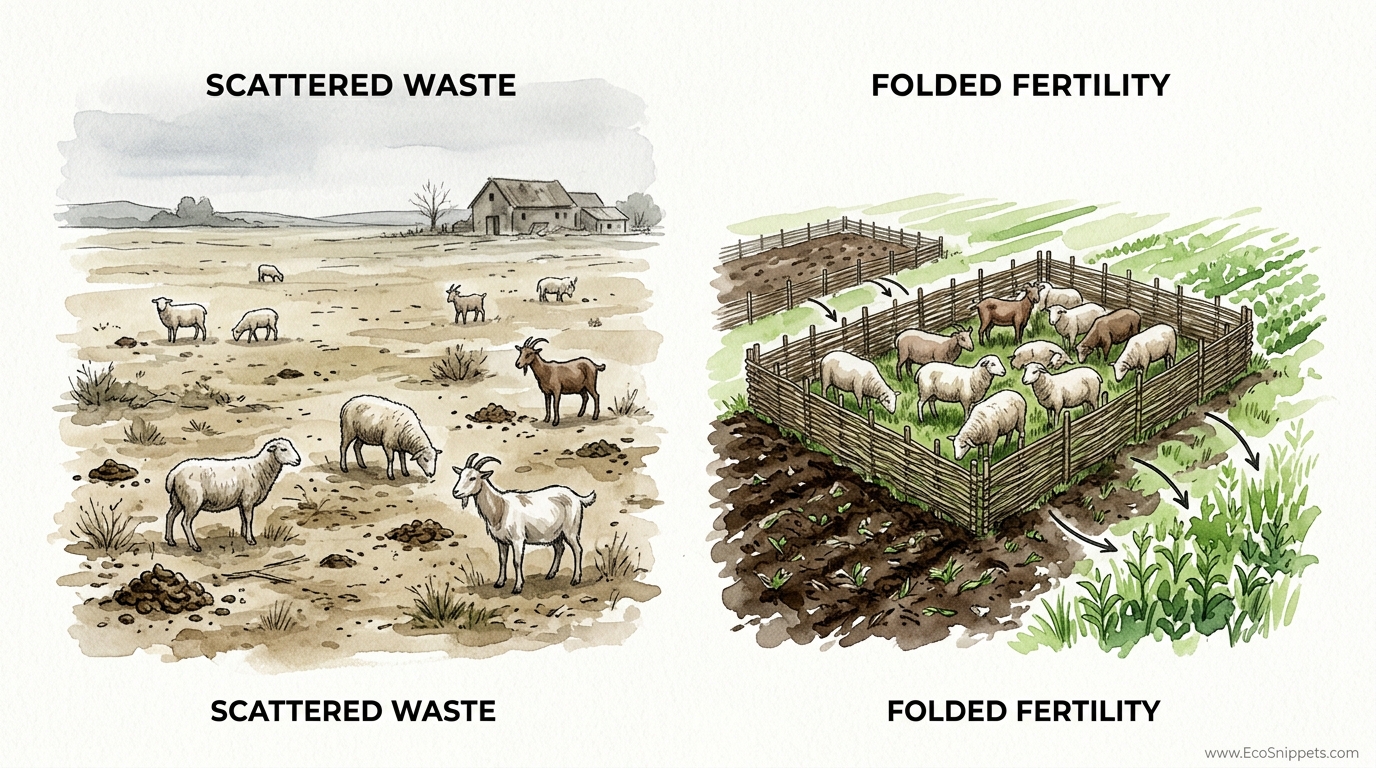
One system wastes 90% of your livestock’s potential, while the other turns a single night of sleep into a perfectly fertilized garden bed. Before chemical fertilizers, medieval farmers practiced ‘folding’—the art of using movable fences to concentrate livestock on specific patches of ground. Instead of manure being wasted across a massive field, it was delivered with surgical precision to the exact spot where grain would be sown the next morning. This isn’t just ‘grazing’; it’s a high-speed nutrient delivery system that eliminates the need for hauling, tilling, or buying bagged fertilizer. Here is how to apply the fold to your modern homestead.
Modern agriculture often views livestock as separate from the soil. We put animals in barns, scrape up the waste, haul it to a pile, let it sit for six months, and then burn diesel to spread it back onto the fields. This process loses a staggering amount of nitrogen to the atmosphere and drains the farmer of time and resources. Ancestral wisdom found a better way. By using the animals as mobile composting units and the soil as the direct recipient, you skip the middleman and the fuel bill.
Folding is the ultimate expression of biological synergy. It treats the sheep, goat, or cow not just as a producer of meat or milk, but as a living, breathing fertilizer spreader. When you master the fold, you are no longer just raising animals; you are building a legacy of deep, black, fertile earth that will outlast any chemical shortcut.
Medieval Livestock Folding Technique For Soil Fertility
Medieval livestock folding, historically known as the “fold-course” system, is the practice of confining animals to a small, temporary enclosure on arable land overnight. During the day, livestock—most commonly sheep—would graze on common pastures, hillsides, or “upland sheepwalks.” As dusk fell, shepherds would drive the flock into a small pen made of movable wooden hurdles (fences) placed directly on the fallow field intended for next year’s crop.
The primary objective was simple: concentrate the “donge and pysse” (dung and urine) in a specific area. In the 13th and 14th centuries, the value of this fertility was so high that manorial lords often claimed the “fold-soke”—a legal right that forced peasant flocks to be folded on the lord’s private lands rather than the peasants’ own strips. It was understood that the golden hoof of the sheep was the only thing standing between a bountiful harvest and starvation.
In a modern context, folding is the predecessor to what we now call “mob grazing” or “high-density rotational grazing.” However, it differs in its intent. While rotational grazing focuses on pasture health and forage regrowth, folding is specifically designed to prepare a seedbed for crops. You are using the animal’s biology to “muck” the land, a term often referred to as being “fold-mucked.” This technique works because it captures the most volatile part of the fertilizer: the urine. When a sheep urinates on a pasture, 70% to 80% of the nitrogen is in that liquid. If it sits in a barn or a dry pile, that nitrogen turns into ammonia gas and vanishes. In the fold, it goes straight into the soil profile.
How to Implement the Modern Fold
Applying this technique today requires a shift in how you view your fences. Instead of permanent structures, you need a system that is lightweight and highly mobile.
1. Selecting Your Gear
Medieval farmers used “hurdles”—interwoven willow or hazel branches that were light enough to be carried by one man. Today, the most effective tool is electric netting (often called Electronet). This lightweight mesh can be set up in minutes and provides both containment for your livestock and protection from predators. If you are working with larger animals like cattle, simple polywire on geared reels with step-in posts works best.
2. Calculating Stocking Density
Precision is the key to folding. You want enough animals to cover the ground evenly but not so many that they become stressed or begin to trample the soil into a muddy mess. A standard rule of thumb for “high-intensity folding” is to aim for roughly 100,000 to 500,000 lbs of animal weight per acre (112,000 to 560,000 kg per hectare) for a very short duration.
On a homestead scale, this means if you have 10 sheep weighing 150 lbs (68 kg) each, you have 1,500 lbs (680 kg) of “fertilizer potential.” To reach a high-density “fold” effect, you might confine them to a space of only 150 to 200 square feet (14 to 18 square meters) for a single night. This ensures that every square inch of that soil receives a hit of nitrogen and organic matter.
3. The Moving Process
Movement must be frequent. In the classic system, the fold is moved every single day. You set the fence in a rectangular “cell,” leave the animals overnight, and the next morning, you move the hurdles to the adjacent patch. This creates a “checkerboard” of fertility across your garden or field. If the soil is dry, the animals can stay longer; if it is wet, you must move them faster to prevent compaction.
4. Water and Mineral Access
Even in a temporary fold, animals must have access to clean water. Modern graziers use “towed troughs” or long hoses with quick-connect valves. Since the animals are only in the fold overnight, many farmers provide a large drink before they enter and another when they are released back to the main pasture in the morning. However, for 24-hour folding, a mobile water source is mandatory.
Benefits of Folding Over Traditional Manure Spreading
Choosing to fold your livestock directly on the field offers measurable advantages that bagged fertilizer or stationary compost piles cannot match.
The most significant benefit is the preservation of nitrogen. Fresh manure and urine are rich in urea and ammonia. When these are deposited directly onto the soil, they are immediately available to soil microbes. In contrast, manure that is collected, stored, and then spread can lose up to 50% of its nitrogen content through volatilization and leaching. Folding ensures a 100% “delivery rate.”
Biological “tilling” is another hidden advantage. As animals move within the fold, their hooves create small indentations. These “micro-basins” catch rainwater and prevent runoff, while also pressing the manure into the top layer of the soil. This “hoof action” stimulates the soil’s biological “digestive system,” waking up earthworms and beneficial bacteria that have been dormant.
Furthermore, folding eliminates the labor of “mucking out” barns. On a homestead, time is the most precious resource. By moving the fence to the manure rather than moving the manure to the garden, you reclaim hours of back-breaking work every week. This creates a self-sustaining loop where the animals do the work of a tractor and a shovel while they sleep.
Challenges and Common Mistakes
While the principles of the fold are simple, execution requires a keen eye for both the animals and the land.
One of the most frequent errors is “over-staying” the fold. If you leave animals in a small enclosure for too long—especially during a rain event—the hoof action turns from a “gentle tilling” into a “destructive compaction.” Once the soil structure is collapsed, it becomes anaerobic, and the very fertility you were trying to build becomes toxic to plants. You must be prepared to move the fold even in the middle of a storm if the ground begins to “puddle.”
Predator protection is another modern challenge that medieval shepherds solved by sleeping with their flocks. In the 21st century, you must ensure your electric fence is “hot” enough to deter coyotes, dogs, or foxes. A weak charge in a small, concentrated area makes your livestock a “sitting duck.” Always test your fence with a voltmeter before leaving for the night; a reading of at least 3,000 to 5,000 volts is generally required for sheep and goats.
Watering logistics can also trip up a beginner. It is easy to forget that a concentrated group of animals will drink more in a small space due to the proximity of the water and the lack of other distractions. If the water runs dry, the animals will become restless, likely knocking down your temporary fences in an attempt to find a drink.
Limitations and Environmental Constraints
Livestock folding is a powerful tool, but it is not a “one-size-fits-all” solution for every landscape.
Soil type plays a massive role in whether folding is appropriate. On heavy clay soils, the risk of “pugging”—where hooves create deep holes that bake into “concrete” when dry—is extremely high. Folding is best suited for sandy, loamy, or well-drained soils. If you live in an area with high clay content, you may only be able to fold during the driest months of summer or the depths of a frozen winter.
Climate and seasonality also dictate the timing. In the medieval system, folding was rarely done in the dead of winter unless the animals were provided with extra bedding. Cold, wet mud is the enemy of animal health, leading to hoof rot and respiratory issues. If the weather is consistently foul, it is better to return the animals to a “sacrifice area” or a well-bedded barn until conditions improve.
Finally, consider the scale of your operation. While folding is incredibly efficient for a 1-acre (0.4 hectare) market garden, it becomes logistically complex on a 100-acre (40 hectare) grain farm without significant investments in automated fencing or large-scale “herd effect” management. It is a technique of “surgical precision,” best applied where every square foot of fertility counts.
Comparison: Static Penning vs. Mobile Folding
Understanding the difference between keeping animals in a fixed location versus moving them across the land is essential for long-term soil health.
| Feature | Static Penning | Mobile Folding |
|---|---|---|
| Nutrient Concentration | Excessive in one spot; leads to runoff. | Optimized and spread evenly across the field. |
| Labor Level | High (manure must be manually removed). | Low to Moderate (moving fences). |
| Parasite Risk | High (animals stay on contaminated ground). | Low (animals move to fresh ground daily). |
| Soil Impact | Compaction and “dead zones.” | Aeration and biological stimulation. |
| Cost | Higher for permanent structures. | Lower (investing in portable gear). |
Practical Tips and Best Practices
To get the most out of your “folded fertility,” follow these ancestral shortcuts adapted for the modern age.
- Pre-Mow the Fence Line: Before setting up electric netting, use a scythe or mower to cut a narrow path where the fence will sit. This prevents grass from “shorting out” the circuit and ensures the fence remains at maximum voltage.
- Use the “Nose Test”: A properly folded field should smell like fresh earth within 48 hours. If it smells strongly of ammonia for days, your stocking density was too high or the animals stayed too long. Adjust your “cell” size for the next move.
- Corner Tying: When using portable panels or netting, always double-tie the corners. In a concentrated fold, animals will naturally lean against the perimeter. A single failed corner can result in your “fertilizer units” wandering into the neighbor’s hay field.
- Timing the Release: Release the animals from the fold as early in the morning as possible. This encourages them to do their “heavy lifting” (depositing waste) in the pen rather than on the trail back to the pasture.
Advanced Considerations: Multi-Species Folding
Once you have mastered the basic fold with sheep or goats, you can begin to integrate multi-species rotations to further refine your soil health.
In a “Leader-Follower” system, you might fold your dairy cow on a patch of ground for 24 hours to take the “best” of the forage and provide a large dose of phosphorus-rich manure. After the cow is moved, a “follower” flock of sheep or chickens is folded on the same patch. The sheep will eat the weeds the cow ignored, and the chickens will scratch through the cow pats, eating fly larvae and spreading the manure into a fine, even layer.
This multi-species approach mimics the diversity of a natural ecosystem. It also breaks parasite cycles; many internal parasites that affect sheep cannot survive in the gut of a cow, and vice versa. By “cleaning” the pasture with a second species, you ensure that the fertility you are building doesn’t come at the cost of animal health.
Example Scenario: Preparing a 1/4 Acre Garden Bed
Imagine you have a 1/4 acre (0.1 hectare) plot that has been neglected and is currently covered in tough weeds and depleted soil. You want to plant a heavy-feeding crop like pumpkins or corn next spring.
Instead of buying 20 bags of fertilizer and renting a tiller, you use a flock of 12 sheep. You divide the garden into 15 “cells,” each roughly 700 square feet (65 square meters). Each evening, you move the sheep into a new cell. Over the course of 15 days, the sheep will have “mowed” the weeds, trampled the organic matter into the surface, and deposited approximately 400 lbs (180 kg) of high-nitrogen manure and hundreds of gallons of urine directly into the root zone.
By the time you are ready to plant, the soil will be dark, moist, and teeming with microbial life. The cost to you? A few minutes of fence-moving each day and a bit of hay to supplement their evening rest. This is the efficiency of the medieval fold in action.
Final Thoughts
One system relies on the global supply chain, fossil fuels, and synthetic chemicals to keep the earth producing. The other relies on the heartbeat of your livestock and the rhythm of the sun. Medieval livestock folding is more than just a technique; it is a return to a way of farming that views the land as a living organism.
When you implement the fold, you are participating in a cycle of fertility that has sustained civilizations for a thousand years. You are turning “waste” into “wealth” and “labor” into “legacy.” Start small, watch your soil transform, and trust in the “golden hoof” to restore the vitality of your homestead. Experiment with your densities, listen to your land, and you will find that the most powerful tools in your arsenal are not in the machine shed, but in the pasture.
