How To Become More Self-Sufficient Without Starting a Full-Blown Farm…
Want to start preserving your harvest, making your own soap, or building a backyard root cellar — but not sure where to begin? “Homesteading Advice” gives you instant lifetime access to 35+ practical homesteading books on food preservation, veggie gardening, DIY natural cleaning products (save over $250 per year with this skill alone), brewing, off-grid energy, and a whole lot more…
Click Here To Check It Out Now!
Your animals need grooming 24/7, but that doesn’t mean you have to be the one holding the brush. Are you a slave to the curry comb? Most homesteaders spend hours every week fighting flies and skin parasites by hand. The passive strategist installs a self-service station that lets the herd manage their own hygiene. It’s better for their skin, better for your back, and costs almost nothing to maintain.
Grooming is more than just a luxury for livestock; it is a fundamental biological need. In the wild, animals use trees, rocks, and abrasive soil to rid themselves of old hair, mud, and external parasites. On a farm or homestead, they often turn to your expensive fencing or barn corners to scratch that itch, leading to structural damage and frustrated owners. By providing a dedicated space for this behavior, you turn a destructive habit into a health-boosting routine.
Establishing a DIY grooming station allows you to reclaim your time while ensuring your animals remain comfortable and healthy. These stations can range from simple fixed brushes to complex systems that apply fly oil or insecticides automatically. Because you are building it yourself, you can tailor the materials and dimensions to fit the specific needs of your cattle, goats, pigs, or horses.
DIY Livestock Grooming Station Ideas
A livestock grooming station is a permanent or semi-permanent installation designed to allow animals to groom themselves without human intervention. These stations typically utilize abrasive materials like heavy-duty brushes, textured mats, or specialized “wick” systems to remove loose hair and debris. In the real world, these are often seen in high-traffic areas like dairy barns or near water troughs in pastures.
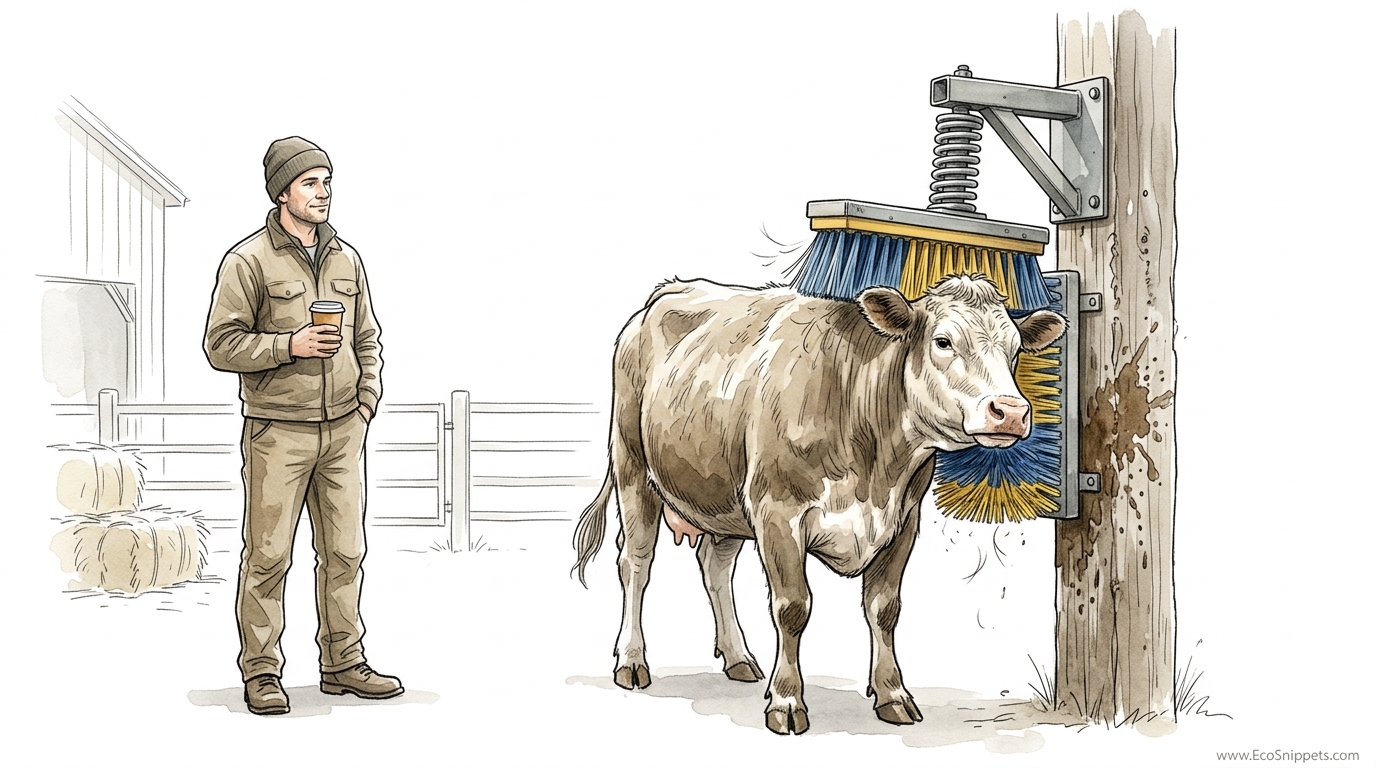
There are several creative ways to build these using recycled or low-cost materials. One of the most popular ideas involves repurposing used street sweeper brushes, which are often discarded by municipalities and provide the perfect stiffness for large cattle. For smaller animals like goats or pigs, old push broom heads or even stiff deck brushes mounted to a sturdy post serve the same purpose.
The core concept is to provide a “scratching post” that is more attractive and effective than your fence line. By centralizing this activity, you can also integrate pest management solutions. For instance, a station can include a reservoir of fly oil that is dispensed as the animal rubs, treating them for pests while they enjoy a good scratch.
How to Build Your Own Grooming Station
Building a successful grooming station requires understanding the physical force your animals will apply. A thousand-pound steer leaning against a brush creates significant torque, so the mounting system must be exceptionally robust.
The Street Sweeper Post
One of the gold standards for DIY cattle scratching is the street sweeper brush. Many homesteaders find these brushes for free or very cheap from local public works departments.
- Mounting: Slide the circular brush over a heavy-duty wooden post (like a 6×6 or a telephone pole).
- Height: Ensure the top of the brush is at the animal’s shoulder height. For cattle, this usually means a post buried at least 3–4 feet (0.9–1.2 meters) deep.
- Stabilization: If using a vertical mount, cap the post with a large washer or a piece of treated wood to prevent the animal from lifting the brush off.
The Wall-Mounted Multi-Brush
For goats or pigs, you can create a multi-angled station using standard push broom heads.
- Step 1: Select three stiff-bristled broom heads. Remove the handles.
- Step 2: Mount one head vertically on a corner post for side-scratching.
- Step 3: Mount a second head horizontally above it, angled slightly downward, to catch the top of the head and neck.
- Step 4: Secure everything with 3-inch (7.6 cm) deck screws and wide washers to prevent the plastic backing of the brush from cracking under pressure.
The Integrated Fly Oiler
To add pest control, you can wrap a section of the post in heavy burlap or a thick rope. Above this, mount a small reservoir (like a PVC pipe with small holes) filled with a mix of mineral oil and an approved livestock insecticide. As the animal rubs, the “wick” transfers the oil to their coat.
Benefits of Self-Service Grooming
The primary advantage of a self-service station is the massive reduction in manual labor. Instead of catching and hand-brushing every animal, the herd maintains itself. This is particularly beneficial during the spring shedding season when animals can become irritable from the “itch” of falling winter coats.
Beyond labor savings, these stations provide measurable health benefits. Regular scratching increases blood circulation to the skin, which can improve coat quality and even boost milk production in dairy breeds by up to 5–8% due to reduced stress. Furthermore, removing mud and manure helps prevent skin infections like dermatitis and discourages external parasites like lice and mites from taking hold.
There is also a significant psychological component. Grooming is a social and enrichment activity for livestock. Providing a safe outlet for this natural behavior reduces boredom and aggressive “bullying” behaviors within the herd, as animals have a constructive way to release energy and manage discomfort.
Challenges and Common Mistakes
The most frequent mistake in DIY grooming stations is underestimating the strength of the animal. A common push broom secured with standard nails will likely be ripped off the wall in less than a day. Always use heavy-duty lag bolts or deck screws with washers to distribute the pressure across the brush’s frame.
Another challenge is the “rub-raw” phenomenon. If a brush is too abrasive or if an animal has an undiagnosed skin condition, they may over-groom one specific spot until the skin is broken. It is essential to monitor your animals during the first few weeks of a new installation to ensure they are using the station healthily.
Placement is also a common pitfall. If you place the station in a narrow “bottleneck” area or right next to a gate, dominant animals may guard the station, preventing others from using it and causing congestion in your traffic flow. Always place stations in open areas where animals can approach from multiple angles.
Limitations: When DIY Isn’t Enough
While DIY stations are excellent for general maintenance, they are not a replacement for veterinary care or professional parasite treatment. If an animal has a severe infestation of mange or lice, a scratching post will only provide temporary relief and might even facilitate the spread of the parasite to other animals through shared bristles.
Environmental factors can also limit the effectiveness of certain builds. In extremely wet or humid climates, natural fiber brushes (like sisal or horsehair) can rot or harbor mold if they don’t have adequate airflow. In these regions, synthetic poly bristles are a much better choice.
Finally, consider the size variation in your herd. A station built for a full-grown cow will be useless for a calf, and a goat-sized station might be crushed if a horse tries to use it. You may need to install multiple stations at varying heights if you run a diverse or multi-age herd.
Manual Labor vs. Self-Service
| Feature | Manual Grooming | Self-Service Station |
|---|---|---|
| Time Commitment | High (Weekly hours) | Low (Initial setup + monthly check) |
| Animal Bonding | High (Direct interaction) | Low (Passive) |
| Cost | Low (Hand brushes) | Medium (Materials/Hardware) |
| Efficiency | Limited to handler’s schedule | Available 24/7 |
Practical Tips and Best Practices
Strategic placement is the secret to a well-used station. Locate your grooming area near natural congregation points, such as water troughs, mineral licks, or shade structures. Animals are more likely to spend time grooming when they are already in a relaxed, stationary mode.
For maintenance, check the bristles once a month. Over time, hair and skin oils will build up, making the brush less effective. You can clean most synthetic brushes with a stiff metal comb or a quick blast from a pressure washer. If you used wood-backed brushes, ensure the wood isn’t splitting or rotting, which could expose sharp screws.
If you have a particularly “heavy” rubber, consider mounting your brushes on a spring-loaded arm. This allows the brush to move with the animal, providing a more thorough “wrap-around” scratch and reducing the stress on your mounting bolts. Heavy-duty truck springs can often be adapted for this purpose.
Advanced Considerations for the Serious Practitioner
For those managing larger herds, consider “rotational grooming.” Much like rotational grazing, moving your portable grooming stations (mounted on skids or heavy concrete blocks) helps prevent high-traffic mud holes from forming in your pasture. Portable stations also allow you to move pest control to where the flies are most active during different seasons.
Performance can also be improved by using “dual-density” bristles. Using a very stiff brush for the initial mud removal followed by a medium-stiff brush for finer hair grooming mimics the natural progression of animal grooming. Some advanced DIYers even set up multiple stations in a “car wash” style alleyway that the animals walk through on their way to water.
Keep in mind that energy efficiency is rarely an issue with static DIY stations, but if you eventually transition to commercial rotating brushes, check the power draw. High-quality motion-activated brushes typically use less than 1kWh per month, making them a viable long-term upgrade if your budget allows.
Scenario: The Goat Shed Upgrade
Imagine a small homestead with five Nigerian Dwarf goats. The owner notice the goats are constantly rubbing against the corner of the wooden shed, causing the siding to pull away. Instead of just fixing the siding, the owner takes a 4×4 pressure-treated post and installs it three feet (0.9 meters) from the shed.
Using four $5 heavy-duty deck brushes, the owner mounts them in a staggered pattern on the post. One brush is set at 12 inches (30 cm) for belly scratches, two are set at 18 inches (45 cm) on opposite sides for the ribs, and one is mounted at a 45-degree angle on top for the head and neck. Within 24 hours, the goats have completely abandoned the shed in favor of the new station. The shed is saved, and the goats’ coats look shinier and cleaner within a week.
Final Thoughts
Implementing a DIY livestock grooming station is a classic example of working smarter, not harder. By observing the natural behaviors of your animals and providing a dedicated outlet for those needs, you solve several problems at once. You protect your infrastructure, improve animal welfare, and free yourself from the repetitive task of hand-grooming.
The beauty of the DIY approach is its flexibility. Whether you are using a recycled street sweeper brush for a bull or a simple push broom for a goat, the principles remain the same: make it sturdy, place it wisely, and keep it clean. It is a small investment in hardware that pays dividends in herd health and peace of mind.
As you move forward, don’t be afraid to experiment with different textures and heights. Every herd is unique, and you might find that your animals prefer a specific corner or a certain type of bristle. By listening to what your livestock are telling you through their behavior, you can create a grooming station that becomes the most popular spot on the farm.
