How To Become More Self-Sufficient Without Starting a Full-Blown Farm…
Want to start preserving your harvest, making your own soap, or building a backyard root cellar — but not sure where to begin? “Homesteading Advice” gives you instant lifetime access to 35+ practical homesteading books on food preservation, veggie gardening, DIY natural cleaning products (save over $250 per year with this skill alone), brewing, off-grid energy, and a whole lot more…
Click Here To Check It Out Now!
Don’t build a monument to manure; build a tool that moves with your animals and builds your soil. A fixed shelter is a liability – it collects parasites, kills the grass, and costs a fortune to maintain. The ‘Mobile Arch’ is a shelter, a feeder, and a land-clearing tool all in one. Learn how to build a structure that works as hard as your livestock do.
Every farmer eventually faces the same dilemma. You build a sturdy, beautiful shed only to watch the ground around it turn into a barren, muddy moonscape within a single season. This concentrated wear is not just an eyesore; it is a biological bottleneck that invites disease and drains your land of its vitality.
The solution lies in shifting your mindset from permanent architecture to dynamic infrastructure. Instead of fighting the natural movement of animals, you must design systems that facilitate it. A mobile arch provides the protection your livestock need while ensuring that no single patch of earth bears the burden of their presence for too long.
This approach mimics the ancestral wisdom of migratory herds. In nature, animals never stay in one place long enough to foul their own beds or deplete the forage to the point of no return. By building housing that moves, you are reintroducing this ancient rhythm to your modern homestead.
DIY Mobile Animal Housing
DIY mobile animal housing is a functional framework designed to be relocated across a pasture with minimal effort. At its core, it is a lightweight yet resilient structure, often built on skids or wheels, that provides shelter from sun, wind, and rain without becoming a permanent fixture of the landscape.
In real-world applications, these structures are the backbone of rotational grazing systems. Whether you are raising a small flock of heritage chickens, a few goats for milk, or pigs for the freezer, the mobile arch allows you to control exactly where the animals deposit their nutrients and where they apply their grazing pressure.
Think of it as a “tractor” for your land. Just as a piece of machinery performs a specific task, this housing unit acts as a concentrated zone of impact. When you move the shelter, you are moving the “impact zone,” allowing the previously occupied area to rest, recover, and flourish under the sudden boost of natural fertilization.
The beauty of the mobile arch is its simplicity. It requires no foundation, no permits in most jurisdictions, and can be constructed from materials found at any local farm supply store. It bridges the gap between the vulnerability of total exposure and the stagnant problems of a fixed barn.
Building the Mobile Arch: A Step-by-Step Guide
Constructing a mobile shelter requires a balance of weight and strength. It must be heavy enough to withstand a summer gale but light enough that you—or a small tractor—can move it daily. The most common design uses 16-foot (4.87 m) cattle panels bent into a semi-cylinder and secured to a wooden or metal frame.
Step 1: Framing the Base
Start with two 8-foot (2.43 m) pressure-treated 4x4s (10×10 cm) or 2x6s (5×15 cm) to act as your skids. These are the rails that will slide across the grass. Cut a 45-degree angle on the leading ends of these boards to help them “ride” over bumps and uneven terrain rather than digging into the soil.
Connect these skids with two or three cross-members, depending on the width of your arch. A 6-foot (1.82 m) width is standard for most small livestock. Use heavy-duty galvanized lag bolts to secure the corners. This frame must be perfectly square, or the tension from the bent cattle panels will eventually pull the structure apart.
Step 2: Arching the Panels
Take your first 16-foot (4.87 m) cattle panel and place one long edge against the inside of a skid. Secure it temporarily with a few fencing staples. With a partner, carefully bend the panel over until the opposite edge meets the other skid. This creates an arch approximately 6 to 7 feet (1.8 to 2.1 m) tall at the center.
Repeat this process with a second panel, overlapping the two panels by at least one or two wire squares. This overlap provides structural rigidity. Use heavy-duty zip ties or galvanized wire to “stitch” the two panels together along the entire length of the seam. Once aligned, secure the panels permanently to the skids using heavy fencing staples every 4 inches (10 cm).
Step 3: Reinforcement and Bracing
The arch is strong but can “parallelogram” under stress. Install diagonal braces on the rear wall of the structure. You can use 2×4 (5×10 cm) lumber to create a frame for the back end, which also gives you a place to attach a solid wall or a heavy tarp. If you are building for larger animals like pigs or calves, consider adding a horizontal “rub rail” 18 inches (45 cm) off the ground to prevent them from pushing directly against the wire panels.
Step 4: Covering the Structure
A heavy-duty, UV-resistant tarp is the most cost-effective cover. Drape the tarp over the arch, ensuring it hangs evenly on both sides. Secure it using zip ties or bungee cords through the panel wires. Do not pull it so tight that the tarp is under extreme tension, as temperature changes will cause it to expand and contract. For a more permanent solution, some practitioners use thin, corrugated metal roofing, though this adds significant weight and cost.
Step 5: Mobility Features
Install heavy-duty eyebolts at the “nose” of each skid. Attach a tow rope or a chain that spans both skids, creating a central pulling point. If you plan to move the unit by hand, you can install removable wheels on the rear. Use 10-inch (25 cm) “never-flat” wheels mounted on a simple axle bolt. When it is time to move, you lift the front and pull; when the move is finished, the wheels can be removed or flipped up to keep the structure flush with the ground.
The Practical Benefits of Dynamic Housing
Switching to a mobile system offers measurable advantages that go beyond simple aesthetics. It changes the biological trajectory of your farm by turning “waste” into “wealth.”
Parasite Management: Most internal parasites that plague livestock depend on a specific life cycle. Eggs are dropped in manure, hatch into larvae, and then migrate onto the grass to be eaten again. By moving the shelter every few days, you leave the parasites behind. By the time the animals return to that patch of ground—usually 30 to 60 days later—the parasite larvae have died off from exposure to sunlight and lack of a host.
Soil Fertility: In a fixed shed, manure accumulates in one spot, leading to toxic nutrient levels and runoff. In a mobile system, the animals deposit manure evenly across the field. This “sheet composting” eliminates the need for mechanical spreaders and ensures that the entire pasture receives the benefit of the animals’ presence.
Reduced Feed Costs: Because the animals always have access to fresh forage, their nutritional intake is higher. They spend more time grazing and less time standing in their own filth. This leads to healthier weight gains and a significant reduction in the amount of supplemental hay or grain required to keep them in peak condition.
Predator Deterrence: Predators are creatures of habit. They spend days or weeks scouting a fixed coop or barn, looking for a weakness. A mobile shelter that is in a different location every night disrupts this scouting process. While it is not a replacement for good fencing, the constant movement makes your livestock a much harder target for opportunistic predators like foxes or coyotes.
Challenges and Common Mistakes
Even the best-designed mobile arch can fail if the builder overlooks a few critical details. Most failures are not due to the concept itself, but to poor execution or maintenance.
One of the most frequent errors is using cheap, thin-gauge tarps. A silver or blue utility tarp will rarely last more than one season under direct sun and wind. Within months, the plastic will begin to flake off, potentially being ingested by your animals. Always invest in a heavy-duty, 12-mil or 16-mil tarp specifically rated for agricultural use.
Another pitfall is “wind-loading.” Because these structures are lightweight and have a large surface area, they can act like a sail in a storm. If you live in a high-wind area, you must anchor the arch. Simple screw-in ground anchors and a ratchet strap over the top of the arch can save the structure from being flipped into the next county during a thunderstorm.
Builders often forget to address the “pinch points” where the cattle panels meet the wooden frame. Over time, the movement of the structure can cause the wires to rub against the wood, eventually snapping the fencing staples. Using metal “plumber’s strap” or specialized panel clips to secure the wire every 12 inches (30 cm) provides much more durability than staples alone.
Limitations of the Mobile Arch
While the mobile arch is a versatile tool, it is not a universal solution. There are specific scenarios where a fixed structure or a different mobile design might be more appropriate.
Extreme Cold: In regions where temperatures drop well below freezing for months at a time, a simple tarp-covered arch may not provide enough thermal mass or wind protection. While you can add “end caps” and heavy bedding, the lack of insulation makes it difficult for animals to maintain their body heat without excessive caloric intake. In deep winter, many farmers move their mobile arches into a protected woodlot or switch back to a more insulated winter barn.
Topography: Mobile shelters work best on relatively flat or gently rolling ground. If your pasture is on a steep hillside, moving a heavy arch becomes a dangerous task. The structure can “run away” from you on the downhill or become impossible to pull on the uphill. On steep terrain, permanent shelters or smaller, ultra-lightweight “chicken tractors” are often safer.
Herd Size: There is a practical limit to how large a mobile arch can be before it becomes too heavy to move without heavy machinery. A 10×12 foot (3×3.6 m) arch is usually the upper limit for a manual move. If you are managing hundreds of head of cattle, you would need dozens of arches, which can lead to a logistical nightmare of moving housing every morning.
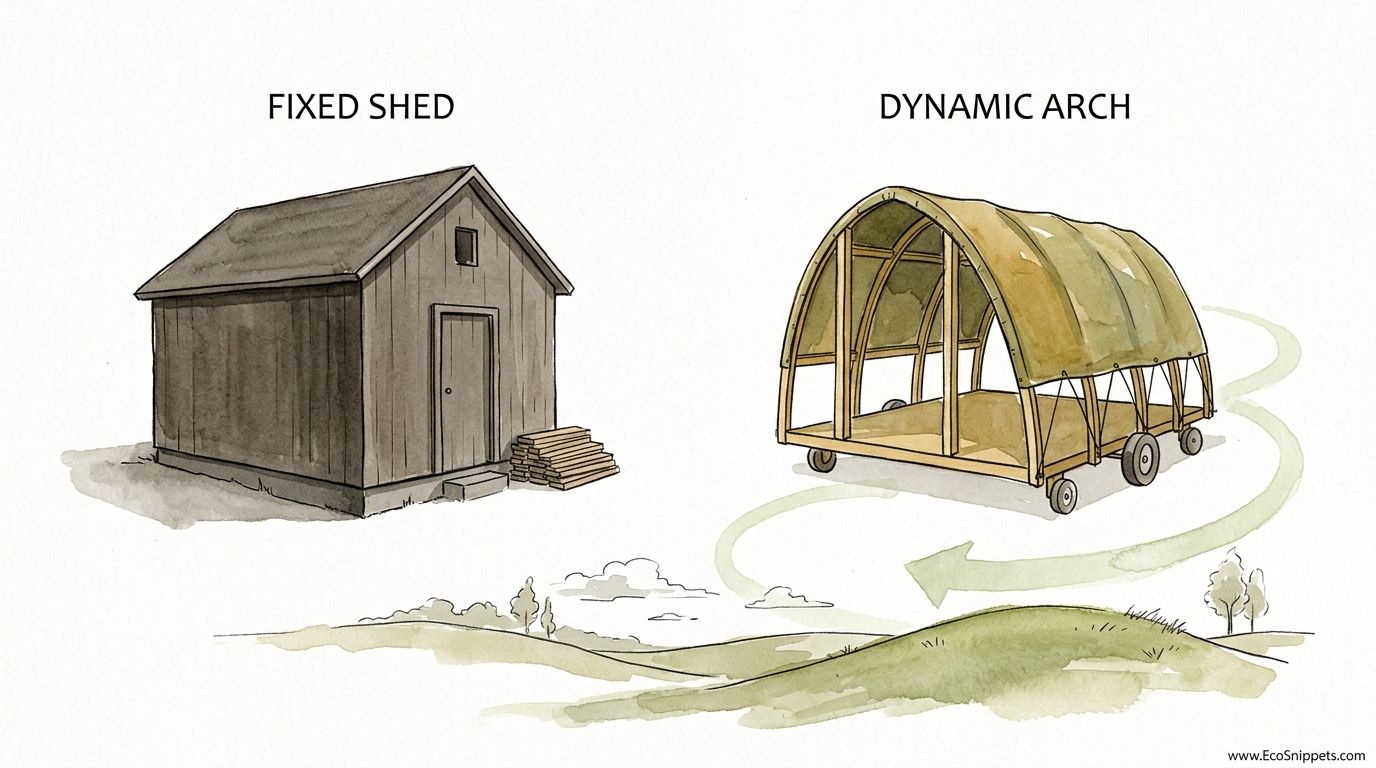
Fixed Shed vs. Dynamic Arch
The choice between a FIXED SHED and a DYNAMIC ARCH often comes down to the scale of your goals and the current health of your land. Both have their place, but they serve very different masters.
| Feature | Fixed Shed | Dynamic Arch |
|---|---|---|
| Initial Cost | High (Foundation, Lumber, Permits) | Low (Panels, Skids, Tarps) |
| Land Impact | Compaction and mud zones | Regenerative fertilization |
| Maintenance | Regular cleaning and manure removal | Move structure (nature cleans the rest) |
| Parasite Risk | High (Pathogens build up in soil) | Low (Cycle is broken by movement) |
| Lifespan | 20–40 years | 5–10 years (with tarp replacement) |
A FIXED SHED is a monument to stability; it is where you store your hay, milk your cows, and keep your equipment dry. It is essential for the “infrastructure” of the farm. However, the DYNAMIC ARCH is the “front line” of your land management. It goes where the work needs to be done, whether that is clearing a brushy fenceline or prepping a garden bed.
Practical Tips for the Field
If you are new to using mobile shelters, a few small adjustments to your daily routine can make the process much smoother. Efficiency is the key to maintaining a mobile system long-term.
- Orient the Opening: Always face the open end of the arch away from the prevailing winds. In most of the Northern Hemisphere, this means facing the opening toward the South or East to avoid the cold North/West gusts.
- Use Never-Flat Wheels: Avoid pneumatic tires. There is nothing more frustrating than trying to move a heavy pig shelter on a Monday morning only to find a flat tire. Solid rubber or foam-filled wheels are a mandatory investment.
- The 24-Hour Rule: If possible, move the shelter every 24 to 48 hours. This prevents the grass from being “suffocated” by the shade of the tarp. If you wait more than three days, the grass underneath will begin to turn yellow, and recovery will take twice as long.
- Multi-Species Use: Use the same arch for different animals throughout the year. Your sheep can use it in the spring, and your meat birds can use it in the late summer. This maximizes the return on your investment in materials.
Advanced Considerations for Serious Practitioners
For those looking to push the limits of mobile housing, integration with other systems is the next logical step. You can turn a simple shelter into a self-contained ecosystem.
Solar Integration: Mounting a small 50-watt solar panel to the top of the arch can power an automated gate, a small LED light for predator deterrence, or even a solar-powered fencer for your electric netting. This makes the shelter a “hub” for your rotational grazing, eliminating the need to haul batteries back to the barn for charging.
Water Harvesting: By adding a simple gutter to the side of the arch, you can collect rainwater and funnel it into a small trough. While this won’t satisfy the needs of a large cow, it can provide a significant portion of the daily water requirements for a small group of sheep or goats, reducing the amount of water you have to haul to the field.
Scaling with “Tandem Arches”: If you need more space but don’t want to build a heavier unit, you can “daisy-chain” two arches together. Use a flexible coupling or just a short length of chain between the skids. This allows you to pull both units at once with a small ATV or tractor while maintaining the maneuverability of two separate structures.
Example Scenario: Clearing the Brush
Imagine a overgrown 1-acre (0.4 hectare) lot filled with blackberry brambles and invasive weeds. A fixed barn at the edge of the property would do nothing to help you clear this land. However, with a mobile arch and two or three pigs, you have a solution.
You place the arch in the densest part of the brush. Because the pigs have their shelter, water, and shade right there, they focus all their energy on the area immediately around the arch. Within a week, they have flattened the brambles and rooted up the weed seeds in a 20×20 foot (6×6 m) area.
You move the arch 20 feet (6 m) to the right. The pigs follow their “home” to the next patch. Over the course of a single summer, those pigs move across the entire acre. By the time they reach the far side, the first patch has already begun to sprout lush, green grass, fueled by the manure they left behind. You have cleared the land, fed your animals, and built soil health—all without a single drop of herbicide or a gallon of diesel for a brush-hog.
Final Thoughts
The transition from fixed to mobile housing is more than just a change in construction; it is a commitment to the long-term health of your land. By choosing to build a tool that moves, you are rejecting the “monument to manure” and embracing a system that honors the biological needs of both the animal and the earth.
While the initial learning curve involves understanding wind loads, skid durability, and rotational timing, the rewards are immediate. Your animals will be healthier, your soil will be richer, and your workload—once the system is established—will feel like a partnership with nature rather than a constant battle against filth.
Start small with a single arch. Observe how the grass reacts to the movement. Watch how the parasites disappear and the forage returns with more vigor than before. Once you see the transformation of a single paddock, you will never want to go back to the mud of a fixed shed again. Build for movement, and your farm will move toward a more resilient future.
