How To Become More Self-Sufficient Without Starting a Full-Blown Farm…
Want to start preserving your harvest, making your own soap, or building a backyard root cellar — but not sure where to begin? “Homesteading Advice” gives you instant lifetime access to 35+ practical homesteading books on food preservation, veggie gardening, DIY natural cleaning products (save over $250 per year with this skill alone), brewing, off-grid energy, and a whole lot more…
Click Here To Check It Out Now!
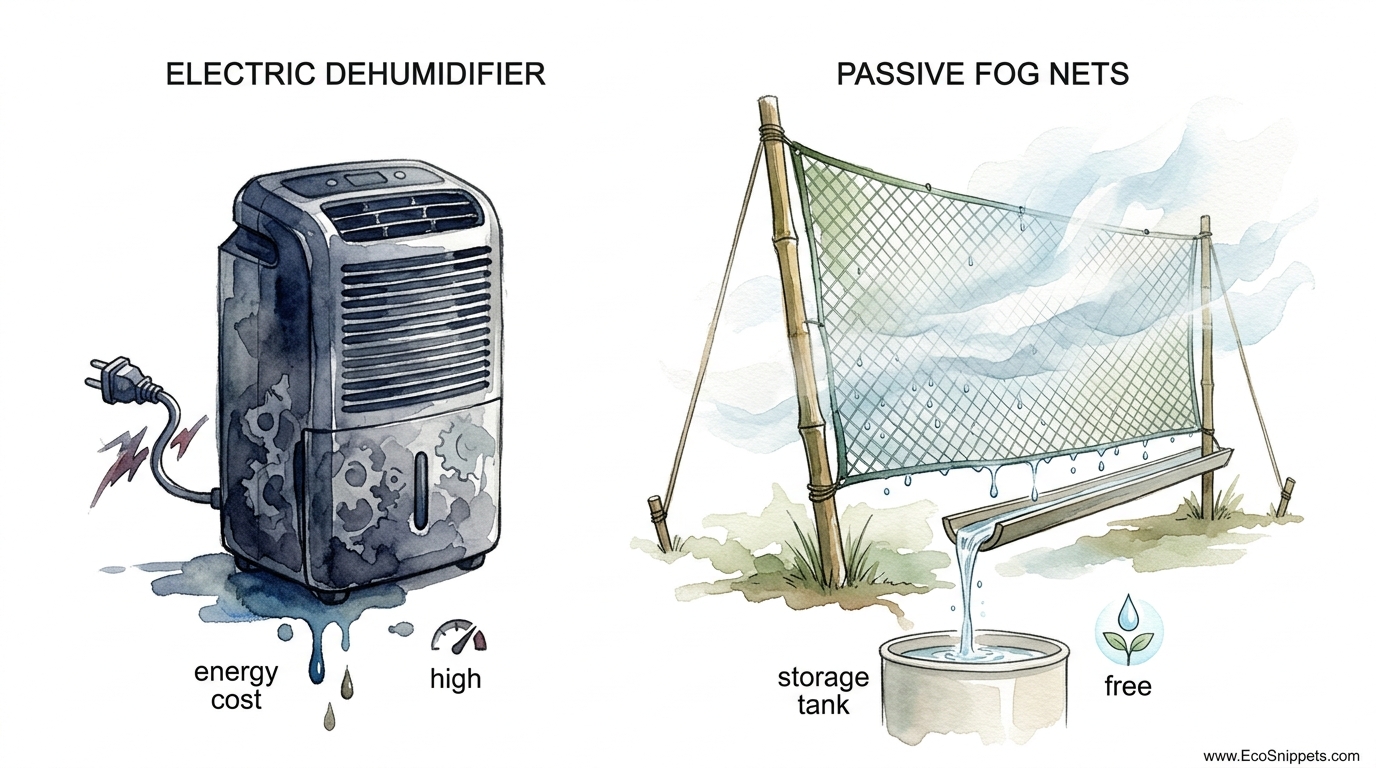
One system drains your batteries to produce a cup of water; the other uses the morning mist to fill a thousand-gallon tank for free. We are so used to plugging things in that we’ve forgotten the atmosphere is a giant river. Why spend your precious solar power on mechanical condensation when a simple mesh screen and the morning breeze can harvest gallons of pure water while you sleep? It’s time to stop fighting the humidity and start catching it.
The concept of pulling water from the sky isn’t new, but our reliance on complex machinery has buried this ancestral logic. For centuries, people living in arid coastal regions watched the fog roll in, leaving everything damp but providing nothing to drink. Today, we understand the physics behind that dampness and how to exploit it using simple, durable materials.
Building a fog collector is a fundamental act of self-reliance. It transforms an invisible resource into a tangible survival asset without requiring a single watt of electricity. Whether you are prepping for a dry future or simply want to stop paying for utility water, this method offers a path to water independence that works in harmony with the environment.
How To Build A Fog Collector For Free Water
A fog collector is a passive system designed to intercept the tiny droplets of water suspended in moving clouds or fog. These droplets are incredibly small, usually ranging from 1 to 40 micrometers in diameter. To put that in perspective, a human hair is about 75 micrometers thick. Because these droplets are so light, they stay suspended in the air until they strike a physical surface.
The “fog catcher” or fog harvester typically consists of a vertical mesh net suspended between two sturdy posts. As the wind pushes the fog through the mesh, the tiny droplets collide with the fibers and stick. This process is called coalescence. As more droplets join together, they grow into larger drops that eventually become heavy enough for gravity to pull them down the net.
This technology has been used successfully in some of the world’s harshest environments. In the Atacama Desert of Chile, where rainfall is almost non-existent, large-scale collectors have sustained entire villages. Similarly, in the Anti-Atlas mountains of Morocco, massive mesh arrays provide thousands of liters of fresh water daily to rural communities.
Historically, humans observed this same process in nature. On the island of El Hierro in the Canary Islands, the indigenous people used the Garoé tree to collect water. This “sacred tree” was constantly shrouded in mist, and its leaves acted as natural collectors, dripping water into holes dug at its base. A modern fog collector is simply a more efficient, man-made version of that tree.
The Physics of Fog Harvesting
Understanding how a fog collector works requires looking at the fluid dynamics of the air. When wind encounters a solid object, the air streamlines flow around it. If the object is too wide, the tiny fog droplets follow those streamlines and never touch the surface. This is why a solid wall cannot collect fog; the air simply carries the moisture around the obstacle.
Mesh provides the perfect balance. It is mostly open space, allowing the wind to pass through while providing enough surface area (the fibers) to intercept the water. The standard material used for this is Raschel mesh, a triangular-knit plastic netting. It usually features a 35% shade coefficient, meaning the fibers cover about 35% of the total area.
When a droplet hits a fiber, surface tension holds it there. As the wind continues to blow, more droplets accumulate until they form a bead of water. Once the weight of the bead overcomes the surface tension and the friction of the mesh, it begins its journey downward. In a well-designed system, these beads merge with others as they slide, creating a steady trickle into the collection gutter.
The orientation of the collector is critical. It must stand perpendicular to the prevailing wind to maximize the volume of air passing through the mesh. If the wind hits the net at an angle, the efficiency drops significantly because the effective surface area is reduced and the air streamlines become more turbulent.
Materials and Tools Required
Building a standard fog collector (SFC) for testing or a large fog collector (LFC) for production requires basic hardware. You do not need specialized aerospace components; you need materials that can withstand UV radiation and high wind loads.
The most critical component is the Raschel mesh. This is typically made of high-density polyethylene (HDPE) or polypropylene. You should look for a “double layer” of 35% shade cloth. Using a double layer creates a 3D structure that increases the surface area and encourages the droplets to “bridge” the gaps between the two layers, leading to faster coalescence.
For the frame of a standard 1-meter by 1-meter (approx. 3.3 ft x 3.3 ft) test collector, you will need 1/2-inch (12.7 mm) copper or galvanized steel pipe. These materials are non-corrosive and provide the necessary weight to keep the frame stable. For the support legs, 1-inch (25.4 mm) galvanized pipe is recommended.
The collection trough can be made from a length of 4-inch (100 mm) PVC pipe cut in half lengthwise. You will also need a variety of fasteners, such as UV-rated cable ties, stainless steel bolts, and guy wires for stabilization. A storage tank or cistern is the final piece of the puzzle, and it should be positioned lower than the collector to allow for gravity-fed drainage.
Step-By-Step Construction Guide
Start by determining if your site is suitable. You need a location that experiences frequent fog, typically at altitudes between 400 and 1,200 meters (approx. 1,300 to 4,000 ft) or along coastal ridgelines. Use a handheld anemometer to check wind speeds; you are looking for a consistent breeze between 2 and 12 meters per second (approx. 4.5 to 27 mph).
For a standard test collector, construct a square frame exactly 1 meter by 1 meter. This size is used globally as a benchmark to measure how many liters per square meter your specific location can produce. Connect the corners of your pipe using 90-degree elbows. Ensure the frame is rigid; any flexing will cause the mesh to sag and reduce efficiency.
Stretch two layers of the Raschel mesh across the frame. It is vital that the mesh is tight. If the mesh is loose, it will flap in the wind, which causes the collected droplets to be blown off before they can reach the trough. Use UV-rated zip ties every 10 centimeters (4 inches) to secure the mesh to the frame, pulling it until there are no visible wrinkles.
Mount the frame onto the support posts. The base of the frame should be at least 2 meters (6.6 ft) above the ground to take advantage of the higher wind speeds and more consistent fog found at that height. Secure the frame to the posts using threaded rods or heavy-duty u-bolts. Use at least two guy wires per post to anchor the system to the ground, as a fog net acts like a sail in high winds.
Install the collection trough directly under the frame. The trough should be slightly wider than the frame—usually 1.04 meters for a 1-meter frame—to catch droplets that might drip at an angle. Angle the trough slightly (a 1% to 2% grade) so the water flows naturally toward one end. Attach a food-grade hose to the low end of the trough and run it into your storage tank.
Benefits of Passive Fog Collection
The primary advantage of a fog harvester is its zero-energy requirement. Unlike an electric dehumidifier, which uses a compressor and cooling coils to force condensation, a fog net relies entirely on the kinetic energy of the wind. This makes it an ideal solution for off-grid living, remote cabins, or emergency survival kits.
Maintenance is exceptionally low compared to mechanical systems. There are no moving parts to wear out, no filters to replace monthly, and no refrigerant gases to leak. Once established, the system can last up to 10 years with only minor repairs. This longevity provides a reliable long-term water source with a very low cost per gallon.
The water quality from fog is generally excellent. Because the water is harvested directly from the atmosphere, it lacks the minerals and contaminants often found in groundwater or surface runoff. In many studies, fog water has met World Health Organization (WHO) standards for drinking water immediately upon collection.
Finally, fog harvesting is a decentralized water source. It removes your dependence on a municipal grid or a deep well that might dry up during a drought. As long as the fog rolls in, you have a fresh supply of water. This independence is the cornerstone of true self-sufficiency.
Challenges and Common Mistakes
The most frequent mistake beginners make is poor site selection. You cannot simply put up a net anywhere and expect water. If your area has high humidity but no “moving” fog, the net will stay dry. Fog harvesting is about interception, not condensation; you need the droplets to be physically pushed into the mesh by the wind.
Another common pitfall is improper mesh tension. A sagging net is an inefficient net. When the wind blows against a loose mesh, the fabric billows. This movement creates turbulence that prevents droplets from sticking and causes existing drops to fly off into the air. If you hear your net “snapping” or “flapping” in the wind, it is not tight enough.
Neglecting the “first flush” or cleaning can lead to water quality issues. While the fog itself is pure, the mesh can accumulate dust, salt, or bird droppings during dry periods. When the fog event begins, the first few liters of water will wash these contaminants into your tank. Failing to install a first-flush diverter or a simple screen can ruin an entire tank of water.
Structural failure is the final major challenge. A 40-square-meter fog net can experience thousands of pounds of force during a storm. If your posts are not deep enough or your guy wires are weak, the entire system can be leveled in a single night. Using “predetermined breaking points”—such as light-duty plastic ties that snap before the mesh tears—can save your expensive components during extreme weather.
Limitations and Environmental Constraints
Geography is the most significant limitation. Fog harvesting is highly effective in “fog oases” like the coasts of Chile, Peru, Namibia, and California, but it is nearly useless in flat, inland plains where fog is stagnant. You need a topographic barrier, like a mountain or a cliff, to force the air upward and concentrate the moisture.
Yield is also seasonal. In many regions, fog is only present during specific months of the year. This means you must have enough storage capacity to carry you through the “clear” seasons. Relying solely on fog without a large cistern is a risky strategy for those in regions with distinct wet and dry cycles.
Wind speed is a double-edged sword. While you need wind to drive the fog through the mesh, excessive wind can actually decrease efficiency. At very high speeds (above 15 meters per second or 33 mph), the droplets are often pushed through the mesh so fast they don’t have time to adhere to the fibers. High winds also increase the risk of mechanical damage to the netting.
Finally, while the water is generally clean, it is not always “ready to drink” in areas with high industrial pollution. Tiny aerosol particles from smog or chemical plants can act as the nuclei for fog droplets. If you live downwind of a major industrial center, you should still run your harvested water through a high-quality carbon or ceramic filter.
Passive Fog Nets vs. Electric Dehumidifiers
| Feature | Passive Fog Net | Electric Dehumidifier |
|---|---|---|
| Energy Source | Kinetic (Wind) | Electric (Grid/Solar) |
| Operational Cost | Zero | High (Continuous power draw) |
| Yield Potential | 200–1,000 Liters/day (LFC) | 10–50 Liters/day |
| Maintenance | Low (Cleaning, Tensioning) | Moderate (Motors, Filters) |
| Ideal Setting | Outdoor, Foggy, Windy | Indoor, Enclosed Space |
The comparison between these two systems highlights the difference between working with nature and fighting against it. An electric dehumidifier is a piece of climate control equipment; it is designed to remove moisture to make a room comfortable. A fog net is a piece of harvesting equipment; it is designed to gather resources to sustain life.
While a dehumidifier can work in a closed room with no wind, it requires a massive amount of energy to create the temperature differential needed for condensation. A fog net uses the energy already present in the environment. For anyone concerned with long-term survival or minimizing their ecological footprint, the passive net is the clear winner in any environment that supports it.
Practical Tips and Best Practices
Always start with a pilot study. Before you invest in a large-scale system, build a 1-square-meter standard fog collector. Record the daily yield for at least one full season. This data will tell you exactly how many large panels you need to meet your daily water requirements.
Orientation is everything. Use a wind vane to determine the most frequent direction of the fog-bearing winds. In many coastal areas, this is the onshore breeze. If your wind direction changes seasonally, consider a frame design that can be rotated. A net that faces even 20 degrees away from the wind can lose up to 30% of its potential yield.
Keep your mesh clean. Dust and biological growth like algae are the enemies of efficiency. Once or twice a year, use a soft plastic brush and clean water to gently scrub the mesh. Avoid using harsh chemicals or high-pressure washers, as these can damage the delicate HDPE fibers and reduce the lifespan of the net.
Implement a multi-stage filtration system. Even though fog water is clean, it travels through a trough and pipes before reaching your tank. Use a fine mesh screen at the end of the trough to catch leaves and insects. Add an activated carbon filter at the tap to ensure the water is clear and tasteless.
Advanced Considerations for High Yield
For serious practitioners, the “Standard Fog Collector” is just the beginning. Advanced designs like the “CloudFisher” use a three-dimensional grid structure to stabilize the mesh. This allows the system to withstand wind speeds up to 120 km/h (75 mph) without collapsing. These systems often use rubber expanders as tensioners, which provide flexibility during gusts.
Consider the “10-times height” rule for spacing. If you are installing multiple collectors, do not bunch them together. A fog collector “shadows” the air behind it, stripping it of moisture. To allow the air to recharge its water content, space your collectors at a distance of at least ten times their height from one another.
Innovations in material science are also worth watching. Some researchers are experimenting with hydrophobic (water-repelling) and hydrophilic (water-attracting) coatings. By making the fibers water-attracting and the vertical supports water-repelling, you can speed up the rate at which droplets slide down into the trough, reducing evaporation losses.
Scaling your storage is as important as scaling your nets. A single large fog event can produce hundreds of gallons of water in a few hours. If your storage tank is too small, you are simply wasting a harvest. A good rule of thumb is to have enough storage for at least 50% of your expected maximum monthly consumption.
Example Scenario: Providing for a Family
Imagine a family of four living on a coastal ridge in California or South Africa. Each person requires roughly 50 liters (13 gallons) of water per day for drinking, cooking, and basic hygiene, totaling 200 liters daily. In a region with moderate fog, a single 40-square-meter (approx. 430 sq ft) Large Fog Collector typically yields between 200 and 1,000 liters per day during a fog event.
To ensure a consistent supply even during clear days, the family installs two 40-square-meter collectors. During a standard fog event, these collectors produce an average of 600 liters per day. They use 200 liters and send the remaining 400 liters into a 10,000-liter (approx. 2,640 gallon) underground cistern.
In this scenario, just 25 days of fog can fill the entire 10,000-liter tank. This surplus provides a 50-day “buffer” for periods of clear weather. By spending roughly $2,500 on materials once, the family has secured a permanent, free, and high-quality water source that requires no electricity to operate.
Final Thoughts
Fog harvesting is a testament to the power of simple solutions. We live in an era where we often look to high-tech, energy-intensive machines to solve basic problems like water scarcity. However, as the pioneers and indigenous cultures of the world’s driest regions have shown us, the answer is often floating right in front of us, waiting to be caught.
By understanding the physics of the atmosphere and applying a bit of manual effort, you can transform the morning mist from a nuisance into a lifeline. A fog collector doesn’t just provide water; it provides the peace of mind that comes from knowing your survival isn’t tied to a power grid or a corporate utility.
Start small, observe your environment, and respect the wind. Whether you are building a single test frame or a mountain-side array, you are participating in a tradition of self-reliance that spans centuries. The air is a river; all you need is the right net to catch what you need.
