How To Become More Self-Sufficient Without Starting a Full-Blown Farm…
Want to start preserving your harvest, making your own soap, or building a backyard root cellar — but not sure where to begin? “Homesteading Advice” gives you instant lifetime access to 35+ practical homesteading books on food preservation, veggie gardening, DIY natural cleaning products (save over $250 per year with this skill alone), brewing, off-grid energy, and a whole lot more…
Click Here To Check It Out Now!
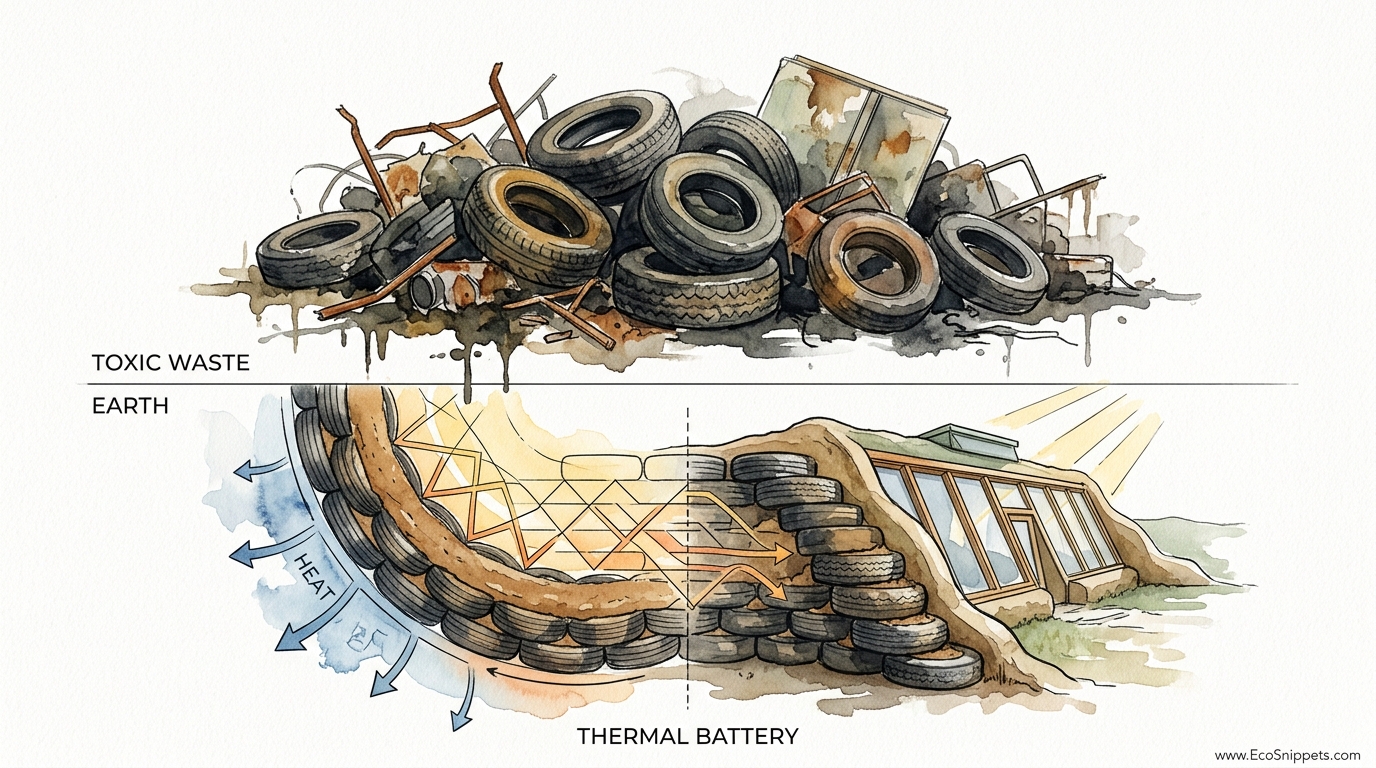
The world’s biggest disposal nightmare is actually the most efficient heating and cooling system ever discovered. Discarded tires are a global environmental disaster, but in the world of alternative energy, they are a ‘thermal goldmine.’ When rammed with earth and buried in a wall, these tires create a massive battery that swallows the sun’s heat during the day and releases it at night. This ‘Nuisance’ can keep your home a perfect 70 degrees (21°C) year-round without a single vent or wire.
Living in a home that breathes with the seasons is not a modern luxury, but a return to fundamental self-reliance. For decades, the concept of the Earthship has challenged the idea that a house must be a consumer of energy. Instead, these structures act as vessels that harvest what the environment provides for free. Transforming what society calls “toxic waste” into a “thermal battery” is the ultimate act of modern alchemy.
Most people see a pile of old tires and think of a landfill fire or a breeding ground for mosquitoes. However, when you fill that same tire with local subsoil and compact it until it is hard as a rock, it becomes a structural brick that can outlast conventional concrete. This method uses the density of the earth to regulate indoor temperatures, proving that the most advanced solutions are often the simplest ones buried right beneath our feet.
Earthship Building With Recycled Tires
Earthship building is a method of “Biotecture” popularized by architect Michael Reynolds, focusing on six core principles of self-sufficiency. The primary structural element is the rammed-earth tire wall. These walls are typically built on the north, east, and west sides of a home, then covered with a massive earth berm. This creates a structure that is literally part of the planet.
Each tire acts as a flexible, steel-belted form for compacted soil. Unlike traditional brick or cinder block, a tire wall does not require a deep concrete footing because the width of the tires—usually 2 to 4 feet (0.6 to 1.2 meters)—provides a massive, stable footprint. This width allows the wall to distribute the weight of the roof across a huge surface area, making it incredibly resilient against structural settling and even seismic activity.
These buildings exist across the globe, from the high deserts of Taos, New Mexico, to the humid climates of Europe and Australia. The concept is universal because the materials are universal. Tires are discarded by the millions every year in almost every country, making them one of the most accessible “natural resources” for a person who wants to build their own home with their own hands.
How It Works: The Physics of the Thermal Battery
Thermal mass is the secret to why an Earthship stays comfortable without a furnace. A tire wall functions like a battery, but instead of storing electricity, it stores heat. During the day, sunlight enters through large south-facing windows (in the Northern Hemisphere) and strikes the dense walls and floors. The rammed earth absorbs this energy, preventing the air inside from becoming too hot.
As the sun sets and the outside temperature drops, the “thermal battery” begins to discharge. The heat stored in the walls slowly radiates back into the living space. This process is known as thermal lag. Because the walls are so thick—often 2 feet (0.6 meters) or more—it can take many hours for the heat to move through the mass, ensuring the home remains warm until the sun rises again the next day.
In the summer, the process reverses its benefit. The high summer sun is blocked by roof overhangs, keeping the interior mass in the shade. The walls remain at the constant temperature of the deep earth, which is usually around 58 degrees Fahrenheit (14°C). As warm air enters the home, the cool mass of the tire walls swallows that heat, keeping the residents refreshed without the need for noisy air conditioning units.
The Step-by-Step Pounding Process
Building a tire wall is a labor of love that requires grit and a steady sledgehammer. The process begins with a level site, often excavated into a hillside to take advantage of the earth’s natural insulation.
- Layout and Leveling: Place the first course of tires on undisturbed, level ground. Use the largest tires (such as 16-inch or 235/85R16) for the bottom courses to create a strong foundation.
- The Containment Layer: Lay a piece of scrap cardboard or heavy plastic inside the bottom of the tire to prevent the dirt from falling out while you are pounding.
- Initial Filling: Shovel loose subsoil into the tire. It is best to use soil with some moisture content, as this aids in compaction.
- Rimming the Tire: Use your hands or a small tool to shove dirt into the “shoulders” or the hollow rim of the tire casing. This is the most critical step for ensuring the tire becomes a solid brick.
- Sledgehammer Compaction: Stand on the tire and use an 8 to 10 pound (3.6 to 4.5 kg) sledgehammer to pound the dirt. You must strike the earth starting from the outer edges and moving toward the center until the tire is rock-hard and the rubber casing is tight and bulging.
- Leveling the Brick: After pounding, use a 4-foot (1.2 meter) level to check the tire in all directions. If it is high, pound it more; if it is low, add more dirt and pound again.
Benefits of Rammed-Earth Tire Construction
The primary advantage is the extreme thermal efficiency. Research has shown that Earthship walls have an effective R-value far superior to standard 2×4 stud walls. While a standard wall might have an R-value of 13 to 19, a massive tire wall combined with an earth berm can perform as if it has an R-value of 40 or higher. This translates to zero utility bills for heating and cooling in many climates.
Durability is another hallmark of this ancestral wisdom. Unlike wood, which rots, or steel, which rusts, a tire wall encased in earth and plaster is virtually indestructible. Tires are engineered to withstand incredible pressure and friction on the road; when buried, they are protected from their only real enemies: UV light and fire. Since they are packed with earth and covered in stucco, they cannot burn because there is no oxygen inside the wall to support combustion.
The environmental impact is twofold. First, the construction diverts thousands of tires from landfills or illegal burn piles. Second, the home’s operational footprint is nearly zero. By using local soil as the primary “filler,” you reduce the embodied energy of the building materials significantly compared to hauling in thousands of pounds of concrete or kiln-fired bricks.
Challenges and Common Mistakes
The most frequent mistake beginners make is underestimated the physical labor involved. Pounding a single tire can take 45 to 60 minutes of intense physical exertion. It is not uncommon for a small Earthship to require 800 to 1,500 tires. Without a team of dedicated volunteers or a pneumatic tamper, this process can lead to burnout before the first floor is even finished.
Another common pitfall is poor drainage. Because the back of a tire wall is usually bermed against a hill, water pressure can build up behind the structure. If you do not install a proper “French drain” or “ag pipe” with gravel backfill, moisture can seep through the wall, causing dampness or even structural failure over time. Always ensure water is diverted away from the base of the wall.
Leveling is a discipline that cannot be ignored. If the first course of tires is even slightly off-level, the error will compound as you go higher. By the time you reach the eighth or ninth course, the wall may lean dangerously or become impossible to cap with a roof. Check every single tire against its neighbor with a long level.
Limitations: When This May Not Be Ideal
Tire walls are not the best choice for every building site. In urban environments where space is at a premium, the sheer thickness of a 3-foot (0.9 meter) tire wall can eat up valuable square footage. These structures are better suited for rural or suburban lots where you have the room to build a substantial earth berm behind the home.
High-water table areas present a significant challenge. If the ground is constantly saturated, the rammed earth inside the tires can lose its structural integrity, and the home may suffer from chronic mold issues. Earthships are designed to be “dry-vessels.” If you cannot keep the foundation dry, you should consider a different off-grid building method like a raised pier-and-beam structure.
Regulatory hurdles are perhaps the most frustrating limitation. In many strictly zoned areas, building inspectors may not recognize a tire wall as a valid structural component. Obtaining a permit often requires hiring a specialized engineer to sign off on the plans, which can add thousands of dollars to the project cost.
Comparison: Earthship vs. Conventional Construction
| Factor | Conventional (Stick Frame) | Earthship (Tire Wall) |
|---|---|---|
| Material Cost | High (Lumber, Insulation, Drywall) | Very Low (Free tires, Local soil) |
| Labor Intensity | Moderate (Skilled trade heavy) | Extreme (Unskilled, high volume) |
| Thermal Performance | Relies on active HVAC systems | Passive (Thermal Mass/Battery) |
| Longevity | 40–80 years (High maintenance) | Centuries (Low maintenance) |
| Ease of Permitting | Very Easy | Difficult (Requires engineering) |
Practical Tips and Best Practices
If you are serious about building with tires, start by collecting tires of the same size. Consistency makes the coursing much easier. Many builders prefer the 235/75R15 or 235/85R16 sizes because they are common, heavy, and provide a wide enough footprint for a two-story wall.
Use a “step-back” method for stability. Each course of tires should be set back about 1 to 1.5 inches (2.5 to 3.8 cm) toward the earth berm. This creates a slight “batter” or incline that makes the wall much stronger against the pressure of the earth pushing from behind. It ensures the wall leans into the hill rather than away from it.
Do not try to pound tires in the rain. Wet soil is incredibly heavy and does not compact as well as slightly damp soil. If your dirt is too wet, it becomes a “spongy” tire, which is unacceptable for a load-bearing wall. Keep your dirt piles covered with tarps to ensure they stay at the perfect moisture level for ramming.
Advanced Considerations: Plaster and Finishing
Once the tire wall is standing, the “voids” between the tires must be filled. Traditionally, this is done using “aluminum can bricks” or “glass bottle bricks” packed with a thick mud or concrete mortar. This creates a flat surface for the final layers of plaster. By using bottles, you can even create beautiful stained-glass effects that let light into the back of the rooms.
The final interior finish is usually a thick layer of adobe (clay, sand, and straw) or lime plaster. These materials are breathable, which is essential for regulating humidity. A well-built Earthship doesn’t just stay at 70 degrees (21°C); it also maintains a stable humidity level of around 50%, which is ideal for human respiratory health and prevents the growth of mold.
For structural integrity at the top of the wall, a concrete “bond beam” is often poured. This is a reinforced concrete ring that sits on top of the last course of tires. It provides a level, solid surface for the roof rafters to attach to. Without a bond beam, the weight of the roof would be unevenly distributed, potentially causing the tire wall to deform over time.
Real-World Example: The Taos Experience
In the high desert of New Mexico, temperatures can swing from 90 degrees (32°C) in the day to 40 degrees (4°C) at night. In the Greater World Earthship Community, hundreds of homes sit in this extreme environment. Owners report that even during record-breaking cold snaps where temperatures drop below zero, their tire-wall homes maintain an interior temperature in the mid-60s without a fire in the stove.
One specific project, a 3,500 square foot (325 square meter) modified Earthship, utilized approximately 2,000 recycled tires. By using a pneumatic tamper to speed up the pounding process, the owners were able to complete the structural walls in a single summer. This home now generates its own power and harvests its own water, proving that large-scale luxury is possible within the “thermal battery” framework.
These results aren’t just anecdotal. Studies by the Colorado School of Mines and other institutions have confirmed the massive thermal potential of these walls. The science is clear: when you have enough mass, you don’t need a furnace. You just need a wall that knows how to hold onto the sun.
Final Thoughts
Building with recycled tires is a commitment to a different way of life. It requires a willingness to trade modern convenience for long-term resilience and a deep connection to the environment. While the labor is intense, the reward is a home that looks after you, rather than a home that requires you to work a 40-hour week just to pay the heating bill.
The transition from viewing tires as toxic waste to seeing them as a thermal goldmine is the first step toward true independence. Whether you are building a small garden wall or a full-scale off-grid estate, the principles of thermal mass and passive solar gain will serve you for a lifetime.
Take the time to experiment. Start with a small retaining wall or a bench. Feel the weight of the sledgehammer and the density of the earth. Once you experience the cool, quiet interior of a rammed-earth structure, you may never want to live in a “stick-built” box again. The future of sustainable living isn’t in a laboratory; it’s in the landfill, waiting to be reclaimed.
