How To Become More Self-Sufficient Without Starting a Full-Blown Farm…
Want to start preserving your harvest, making your own soap, or building a backyard root cellar — but not sure where to begin? “Homesteading Advice” gives you instant lifetime access to 35+ practical homesteading books on food preservation, veggie gardening, DIY natural cleaning products (save over $250 per year with this skill alone), brewing, off-grid energy, and a whole lot more…
Click Here To Check It Out Now!
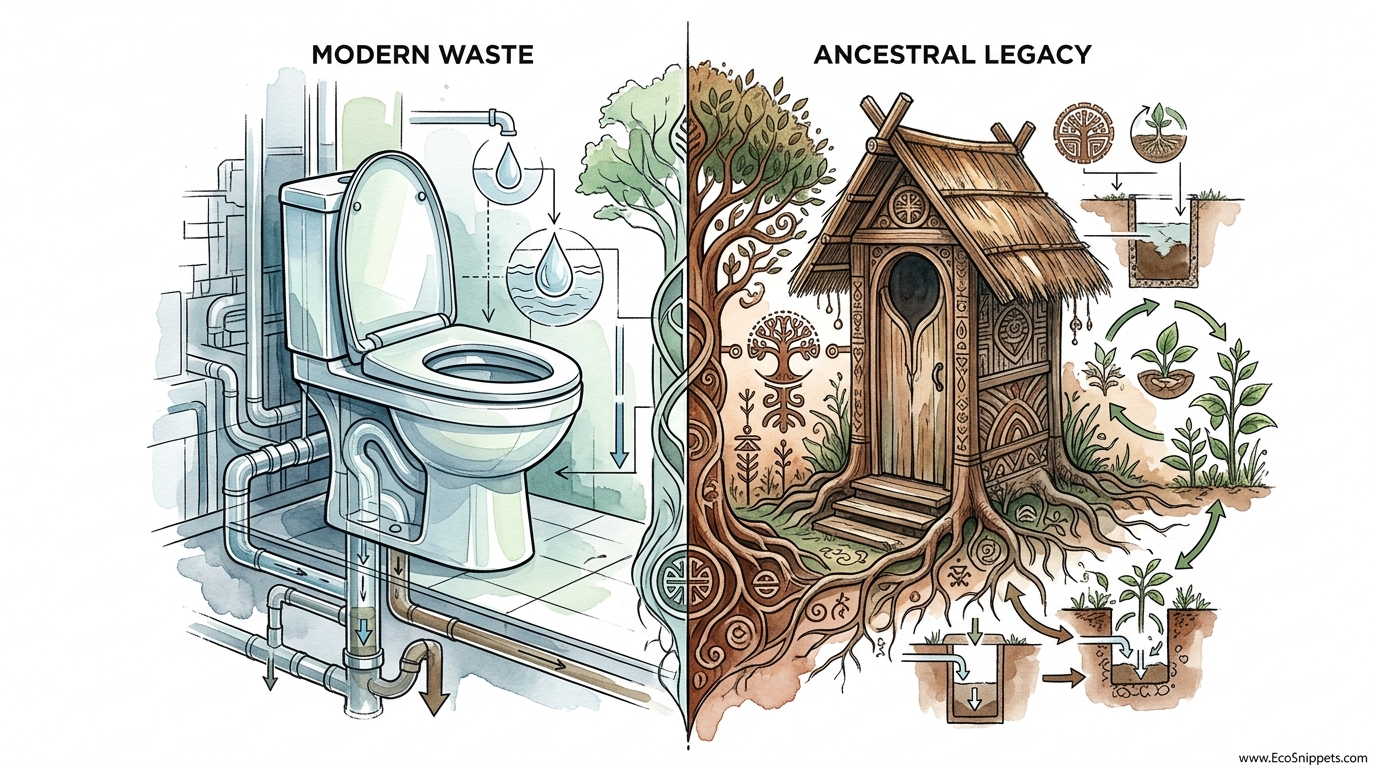
What if your daily waste was the secret ingredient to a 20-year harvest instead of a monthly utility bill? Most people see a waste problem; permaculturists see an orchard in the making. The Arborloo is the ultimate ancestral cycle of life that turns ‘waste’ into abundance.
For generations, the modern world has treated human waste as a biohazard to be flushed away and forgotten. We pay enormous sums to hide this fertility in pipes, only to buy synthetic fertilizers later to grow our food. This break in the nutrient cycle is a modern inefficiency that our ancestors would hardly recognize. They understood that everything the earth gives must eventually return to the earth to keep the cycle of life spinning.
The Arborloo offers a bridge back to that self-reliant wisdom. It is a simple, elegant, and deeply practical system of ecological sanitation that transforms a basic human need into a productive agricultural asset. Instead of building a permanent monument to waste, you build a temporary station for fertility that moves across your land, leaving a trail of thriving fruit trees in its wake.
In this guide, we will explore exactly how to design, build, and manage an Arborloo system. Whether you are looking to increase your homestead’s self-sufficiency or simply want to stop wasting one of your most valuable organic resources, this “tree toilet” is a pioneer-style solution that works with nature rather than against it.
How To Build An Arborloo
An Arborloo is essentially a shallow, portable pit latrine designed to be moved regularly. Unlike a traditional pit latrine which is deep, permanent, and often a source of long-term contamination, the Arborloo is shallow (typically 1 to 1.5 meters or 3.3 to 5 feet deep) and unlined. The “Arbor” in the name—derived from the Latin word for tree—reveals its true purpose: once the pit is nearly full, it is covered with soil and a tree is planted directly on top.
This system was famously championed by Dr. Peter Morgan and has since been adopted globally, particularly in regions where soil fertility is low and professional sanitation is expensive. It exists to solve two problems at once: the need for a safe, dignified place to manage human waste and the need for high-quality organic fertilizer for food production. In the real world, it is a staple of permaculture design because it requires no water, no expensive chemicals, and very little specialized skill to maintain.
Visualize the Arborloo as a modular kit. It consists of four primary components: a shallow pit, a “ring beam” to stabilize the top of that pit, a concrete or wooden slab for the floor, and a lightweight superstructure (the privacy house) that can be easily picked up and moved by two or three people. It is a “nomadic” toilet that migrates through your garden, creating “organic oases” wherever it goes.
How It Works: The Step-by-Step Cycle
The operation of an Arborloo is a rhythmic process that mimics the natural forest floor. It relies on the aerobic and anaerobic breakdown of organic matter, facilitated by the addition of carbon-rich materials. Understanding the process is key to ensuring the system remains odorless and highly fertile.
Step 1: Selecting the Site
Choose a location where you eventually want a tree to grow. The site should be at least 30 meters (approx. 100 feet) away from any surface water or shallow wells to prevent any risk of groundwater contamination. It should be on slightly elevated ground so that rainwater flows away from the pit rather than into it. Since you will be moving the structure every 6 to 12 months, plan a “migration path” through your yard or orchard area.
Step 2: Digging the Pit
Dig a circular pit approximately 0.8 to 1 meter (2.6 to 3.3 feet) in diameter. The depth should be between 1 and 1.5 meters (3.3 to 5 feet). Circular pits are naturally more stable than square ones and are less likely to cave in. Do not line the pit with bricks or concrete; the goal is for the tree roots to eventually penetrate the surrounding soil. If the soil is very sandy or loose, you may need a “ring beam” to support the weight of the slab at the surface.
Step 3: Installing the Ring Beam and Slab
The ring beam is a simple circle made of concrete or fired bricks that sits on the ground around the edge of the pit. Its job is to prevent the edges of the pit from eroding and to provide a solid foundation for the slab. Once the ring beam is level, place the reinforced concrete slab on top. This slab has a central hole for use. Bedding the slab in a thin layer of weak mortar or even firm mud helps create a seal that keeps flies from entering the pit from the sides.
Step 4: The Daily Ritual
Before the first use, drop a thick layer of dry leaves (about 2 full sacks) into the bottom of the pit. This provides an initial carbon base. After every single use, add a cup of “dry mix”—usually a combination of dry soil and wood ash. Occasionally adding more dry leaves or even straw helps maintain the air pockets needed for composting. The soil and ash cover the waste, which immediately eliminates smells and prevents flies from landing and breeding.
Step 5: Closing and Moving
When the pit is about 15 to 30 centimeters (6 to 12 inches) from the top, it is time to move. Remove the superstructure, the slab, and the ring beam. Use the soil you dug from the *new* pit to fill the remainder of the *old* pit, forming a small mound. This mound will settle over time as the organic matter decomposes. Let the pit “rest” for a few weeks or until the next rainy season before planting your tree.
Benefits and Practical Advantages
The Arborloo is more than just a toilet; it is a soil-building strategy. Its advantages extend far beyond the immediate need for sanitation. For the self-reliant practitioner, it offers a measurable return on investment that few modern utilities can match.
Sanitation without Infrastructure: It requires no plumbing, no septic tank, and no municipal connection. This makes it ideal for off-grid properties or rural areas where traditional systems are cost-prohibitive. Because the pit is shallow and is filled with soil/ash daily, it is significantly more sanitary than a standard “long-drop” pit latrine.
Nutrient Cycling: Human waste is rich in nitrogen, phosphorus, and potassium—the “NPK” that plants crave. By composting this material in situ, you are placing those nutrients exactly where the tree can use them. There is no need to handle “humanure” or transport heavy compost; the tree does the work of “mining” the pit for you.
Rapid Tree Growth: Experience in various climates has shown that trees planted on Arborloo pits grow significantly faster than those in native soil. The “compost core” acts as a long-term slow-release fertilizer and a moisture reservoir. In many cases, fruit yields from Arborloo trees are double those of trees grown without this advantage.
Low Cost: Depending on the materials used for the superstructure, an Arborloo can be built for very little money. The primary expense is the cement for the slab and ring beam, which can be reused for decades as they move from pit to pit. Many homesteaders use local timber, bamboo, or thatch for the house, making the system nearly free to maintain.
Challenges and Common Mistakes
Even a system as simple as the Arborloo can fail if the basic principles of composting and pit stability are ignored. Most issues arise from trying to treat it like a traditional flush toilet or a permanent pit.
The “Cone” Effect: One frequent mistake is allowing the waste to build up in a tall cone in the center of the pit. This wastes space and prevents proper covering with soil. Users should use a stick occasionally to level the contents of the pit, ensuring the entire volume is utilized and that the soil/ash cover is even.
Neglecting the Dry Mix: The single most common cause of odors and flies is failing to add enough soil and ash. The ash is particularly important because its high pH helps kill pathogens and its potassium content enriches the eventual compost. If the pit smells, you aren’t adding enough dry material.
Dumping Non-Biodegradables: The Arborloo pit is a living compost pile. Dumping plastic, glass, feminine hygiene products, or chemicals into the pit will ruin the soil quality for the future tree and prevent proper decomposition. This system requires a disciplined “organic-only” mindset.
Pit Collapse: In very sandy or loose soils, an unlined pit can collapse under the weight of the slab or during heavy rain. Using a wide, well-cured concrete ring beam is essential in these conditions. If the soil is exceptionally unstable, you may need to use a perforated 200-liter (55-gallon) drum as a temporary liner, though this should be a last resort as it can hinder tree root growth.
Limitations and Environmental Constraints
While the Arborloo is a powerful tool, it is not a “one size fits all” solution. There are specific environmental conditions where this method may not be ideal or may require significant modification.
High Water Tables: If your groundwater is less than 2 meters (6.6 feet) from the surface, an Arborloo is not suitable. Because the pit is unlined, there is a risk of leached pathogens entering the water table. In these areas, an above-ground composting system or a “Fossa Alterna” with sealed vaults is a safer choice.
Limited Space: The Arborloo requires a “never-ending journey” across the land. If you have a very small urban lot, you may run out of places to dig new pits before the first trees have matured. Each pit site should be spaced according to the final canopy size of the tree you intend to plant—usually 3 to 5 meters (10 to 16 feet) apart.
Cultural Taboos: In some regions, there is a psychological resistance to eating fruit grown from “waste.” While the composting process and soil filtration effectively neutralize pathogens, this “yuck factor” can be a barrier. Education about the science of composting and the separation of the fruit from the waste by the tree’s biological processes is often necessary.
Comparison: Arborloo vs. Fossa Alterna
It is helpful to compare the Arborloo to its “big brother,” the Fossa Alterna. While they share similar DNA, they serve different management goals.
| Feature | Arborloo | Fossa Alterna |
|---|---|---|
| Main Goal | Planting a tree (Orchard growth) | Producing humus for garden beds |
| Structure | Single shallow pit, moved often | Two alternating pits, permanent site |
| Pit Depth | 1.0m – 1.5m (3.3ft – 5ft) | 1.5m (5ft), usually lined |
| Cycle Time | 6–12 months per pit | 12 months per pit (alternating) |
| Human Handling | Zero (tree is planted on pit) | Minimal (humus is dug out) |
| Space Required | High (needs a trail of sites) | Low (stationary) |
If your goal is to expand an orchard and you have the space to move the toilet, the Arborloo is the superior choice for its simplicity and the “plant and forget” nature of the waste management. If you have limited space and need compost for a vegetable garden, the Fossa Alterna is more efficient.
Practical Tips and Best Practices
To get the most out of your Arborloo, follow these field-tested optimization techniques. These small adjustments can significantly improve the health of your trees and the efficiency of the composting process.
- The Ash Factor: Use wood ash from your fireplace or cookstove liberally. Ash is rich in potassium and calcium, which are vital for fruit development. It also raises the pH of the pit, which accelerates the destruction of pathogens like Ascaris eggs.
- Urine Management: While the pit can handle urine, excessive liquid can lead to anaerobic (smelly) conditions. If possible, encourage male users to “water” other non-fruit trees nearby, or install a simple urine-diversion pipe to a separate soakaway or a diluted-fertilizer container.
- Pathogen Safety: Always wait at least 6 to 12 months after closing the pit before harvesting fruit from a tree planted there. This is a conservative safety margin. The biological activity in the soil, combined with the tree’s internal filtration, ensures the fruit is safe to eat.
- Tree Siting: Think 10 years ahead. Don’t plant a large avocado tree 2 meters from your back door. Research the mature size of the trees you want and plan your Arborloo path to accommodate their growth.
Advanced Considerations: Scaling and Soil Tuning
For the serious practitioner, the Arborloo is just the beginning of a larger soil-regeneration strategy. You can “tune” the contents of your pit to match the specific needs of the tree you intend to plant.
If you plan to plant a nitrogen-loving tree like a citrus or a banana, you might increase the amount of green material (like fresh grass clippings) added to the pit toward the end of its cycle. If you are planting a tree that prefers fungal-dominated soil (like many forest fruits), you should increase the amount of woody material (dry leaves, small twigs, or wood chips) added throughout the year.
Scaling the system is also possible for larger families. Instead of one Arborloo, you can run two in parallel, moving them more slowly and creating a denser “food forest” canopy. Some practitioners even use the Arborloo to plant “timber oases,” using fast-growing leguminous trees that can later be coppiced for fuel or building materials, further closing the self-sufficiency loop.
Examples and Realistic Scenarios
Consider a family of four living on a half-acre (0.2-hectare) homestead. They decide to start an Arborloo cycle to provide fruit and manage their waste without a septic system.
They dig their first pit in the spring, 1 meter wide and 1.2 meters deep (3.3 by 4 feet). After each use, the children add a scoop of dry garden soil and ash. By the following spring, the pit is 3/4 full. They move the lightweight wooden structure 4 meters (13 feet) to the left to start a new pit. They fill the old pit with the soil from the new one, creating a mound. A month later, they plant a young “Meyer” lemon sapling in that mound.
Five years later, that family has a row of five citrus trees—lemon, lime, orange, grapefruit, and tangerine. The trees are noticeably larger and greener than the neighbor’s trees, despite receiving no commercial fertilizer. The family has saved thousands in plumbing costs and has created a permanent legacy of food security on their land, all by simply returning what they took.
Final Thoughts
The Arborloo is a profound reminder that “waste” is a human invention. In the natural world, every output is an input for something else. By choosing this system, you are stepping back into a functional relationship with the earth, transforming a daily necessity into a gift for the future. It is a practice that requires a little more mindfulness than a flush-and-forget toilet, but the rewards are tangible, edible, and sustainable.
Whether you are building your first off-grid cabin or looking to improve the soil of a degraded backyard, the Arborloo offers a path to self-reliance that is as old as the hills and as fresh as a new harvest. Start with one pit, plant one tree, and watch as your “waste problem” slowly transforms into a thriving orchard. The secret to abundance has been beneath your feet all along; you only need to dig a shallow hole and let nature do the rest.
As you experiment with this system, remember that you are part of a global movement toward ecological sanitation. Share your successes, learn from your collapses, and always keep the cycle moving. Your soil, your trees, and your descendants will thank you for the legacy of fertility you leave behind.
