How To Become More Self-Sufficient Without Starting a Full-Blown Farm…
Want to start preserving your harvest, making your own soap, or building a backyard root cellar — but not sure where to begin? “Homesteading Advice” gives you instant lifetime access to 35+ practical homesteading books on food preservation, veggie gardening, DIY natural cleaning products (save over $250 per year with this skill alone), brewing, off-grid energy, and a whole lot more…
Click Here To Check It Out Now!
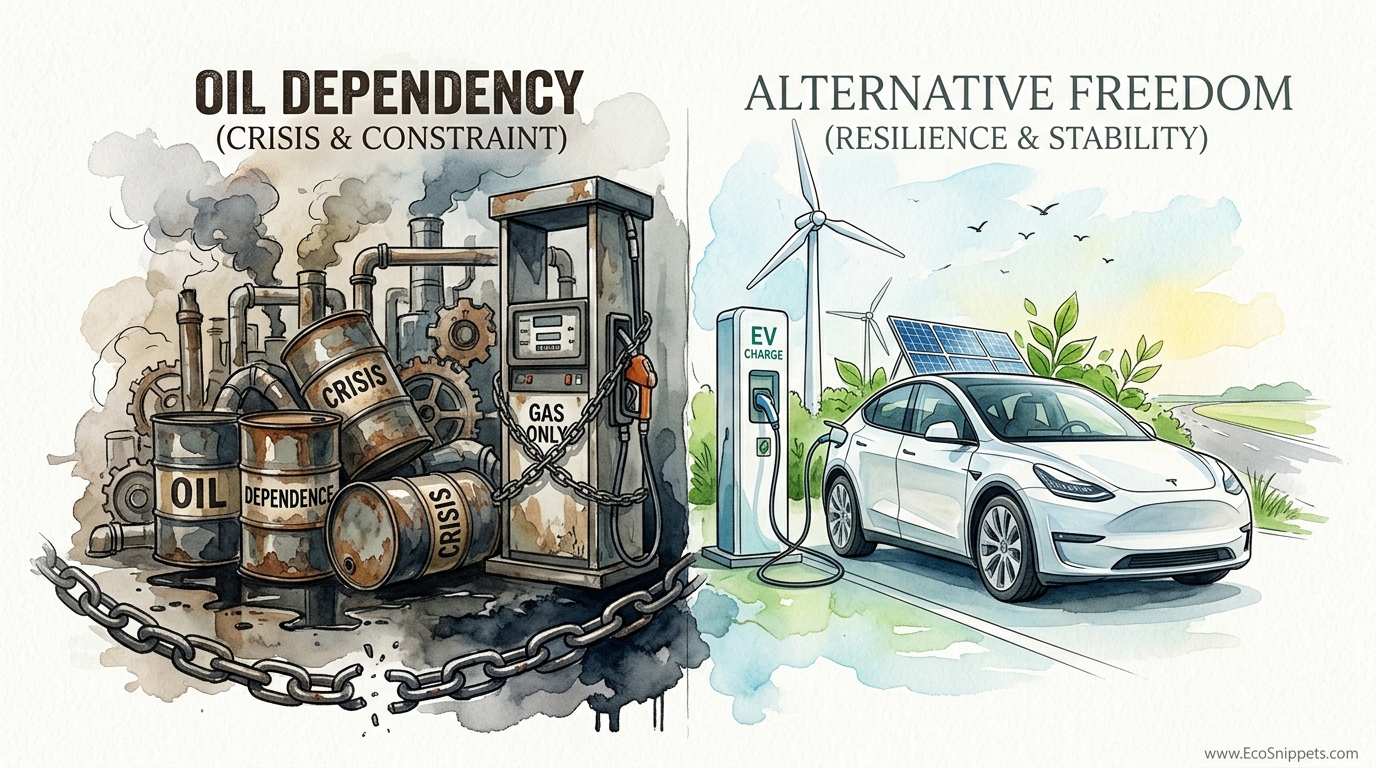
Wild how the price of a barrel of oil can shake the entire economy… yet investing in renewable energy is constantly up for debate and It is wild that the entire global economy can be brought to its knees by a few miles of water in the Middle East. We debate the ‘cost’ of EVs while paying a ‘fragility tax’ every time we hit the pump. Static energy is vulnerable energy. Dynamic energy is harvested at home. Which side of the blockade do you want to be on?
This is not just about choosing a different car. It is about choosing where your agency lies. For over a century, the ability to move across the land has been tied to a liquid that most people cannot produce, refine, or store in meaningful quantities. This dependency creates a invisible tether to global markets that do not care about your commute or your family’s budget. When a shipping lane closes or a pipeline fails, the person relying on oil pays the price in real-time.
Choosing an electric vehicle paired with home energy production is a return to an older way of living. It mimics the ancestral wisdom of the woodlot or the well. Our grandparents did not wait for a global supply chain to deliver heat; they cut it from their own land. Today, we can do the same with the sun. This guide will walk you through the practical reality of breaking that tether and finding true freedom on the road.
Why Electric Vehicles Beat Oil Dependence During Crisis
Oil is a fragile master. The current global energy landscape is a complex web of extraction, refining, and transportation that spans thousands of miles. When any single thread in this web snaps—whether due to geopolitical conflict in the Middle East or a technical failure in a refinery—the end-user feels the impact immediately. This is the “fragility tax.” It is a cost you pay not for the energy itself, but for the inherent weakness of the system that delivers it.
Electric vehicles (EVs) offer a way out because they decouple transportation from a single, volatile commodity. Unlike an internal combustion engine (ICE) which only runs on one thing, an EV is energy-agnostic. It does not care if the electricity comes from a coal plant, a wind farm, or the solar panels on your own roof. This flexibility is the ultimate hedge against crisis.
During the 2021 fuel shortages in the United Kingdom or the more recent spikes where Brent crude climbed toward $128 per barrel, the advantage became clear. While gas-powered cars sat in lines for hours, EV owners charged at home. They bypassed the panic because their “fuel station” was on their property. This is the difference between being a consumer of a scarce resource and a producer of an abundant one.
In a crisis, mobility is survival. Being able to move when the pumps are dry or the prices have tripled is a form of security that no government subsidy can match. It is the modern equivalent of having a full granary during a lean winter. You are no longer waiting for the tanker to arrive; you are waiting for the sun to rise.
How Home Energy Harvesting Drives Modern Motion
Moving a vehicle using the sun is a process of simple transformations. It begins with the solar photovoltaic (PV) array. These panels capture photons and convert them into direct current (DC) electricity. This is the raw material of your independence.
To make this energy useful for your home and your car, it must pass through an inverter. The inverter changes DC electricity into alternating current (AC), which is what your household appliances and your Level 2 EV charger require. Most modern systems use a hybrid inverter. This specialized device can manage power from the panels, a stationary home battery, and the utility grid simultaneously.
Once the energy is converted to AC, it flows to your home’s electrical panel. From there, a Level 2 charger—typically a 240-volt circuit—delivers it to the vehicle. The car then performs its own conversion, turning that AC back into DC to store in the large battery pack under the floorboards.
This system works best when it is “smart.” Smart chargers can communicate with your solar inverter to ensure the car only charges when there is excess sun. Instead of sending your extra power back to the utility company for a few pennies, you are “storing” that value in your car’s battery for later use. This is the most efficient way to use the energy you harvest, as it avoids the losses associated with the grid and maximizes your self-consumption.
The Practical Advantages of Independent Energy
The most immediate benefit of switching to electric is the radical simplification of maintenance. An internal combustion engine is a marvel of engineering, but it is also a collection of thousands of moving parts that rely on controlled explosions and high-friction cycles. It requires oil changes, spark plugs, timing belts, and exhaust systems—all of which are points of failure.
Electric motors have about twenty moving parts. There are no valves to grind, no pistons to seize, and no transmissions to slip. This leads to a measurable reduction in long-term costs. Research shows that EV owners can save between $1,800 and $2,600 (approx. £1,400 to £2,000) per year on maintenance and repairs compared to gas vehicles.
Beyond maintenance, the “fuel” cost is remarkably stable. If you charge from your own solar panels, your cost per mile is essentially fixed for the life of the system. You are effectively pre-purchasing twenty years of fuel at a known price. Even if you charge from the grid, electricity prices are historically much less volatile than oil. In many regions, driving an EV costs only 15-20% as much per mile as a gas-powered car.
There is also the matter of performance. Electric motors provide 100% of their torque instantly. This is not just for racing; it is a safety feature. Being able to merge into fast-moving traffic or navigate out of a dangerous situation with immediate response is a practical edge. The low center of gravity from the floor-mounted battery also makes the vehicle more stable in turns and during emergency maneuvers.
The Hurdles of Transitioning to Electric
The path to independence is rarely without obstacles. The most significant challenge is the upfront cost. While the total cost of ownership is often lower over five years, the “sticker price” of an EV and a home solar installation can be daunting. Many families find it difficult to trade a manageable monthly gas bill for a large capital investment, even if that investment pays for itself in the long run.
Infrastructure is another reality. If you live in an apartment or a rental without dedicated parking, you are still dependent on public charging networks. These networks are more reliable than they were a decade ago, but they still carry a “convenience tax” that can rival the cost of gasoline. True energy freedom requires owning the “well”—the roof and the charger.
There is also the learning curve of energy management. You have to think in kilowatt-hours (kWh) rather than gallons or liters. You have to understand that your range might drop in extreme cold or when towing a heavy load. It requires a shift from a “fill-and-forget” mindset to one of “grazing”—charging when the sun is out or during off-peak hours at night.
Finally, we must acknowledge the “new dependency” on minerals like lithium, cobalt, and nickel. While we are breaking away from oil, we are entering a market for battery metals. The difference is that these metals are recyclable. Once the lithium is in the battery, it stays there for fifteen years and can then be recovered. Oil, once burned, is gone forever.
Realistic Boundaries and Constraints
It is important to be honest about where the technology currently reaches its limits. For those living in extreme northern or southern latitudes, winter can be a significant constraint. When temperatures drop below freezing (0°C / 32°F), battery chemistry becomes less efficient. You might see a range reduction of 20% to 40% as the car uses energy to keep the battery and the cabin warm.
Towing is another area where internal combustion still holds an edge for long-distance work. While electric trucks have massive torque, pulling a heavy trailer (over 5,000 lbs / 2,200 kg) can cut your range in half. For a local contractor, this isn’t an issue. For someone crossing the continent with a horse trailer, the charging stops will add significant time to the journey.
Geographic isolation also plays a role. In the vast interiors of continents, fast-charging stations can still be hundreds of miles apart. If your work takes you deep into the bush or across remote desert tracks where there is no grid and no sun for days, a traditional liquid-fuel vehicle with extra canisters remains the safer bet for now.
Comparing the Blockade to the Backyard
To see the value clearly, we must look at the two systems side-by-side. One relies on a global, fragile chain of command; the other relies on local, resilient systems.
| Feature | Oil Dependency (ICE) | Alternative Freedom (Solar + EV) |
|---|---|---|
| Fuel Source | Global commodity (Volatile) | Home-harvested (Stable) |
| Fuel Cost | $3.50 – $6.00+ per gallon | $0.00 – $0.15 per kWh |
| Supply Chain | Thousands of miles / Many actors | Roof to Battery / Direct |
| Maintenance | High (Moving parts/Fluids) | Low (Solid state/Minimal friction) |
| Grid Independence | None (Refineries need power) | High (Can charge off-grid) |
| Vulnerability | Affected by distant wars | Affected by local weather |
This table illustrates that while oil is susceptible to events happening on the other side of the planet, your solar-powered EV is only susceptible to your local environment. You are trading a vulnerability you cannot control for one that you can manage through planning and storage.
Practical Strategies for the Independent Driver
Taking control of your energy requires a few tactical adjustments. If you are planning a home solar system to support an EV, do not just size it for your current light bill. An average EV needs about 1 kWh for every 3.5 to 4 miles (5.6 to 6.4 km) driven. If you drive 40 miles (64 km) a day, you need about 10-12 kWh of extra production. This usually means adding 5 to 10 additional solar panels to your roof.
Invest in a smart Level 2 charger. Units that can communicate with your solar inverter allow you to use a “Solar Only” mode. This ensures that the car only sips power when your panels are producing a surplus. It prevents you from pulling expensive power from the grid during the day and maximizes your “free” miles.
Explore Bidirectional Charging. This is the next frontier of independence. Some modern EVs have Vehicle-to-Home (V2H) or Vehicle-to-Load (V2L) capabilities. This means your car is not just a consumer; it is a backup battery for your house. A typical 60 kWh EV battery can power an average home for two to three days during an outage. This turns your vehicle into a critical piece of survival infrastructure.
Optimize your tires. EVs are heavier than gas cars because of the battery. Using tires specifically designed for EVs will improve your range and reduce road noise. Check your pressure monthly; even a slight drop can decrease your efficiency by 3-5%. In the world of self-reliance, every small gain in efficiency is a gain in autonomy.
Advanced Considerations for Long-Term Autonomy
For those who want to go beyond the basics, consider the role of a microgrid. A microgrid is a localized group of electricity sources that normally operates connected to the traditional wide-area grid, but can also disconnect and function autonomously as physical or economic conditions dictate. By combining your EV, your solar panels, and a dedicated home battery (like a Tesla Powerwall), you create a fortress of energy.
Battery degradation is a common concern, but modern data suggests it is less of a threat than many fear. High-quality lithium-iron-phosphate (LFP) batteries can last for thousands of cycles—often outliving the car itself. When these batteries eventually drop to 70% of their original capacity, they can be repurposed as stationary home storage. This is the “circular economy” in action, where the tool that provided you with mobility for a decade provides you with home backup for the next.
Consider also the legal and regulatory landscape. In many regions, “Net Metering” laws allow you to sell excess power back to the grid. However, as more people adopt solar, these incentives are changing. Building your system to maximize “behind-the-meter” storage—keeping the power you make rather than selling it—is the safest long-term strategy for independence.
Real-World Scenarios: The Difference in the Drive
Imagine a week of heavy storms that knocks out the power across three counties. In the traditional world, gas stations cannot pump fuel without electricity. Even if they have generators, the supply trucks might not be able to get through. You are stuck with whatever is in your tank.
In the independent world, your solar panels continue to work the moment the clouds break. If you have V2H, your car powers your refrigerator and lights. When the sun comes out, you charge the car. You have mobility and home comfort while the surrounding system is paralyzed. This is not a hypothetical scenario; it has played out during every major hurricane and blizzard of the last five years.
Consider a different scenario: a geopolitical shock sends gas prices to $8 per gallon (£2 per liter). For the commuter in a gas-powered SUV, this is a financial emergency. For the EV driver with solar panels, it is a non-event. The cost of their commute has not changed by a single penny. They are shielded from the “fragility tax” by the hardware on their roof.
Final Thoughts
The choice between oil and alternative energy is ultimately a choice between dependence and agency. For too long, we have accepted that our ability to move is subject to the whims of global markets and distant conflicts. We have paid the “fragility tax” without questioning why our energy must travel halfway around the world before it reaches our wheels.
Moving toward an electric vehicle paired with home production is a return to the self-reliant spirit. It is the realization that the sun provides more energy in an hour than the human race uses in a year, and that we finally have the tools to harvest it. By building your own “fuel station,” you are not just saving money; you are reclaiming your freedom.
Experiment with the technology. Start with a small solar array or a plug-in hybrid if a full EV feels like too big a leap. But whatever you do, start the process of shortening your supply chain. The next time the price of oil shakes the world, you will be able to look at the headlines with a sense of calm, knowing that your energy is harvested at home.
